Wisdom9 min read
Wu Wei (无为): The Taoist Secret to Letting Go of Retirement Anxiety
What wu wei really means — and how this Taoist idea from the Tao Te Ching offers a calmer way to face retirement, control and the fear of not doing enough.
By The Mindful Prime Editors — Editorial Team
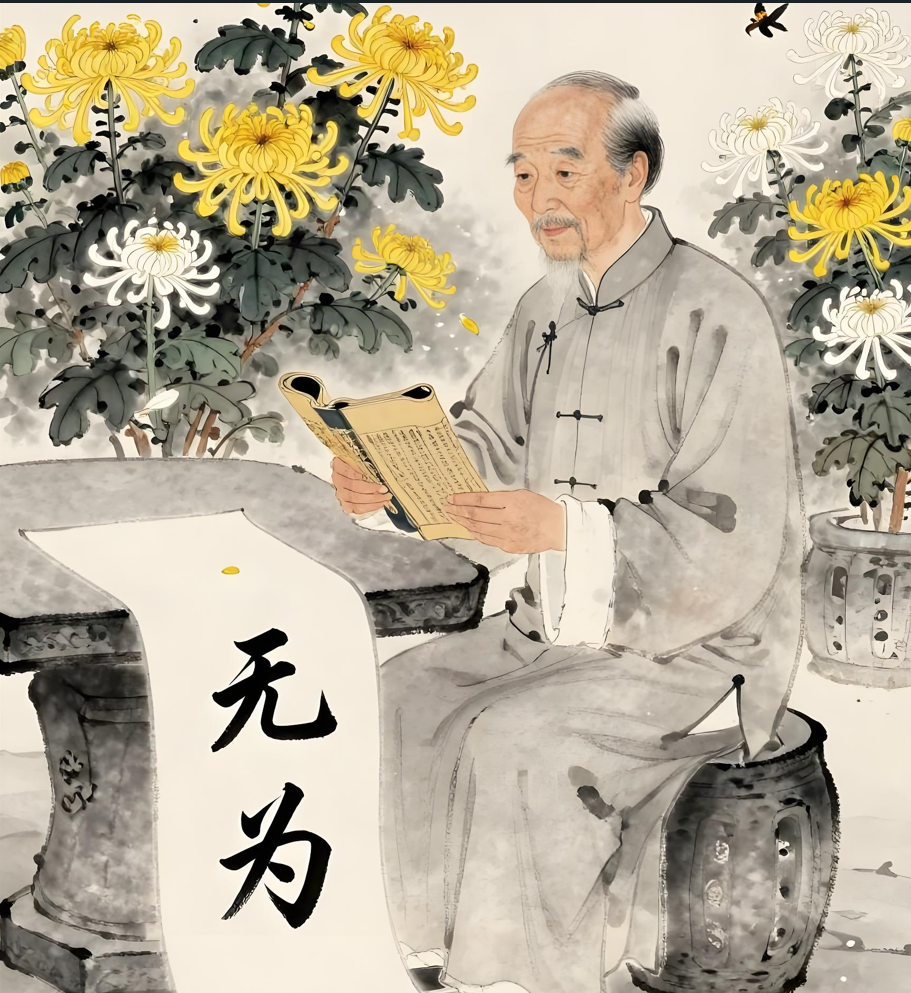
Retirement has a way of handing you a list. Stay active. Watch the savings. Be useful. See the grandchildren. Plan the health checks. Do more, arrange more, worry more.
Two and a half thousand years ago, a book from ancient China offered what sounds like the opposite answer. It is called wu wei — often translated as “non-action” or “effortless action.” On first hearing, it sounds like an invitation to lie down. It is actually one of the most practical ideas ever written down, and it may be the most useful lens you can bring to the years after work.
This guide explains where wu wei comes from, what it does not mean, and six small ways to practice it — starting today.
The Word, the Book, the Source
Wu wei (无为) is pronounced “woo way.” Wu means without or non-. Wei means forced, deliberate action — the straining, grasping kind. Put together: acting without forcing.
The idea comes from the Tao Te Ching (道德经), a short, luminous classic attributed to Laozi. Laozi is traditionally dated to around the sixth century BCE and honored as the founder of Taoism. Taoism is the school of thought built around the Tao — the natural way things flow.
One line from the book: “Act through non-action, and nothing is left unmanaged.” Another image is more famous still. The highest good, says the Tao Te Ching, is like water. Water does not fight. It flows around obstacles, settles in low places nobody wants, and in the end it wears down stone. Softness, in this picture, is not weakness. It is the longer lever.

What Wu Wei Is Not
This is where most first readings go wrong, so let us clear the ground.
It is not laziness. Laziness avoids the work. Wu wei avoids only the straining — the useless, self-defeating part. The gardener still waters and weeds. What the gardener does not do is tug at the petals to hurry the bloom. The work happens; the forcing does not.
It is not giving up. A boatman in a fast current does not surrender to the water. He reads it, borrows it, and adjusts his angle constantly. That is wu wei — effort, but effort aligned with the flow rather than against it.
It is not passivity about everything. Wu wei makes a quiet distinction at its core: some things are yours to do, and some things are simply not yours to control. Your energy belongs to the first category. The second deserves your release, not your grip.
The essence, in one sentence: put your strength where effort works, and stop spending it where it cannot.
What the Tao Te Ching Actually Says
The book is short — about five thousand Chinese characters — and famously slippery. But the wu wei passages reward a slow reading. Two are worth meeting in plain terms.
Chapter sixty-three says: act through non-action. Taste the flavorless. Treat the small as great and the few as many. The line sounds paradoxical until you see what it rejects — the dramatic gesture, the big push, the constant reacting. What remains is steady attention to small things, done early and calmly, before they grow big.
Chapter sixty-four supplies the most quoted image: a journey of a thousand miles begins with a single step. Less quoted is the sentence just before it. People ruin things, the text warns, by grabbing at them when they are almost finished. Anyone who has abandoned a project at ninety percent knows this failure personally. Laozi’s answer is not more effort at the end. It is the same unhurried step as at the start.
Reading tone matters here. The Tao Te Ching was written as advice for rulers, which is why so many lines concern restraint in power. Read at fifty-plus, the advice lands differently: you are the ruler now — of your mornings, your attention, your reactions. The text assumes you will keep acting. It only asks that the acting stop fighting the water.
Why Retirement Is Where This Idea Earns Its Keep
Retirement collects three kinds of anxiety, and wu wei has something useful to say to each.
The identity drop. For decades, a job answered the question “who am I?” Retirement removes the answer, and the mind scrambles to replace it. Wu wei’s response: identity was never really the job title. It lives in what you do with care — the garden, the letters, the repairs, the recipes, the attention you give people. Those did not retire when you did.
The clock panic. “There is still time to get it right” can curdle into “there is no time left.” The first is a compass; the second is a whip. Wu wei notices that the whip-shaped version rarely produces anything but exhaustion. Things bloom on their own schedule — including projects, friendships, and abilities you have not discovered yet. Your job is the watering, not the blooming.
The control gap. Grown children make choices you would not have made. The body changes its pace without consulting you. Old plans expire. The natural reaction is to grip harder, and the natural result is that nothing loosens. Wu wei proposes the counterintuitive move: open the hand. Not because you approve of everything — because the fist was only ever hurting one person.
An honest limit belongs here. Wu wei does not erase anxiety, and this article does not claim it does. What it offers is a posture to meet anxiety with — a way of standing that asks, before every struggle: is this mine to do, or mine to release?
Six Small Ways to Practice It
Wu wei becomes real through small, repeatable moves. Here are six.
1. Keep a daily “non-doing” stretch
Fifteen minutes with no output of any kind. Sit by the window. Watch the light move. Do not read, do not scroll, do not optimize. To a productivity-soaked mind this feels wrong at first — that discomfort is the point. You are teaching your nervous system that its worth does not depend on producing.
2. Write a not-to-do list
Alongside your task list, write three things you are explicitly not doing today. Not checking the news twice. Not comparing your week to anyone else’s. Not re-arguing a conversation from 1994. A not-to-do list is wu wei made visible.
3. Ask one question before acting
Before you push — on a plan, a person, a project — ask: is this within my power, or am I forcing? If it is within your power, do it calmly. If it is not, you have just been handed permission to put it down. Most of the day’s hidden weight comes from category errors.
4. Trade goals for rhythms
“I will walk every Wednesday morning” will outperform “I will lose ten pounds by March.” A rhythm is repeatable, forgivable, and yours. A goal is a boss that never stops. This is wu wei applied to your calendar: choose the shape of the effort, then let results arrive when they arrive.
5. Practice noticing without grading
On a walk, try ten minutes of pure observation — the shape of rooftops, the sound of leaves — without counting, ranking, or evaluating any of it. This is the same muscle the morning Qigong practice trains with slow breathing and simple motion: the body moves, the mind follows quietly, nobody is grading.
6. Let one thing unfold
Pick one situation currently causing you to push — a family matter, a slow project, a decision you keep rehearsing. Resolve to leave it alone for two weeks and see what happens on its own. Sometimes nothing happens, which is information. Often, something moves, which is a lesson. Occasionally you realize the pushing was the whole problem.
Three Common Misreadings
“So I should stop trying?” No — stop straining. The distinction is the entire teaching. A farmer who never plants is lazy. A farmer who plants, waters, and then stands over the soil yelling at the seeds has misunderstood his role in the process.
“Isn’t this just fatalism?” Fatalism says nothing you do matters. Wu wei says what you do matters enormously — which is precisely why you should stop spending it on battles that were never yours.
“Doesn’t this clash with ambition?” Watch a great athlete in the zone or a musician deep in a performance. Effort and ease are not enemies; the best moments of skilled work happen when the straining stops. Taoists simply noticed this earlier than most.
A Note on Reading It in English
Translations of the Tao Te Ching vary more than most classics, because the original Chinese is compact, poetic, and deliberately ambiguous. Two well-regarded translators can render the same chapter in visibly different words — and both can be right.
The practical advice: borrow one translation from the library, read it slowly, and do not worry about catching every shade. The book was designed for rereading, not for finishing. A single chapter that genuinely lands — the water chapter, usually — is a complete first visit. The rest of the book will keep for the years ahead, which is fitting, because the book is largely about letting things keep.
Frequently Asked Questions
How do I read the Tao Te Ching as a beginner? It is short — eighty-one brief chapters. Look for a well-regarded English translation and read a chapter at a time, the way you would eat small, strong sweets. Rereading matters more than finishing.
Is wu wei the same as mindfulness? Close cousins. Both train presence and non-grasping. Wu wei adds the outward dimension: not just watching your thoughts, but flowing with circumstances as they actually are.
Can I still have goals? Yes. Wu wei objects to being whipped by goals, not to having them. Hold the goal with an open hand.
Where do I start? With the first practice above: fifteen unproductive minutes, today. It is the smallest door into the largest idea on this site.
The Water Way
Wu wei will not organize your retirement, and it will not pretend the years are not real. What it offers is quieter and more durable: the difference between effort and strain, between caring and gripping, between the gardener and the person tugging at petals.
Water does not argue with the stone. It simply keeps arriving, softly, in the direction it was already going. There are worse models for the years after fifty — and very few better ones. If you try only one practice from this article, make it the fifteen non-doing minutes. The rest of wu wei grows out of that small, quiet room.
For another angle on releasing what you cannot control, read the story of Sai Weng Shi Ma, the Chinese proverb about a lost horse and an unfinished verdict. More gentle wisdom lives in our Culture & Arts section.