Wisdom9 min read
Best Chinese Poems About Aging, Solitude, and Finding Peace
Four classical Chinese poems about aging and solitude — Tao Yuanming, Wang Wei, Liu Yuxi, Su Shi — with pinyin, plain English versions and modern meaning.
By The Mindful Prime Editors — Editorial Team
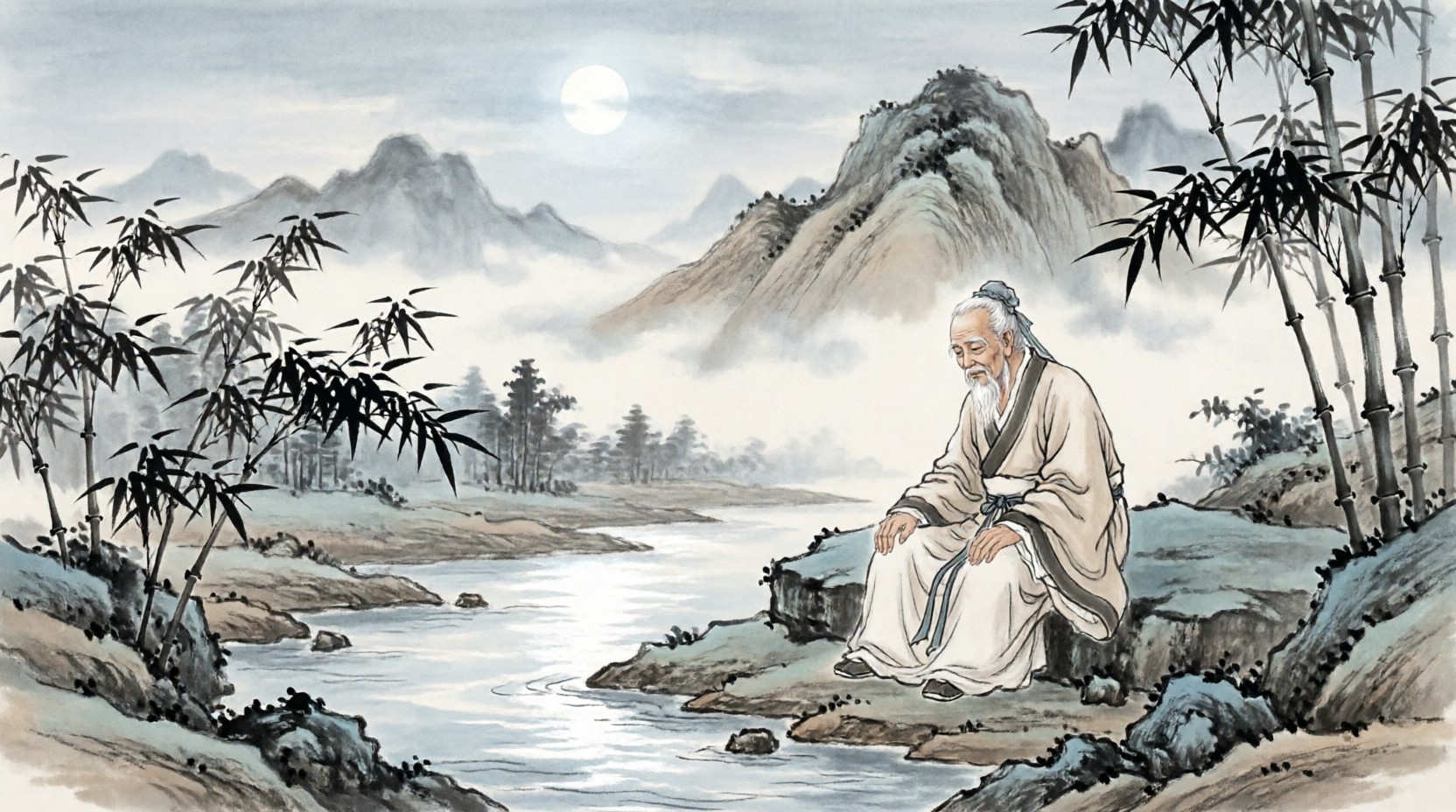
Somewhere around the age when careers wind down and houses grow quieter, many readers go looking for a different kind of book. Not advice. Not plans. Something that sits with you.
Chinese classical poetry was practically built for that hour of the evening. The tradition’s most beloved poems were written by people in their own later chapters — demoted officials, retired farmers, poets past sixty answering letters from friends who feared getting old. They wrote short poems, in plain language, about the exact territory many readers over fifty are crossing: solitude, time, weather, and a strange new calm.
Here are four of the best, each with its opening line in pinyin, a plain English version, the story behind it, and what it still has to say.
1. Tao Yuanming — Picking Chrysanthemums by the Fence
Tao Yuanming (365–427 CE) did something almost no official did: he quit. After decades of minor posts and minor humiliations, he resigned at forty-one and went home to farm. There he drank wine and became the founding poet of the simple life in Chinese letters.
His most famous poem begins:
Jie lu zai ren jing, er wu che ma xuan (结庐在人境,而无车马喧)
I built my hut where other people live, yet hear no carriage noise, no horse. You ask me how that can be? When the heart stands far away, the place grows quiet by itself.
Then comes the famous turn:
I pick chrysanthemums by the eastern fence, and at my ease I see the southern mountain. The mountain air is lovely as the day goes down, and flying birds come home together. In this there is a truth worth keeping — but the moment I try to say it, the words are gone.
The heart of the poem is one line: xin yuan di zi pian — when the heart is far, the ground is quiet of itself. Tao is not describing a move to the countryside. He is describing an attention that no longer leans toward the noise. His hut is next to a road; the quiet is internal.
Read at fifty-plus, this is almost embarrassingly on time. Much of late life is an unplanned retreat from noise — retirement, quieter houses, grown children far away. Tao’s poem refuses to call that retreat a loss. It calls it the condition in which the southern mountain finally becomes visible. Readers who want the philosophy underneath this will find it in wu wei — effort released, not effort abandoned.
2. Wang Wei — Alone in the Bamboo Grove
Wang Wei (699–761) was a court official, a painter, and a devoted lay Buddhist — the poet of quiet better than anyone before or since. His short poem about an evening alone has four lines and no company at all:
Du zuo you huang li, tan qin fu chang xiao (独坐幽篁里,弹琴复长啸)
I sit alone in the deep bamboo grove, strumming the qin, then humming a long note. Deep in the woods, nobody knows I am here. Only the bright moon comes to shine on me.
Four sentences: a person, an instrument, a forest, and the moon. Nothing happens. Nothing needs to. Yet few poems in any language make solitude feel this much like a gift.
Here is the distinction the poem quietly teaches. Loneliness is being somewhere no one notices you. Solitude is being somewhere the moon notices you. Wang Wei is alone in the first sense and utterly accompanied in the second — by the instrument, the grove, the light. The poem does not argue that being alone is fine. It simply performs one evening in which it was rich.
For readers whose houses have gone quiet, that difference is not literary decoration. It is a reframe you can use the very next quiet evening: choose one companion — music, a candle, the window — and sit with it on purpose.
3. Liu Yuxi — Do Not Say the Sunset Is Late
The most direct poem about aging on this list was written as a reply in an old friendship. Bai Juyi — then sixty-two, a famous poet — sent Liu Yuxi a poem lamenting old age: the thinning hair, the aching frame, the friends already gone. Liu Yuxi, sixty-four, answered with his own. His last lines are now among the most quoted in the language:
Mo dao sang yu wan, wei xia shang man tian (莫道桑榆晚,为霞尚满天)
Do not say the sun sets late on mulberry and elm — its evening glow still fills the whole sky.
Two notes of background. First, sang yu — mulberry and elm — is an old image for where the sun goes down, so the line literally plays on sunset as old age. Second, Liu is not denying what Bai listed. He agrees the years are real. His claim is narrower and sharper: the light is still coming, and it is arriving from a direction only the late day can produce.
As a response between two old friends, the poem is a marvel of tact — neither false cheer nor shared gloom, but a second opinion offered with love. As advice for anyone standing where Bai stood, it does exactly what the best poems about aging do. It does not argue the sunset away. It asks you to look at the color.
4. Su Shi — Neither Storm nor Clear Sky
Su Shi (1037–1101) wrote the greatest rainstorm poem in Chinese the way most people write a grocery list: on the spot, out walking, after being caught unprepared. He was in his mid-forties, demoted to a riverside town after a political case nearly cost him his life. The spring rain came down hard through the trees. Everyone around him scattered. He kept walking.
Mo ting chuan lin da ye sheng, he fang yin xiao qie xu xing (莫听穿林打叶声,何妨吟啸且徐行)
Do not listen to the rain crashing through the leaves. Why not sing a little, and walk slowly on? A bamboo staff and straw shoes are lighter than a horse. Who is afraid? In a straw cloak, in misty rain, I could live my whole life.
Then, after the storm has passed and the walk is nearly over:
I turn back to the bleak stretch I have just come through. Going home — there is no storm, and no clear sky either.
That final line — ye wu feng yu ye wu qing — carries the whole poem. From inside, the rain was an event. From the end of the path, it was neither a disaster nor a test. It was weather, and he walked through it singing.
The poem is the story of the frontier old man in first person: a refusal to grade the middle of a chapter. Su Shi’s version adds something the proverb does not — the tone. You can almost hear the half-smile. Half a life’s worst events, he suggests, will eventually compress into exactly this: a stretch you once called bleak, walked back over in ordinary light.
What Chinese Poems Say About Aging
Line these four up and a pattern appears. In the dominant Western story, the later chapters are a subtraction — youth, energy, possibility, gone. In these poems, the later chapters are a change of light. Tao finds the mountain because the noise has stopped. Wang Wei gets the moon precisely because the crowd is gone. Liu insists the sky is still full. Su Shi discovers that the storm only ever looked like a storm.
None of the four poets was writing from easy circumstances. Quitting his job made Tao poor. Su Shi’s demotion followed exile and grief. The calm in these poems was earned the hard way, which is why it still reads as credible rather than decorative. Poems about peace written by comfortable people are posters. These are field notes.
How to Start Reading Classical Chinese Poetry
A small method, for anyone new to it.
One poem a day, not one book a month. These poems are short by design. Read one, then put the book down and let it sit through breakfast. A poem a day turns a whole collection into a season of small visits.
Read the English version twice, then glance at the pinyin. The sound matters — Chinese poetry was written to be heard — but comprehension comes first. Let the pinyin be seasoning, not homework.
Get one good anthology, not four. A single well-chosen anthology of Chinese poetry in translation will outlast years of browsing. Read the introduction once, then ignore it and go straight to the poems.
Copy one out by hand. Before poetry was printed, it was memorized and copied. Writing four lines of Wang Wei on paper — any paper, any pen — slows the mind down to the poem’s speed. Readers who enjoy this will likely enjoy brush calligraphy as a daily practice.
Frequently Asked Questions
Do the translations here follow a particular translator? No. The English versions above were made for this article — plain, a little free, aiming for sense and tone over rhyme. For deeper reading, well-regarded published anthologies offer many fine alternatives.
Is classical Chinese poetry hard without knowing Chinese? Less than its reputation. The great poems are famously plain — farm work, moonlight, wine, rain. Depth in this tradition comes from simplicity, which is exactly what survives translation.
Which poem should I read first? Wang Wei’s bamboo grove. It is four lines, needs no historical context, and does its work in under a minute.
Was Liu Yuxi really answering a poem about old age? Yes — the full title frames it as a reply to Bai Juyi’s poem on growing old, written when both men were in their sixties. The exchange is one of the most touching duets in the tradition: two old friends, one complaint, one second opinion.
The Light from a Different Direction
These poems are over a thousand years old, and not one of them has aged a day. That is the quiet joke built into them. They were written about aging, and they outlasted the aging of everyone who wrote them.
Pick the one that matches your season. The bamboo grove for the quiet evening. The chrysanthemums for the noise you no longer miss. The evening glow for anyone who has caught themselves saying too late. And the rain, for the middle of any storm you are currently walking through — sung at, slowly.
For more of the tradition’s take on the later years, see five proverbs about aging and a beginner’s guide to the four great novels. The full shelf lives in our Culture & Arts section.