Wellness8 min read
Pear and Snow Fungus: A Chinese Autumn Sweet Soup, Step by Step
Autumn brings crisp pears and a pot that simmers for an hour. How pear and snow fungus became a Chinese sweet soup, with a home recipe and honest notes.
By Lian Zhao — Copy Editor
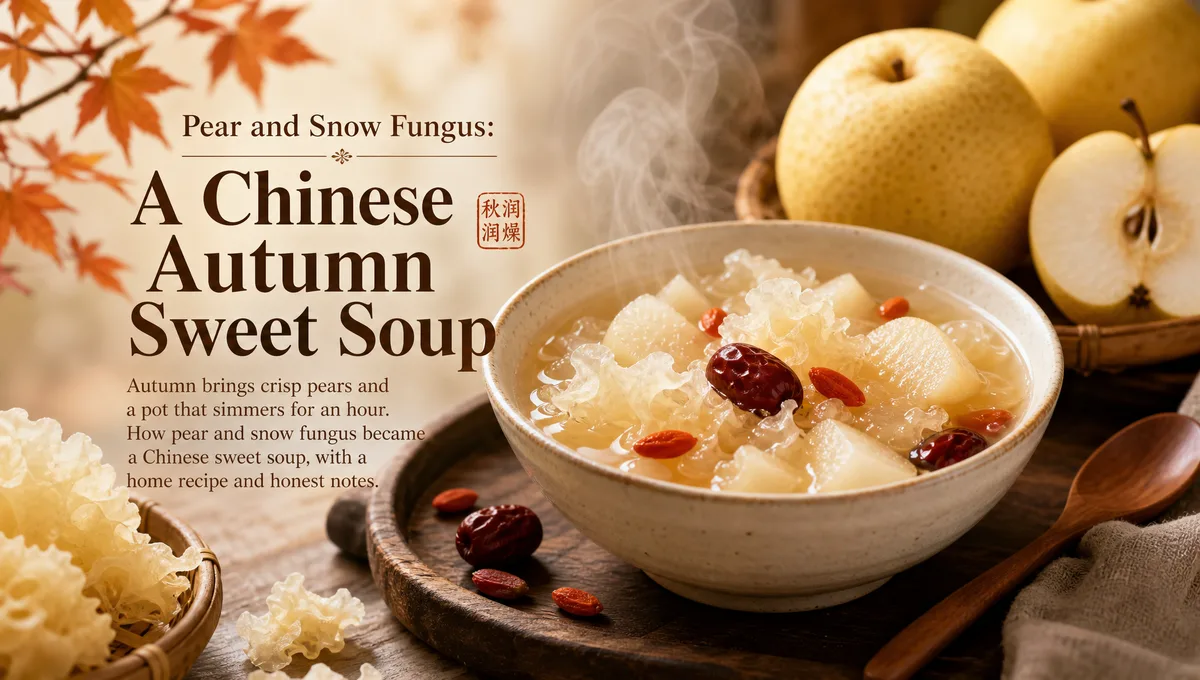
Two things appear in Chinese kitchens in October.
The first is a pear, heavy and crisp, stacked in baskets at the market. The second is a bag of dried snow fungus from the back of a cupboard, pale and brittle, waiting to be soaked.
They meet in one pot. The result is a sweet soup that takes an hour, costs very little, and asks for almost no skill. It is also one of the clearest examples of how this cuisine thinks about a season.
Autumn Is the Season of the Long Pot
In the traditional reading of the year, autumn is dry. The term is qiu zao, autumn dryness, and it belongs to the same seasonal framework as the solar terms.
That framework organises food and household habits by season. It is not a description of what a food does inside a body, and this site does not present it as one. Read it the way you would read an almanac: a set of customs that grew up around a climate.
What it produces in practice is a shopping list. Autumn brings pears, chestnuts, persimmons, hawthorn and lotus root. It also brings the cooking method that suits a slower season: the long simmer.
Our guide to Chinese seasonal eating covers the wider picture. The calendar of solar terms explains where the season boundaries fall.
Pears: Crisp, Not Soft
A pear in a Chinese market is usually an Asian pear, and there are dozens of varieties. The names worth knowing are the Ya pear, the snow pear, the Korla fragrant pear and the crown pear.
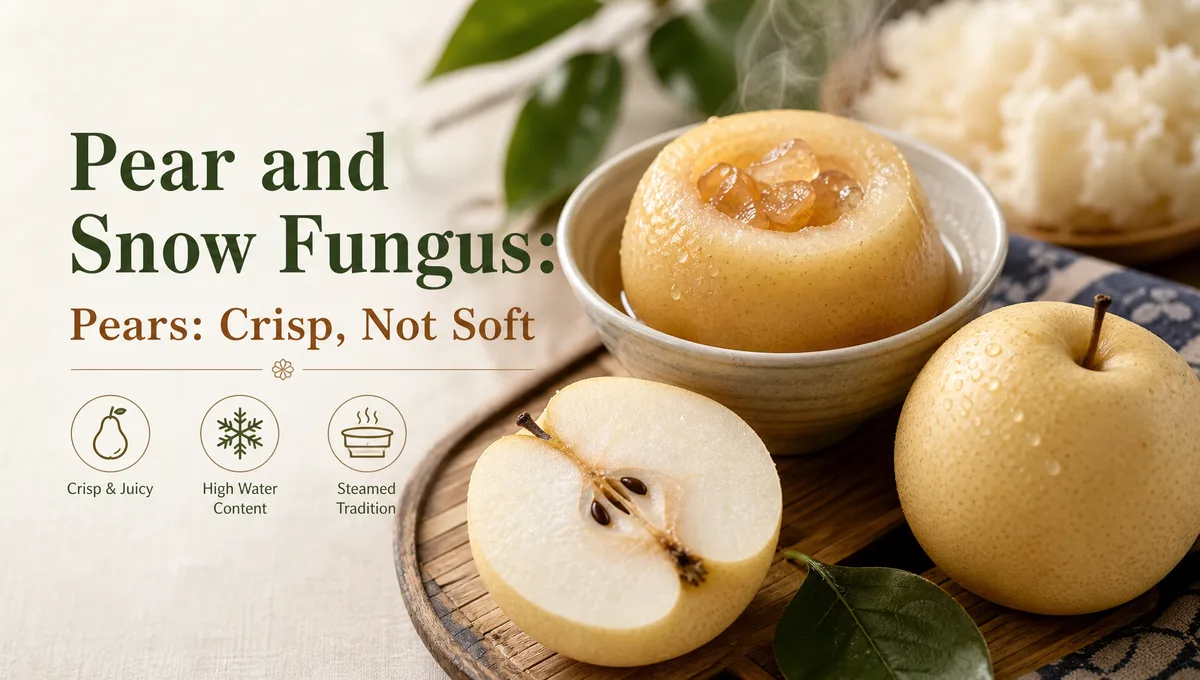
They differ in sweetness and skin, but they share one quality. Asian pears ripen on the tree and stay crisp after picking. A Western pear is picked hard and softens on a shelf; an Asian pear arrives ready and stays that way for weeks.
That texture comes partly from stone cells, tiny clusters that give the flesh a faint graininess. Combined with a very high water content, they produce the crunch people either love or find strange.
Most of these pears are eaten raw, in slices, with the skin on. Cooking is the second use, and it is old. A pear is cored, filled with a piece of rock sugar, and steamed whole for forty minutes until the flesh turns translucent.
Storage is the other autumn job. In northern China, pears went into a cellar or a cold room in October and came out through the winter, along with persimmons and hawthorn. The kitchen version of the year is simple: eat what is ripe now, keep what will wait.
What Snow Fungus Actually Is
The dried thing in the bag is Tremella fuciformis, a fungus that grows on dead broadleaf wood. Chinese calls it bai mu er, white wood ear, and English has settled on snow fungus.
For most of its history it was rare and expensive, because it had to be found. The usual account credits small-scale cultivation on logs in Sichuan, around Tongjiang, from the nineteenth century, and then large-scale growing in Fujian from the 1970s. After that, it became cheap enough to keep in the cupboard.
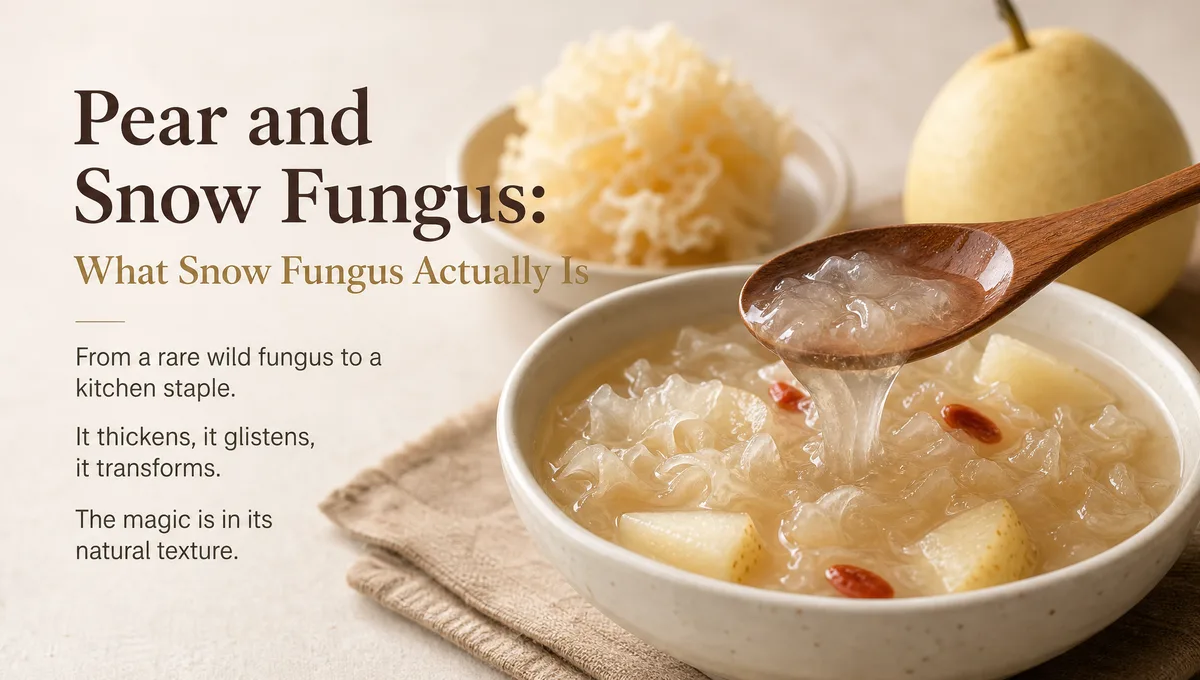
Cook it and something odd happens. The liquid thickens, coats a spoon, and turns faintly glossy. That body comes from natural gelatinous material in the fungus. It is a texture, not a property, and it is the whole reason the ingredient is used.
Making It: Three Steps Before the Pot
The recipe itself is short enough to memorise.
- Soak. Cold water, two to four hours. If you leave it overnight, put the bowl in the fridge.
- Trim. Cut away the yellow hard base and tear the rest into small pieces. Smaller pieces give up their body faster.
- Simmer. About ten parts water to one part dried fungus. Low heat, forty to ninety minutes, with rock sugar added in the last ten.
Fresh snow fungus is sold in some markets and needs only twenty to thirty minutes. Dried fungus is the version most kitchens keep.
You can tell when it is ready without a timer. The liquid turns slightly gold, slides off a spoon in a sheet, and the edges of the pieces go translucent. If the pot still looks like water, it needs more time, not more sugar.
What to Add, and When
The base is neutral, which is why so many households add to it. Red dates and longan go in at the start and sweeten the pot on their own. Lotus seeds and dried lily bulbs need a head start, so they go in with the fungus. Goji berries and rock sugar go in at the end, or they lose their shape.
For the pear version, cut the pear into thick wedges and add them in the last twenty minutes. They hold their shape that way and keep a little bite. This combination, pear with snow fungus, is the standard autumn pot in many homes.
Nothing here is fixed. The only rule that matters is the last one: sugar at the end, because early sugar slows the fungus down and leaves the liquid thin.
Sweet Soup Is Its Own Category
In Cantonese cooking, sweet soups are a category of their own, with a name: tang shui, sugar water. Hong Kong and Guangzhou have shops that sell nothing else, open late, with a short menu of twenty bowls.
Snow fungus soup is one of the most common of them. It is served warm, in a small bowl, after dinner rather than as dessert in the Western sense.
It is also the dish people carry. A pot travels well in a thermos, and bringing one to a friend’s kitchen is a standard gesture, quiet and practical. The pot is the message, not the ingredients.
What This Is Not
Three statements, because this is a food article and the wording matters.
First, autumn dryness and the idea that certain foods are moistening are traditional categories. They describe how households sorted food by season. They are not descriptions of effect, and this site does not make health claims.
Second, this is a recipe, not care. Nothing in a kitchen takes the place of advice from your own doctor. If something in your body is troubling you and does not settle, the answer is a doctor, not a bowl of sweet soup.
Third, if your doctor has given you a list of foods to be careful with, that list wins. Follow it.
Buying and Keeping
Dried snow fungus should look off-white rather than bright white, feel dry enough to snap, and smell of nothing much. A sour smell means it has taken on moisture. Keep it sealed and away from light; the flavour fades after about a year.
Soak it in the fridge if the soaking will run past a couple of hours, and use it the same day. A cooked pot keeps two to three days in the fridge, and it reheats well on the stove with a splash of water.
Common Questions
Is snow fungus the same as bird’s nest?
No. Bird’s nest is a different ingredient entirely, made by swifts, and it is far more expensive. In China, snow fungus is sometimes nicknamed the poor man’s bird’s nest because both give a soft, gelatinous texture in a sweet soup. The nickname is about texture and price, nothing else.
Fresh or dried?
Fresh cooks in twenty to thirty minutes and has a cleaner flavour. Dried keeps for a year, is available everywhere, and needs the longer simmer. Both work in the recipe above.
Do I have to cook the pear?
No. Most Asian pears are eaten raw, and that is the more common way. Cooking is a seasonal habit rather than a requirement, and it is worth trying once with rock sugar.
Can I use ordinary sugar?
Yes, though rock sugar gives a rounder sweetness and dissolves more slowly. Brown sugar will darken the soup and change the taste. Honey should go in after the pot comes off the heat.
Why is my soup still thin?
Three usual reasons. The pieces were too large, the heat was too high so the water boiled off before the fungus softened, or the pot simply needed another half hour. Sugar added too early is the fourth reason.
The Pot That Takes an Hour
Autumn cooking in this tradition is not about ingredients doing something to you. It is about a season when the kitchen slows down, and about one pot that can sit on a low flame while you get on with the evening.
If you like food that works this way, our piece on the Chinese breakfast table covers the morning version, where the same patience shows up as a bowl of congee. The evening version, with a small pot and a chair, is in the afternoon tea guide.
The rest of this corner of the site is in our wellness section, including how a Chinese household eats with the seasons.