Wellness5 min read
Three Chinese Winter Soups: Lotus Root, Radish and Egg Drop
Three home-style Chinese winter soups — lotus root and pork rib, daikon, and tomato egg drop — with the 'radish in winter' proverb and how to cook each.
By Lian Zhao — Copy Editor
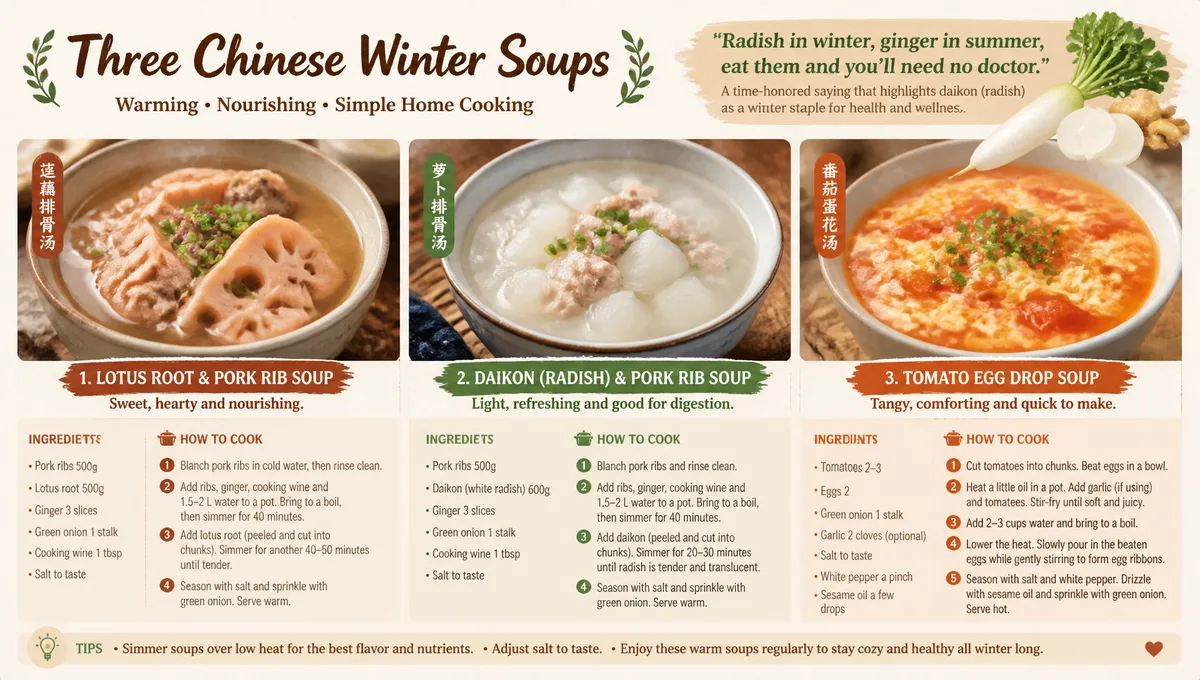
When the temperature drops in China, the first thing a household puts on the stove is a pot of soup.
Not one soup. Three, on a quiet rotation. A slow bone soup for a free afternoon. A radish soup for the proverb it carries. A five-minute egg drop soup for everything else.
They sound plain. Plain is the idea. Winter soup in China is rarely a showpiece. It is the warm thing on the table while the rest of the meal gets made.
Soup Is the Season’s Default
Chinese food writing has a saying for exactly this time of year: dong chi luo bo, xia chi jiang. It means “eat radish in winter, ginger in summer.”
It is less a rule than an observation. The market and the weather point the same way.
Radish turns sweet after the first frost. Pork ribs and lotus root hold up to long simmering. Eggs are always in the house. Winter soup is built from things that are cheap, sturdy, and unhurried with time.
Three Soups, Three Speeds
The three pots below cover a whole week.
- Lotus root and pork rib soup — the slow one, for a free afternoon
- Daikon and pork rib soup — the proverb soup, sweet and clear
- Tomato egg drop soup — the quick one, for a Tuesday
Each is home food, not restaurant food. None of them needs more than a few ingredients or a sharp knife.
The Slow One: Lotus Root and Pork Ribs
Lotus root (lian ou) is the star of Hubei cooking, especially around Wuhan. There it is simmered with pork ribs into a pale, clean broth.
The root is the interesting part. Raw, it is crisp, a little like a water chestnut. Cooked slowly, it softens and takes on a faint sweetness. The broth stays light because the ribs are blanched first and the flame is kept low.
Method in one line: blanch the ribs, add fresh water and thick slices of lotus root, simmer for two hours, salt at the very end.
The Proverb Soup: Daikon and Pork Ribs
White radish (luo bo) is the vegetable that old saying is about, and it is at its best right now.
Frost matters. Cold pushes a radish to store sugar rather than starch, so a winter radish is sweet where a summer one is sharp. That is the whole reason the saying landed in winter instead of July.
The soup is even simpler than the first. Radish, a few ribs, water, salt. The radish goes in late, so it keeps a little bite.
The Quick One: Tomato Egg Drop
Not every winter meal has two hours to wait.
Tomato egg drop soup (fan qie dan tang) is the five-minute answer. Bring water or a light stock to a simmer. Add tomato, then pour in beaten egg in a thin stream. It sets into soft ribbons in seconds.
It is the default “there is nothing in the house” soup, and it never feels like a compromise.
What the Three Share
Strip away the details and the three pots run on the same habits.
Few ingredients, chosen for the season. A low flame and a closed lid. Salt at the end, never the start. And a bowl served first, before anything else reaches the table.
The soup opens the meal. In many homes it stays out the whole time, sipped between bites of rice and stir-fried greens. A meal without it feels unfinished.
A Cold Evening, Step by Step
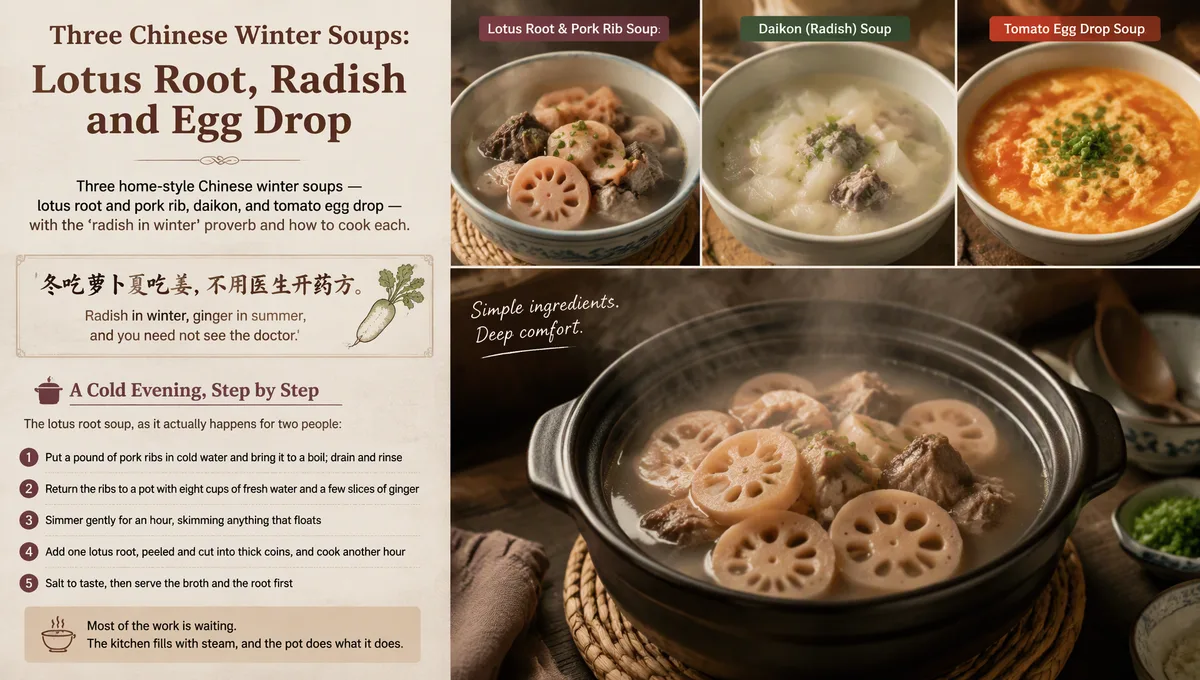
The lotus root soup, as it actually happens for two people:
- Put a pound of pork ribs in cold water and bring it to a boil; drain and rinse
- Return the ribs to a pot with eight cups of fresh water and a few slices of ginger
- Simmer gently for an hour, skimming anything that floats
- Add one lotus root, peeled and cut into thick coins, and cook another hour
- Salt to taste, then serve the broth and the root first
Most of the work is waiting. The kitchen fills with steam, and the pot does what it does.
Common Questions
Do I need a clay pot?
No. A heavy-bottomed pot works. A clay pot holds the heat more evenly, which our piece on clay pots and steamers explains, but any deep pot will do.
What if I cannot find lotus root?
Use daikon, or a parsnip, or a turnip. The soup keeps its shape with any sturdy winter root.
Is tomato egg drop really a winter soup?
It is a year-round soup that earns its place in winter by being quick. On a cold evening, speed counts for as much as simmering time.
Do the soups keep?
The bone soup keeps a day or two and deepens overnight. The egg drop soup should be eaten at once, which is not hard.
Is any of this about improving health?
No. These are cooking methods with a long history and a good record for flavour. Whether they suit you is a question for your own table.
Two Things Worth Keeping
Winter soup is a habit more than a recipe. Buy what the season makes cheap, set the flame low, and let the pot finish the work.
If the idea fits how you already live, two more pieces continue it. Our guide to staying warm the Chinese way covers the rest of the season. And eating with the seasons shows where the radish saying comes from.