Wellness7 min read
The Slow Kitchen: Clay Pots and Bamboo Steamers
Clay pots and bamboo steamers are the slow kitchen of a Chinese household. How they work, how to care for them, and what they cook on a weekday.
By Lian Zhao — Copy Editor
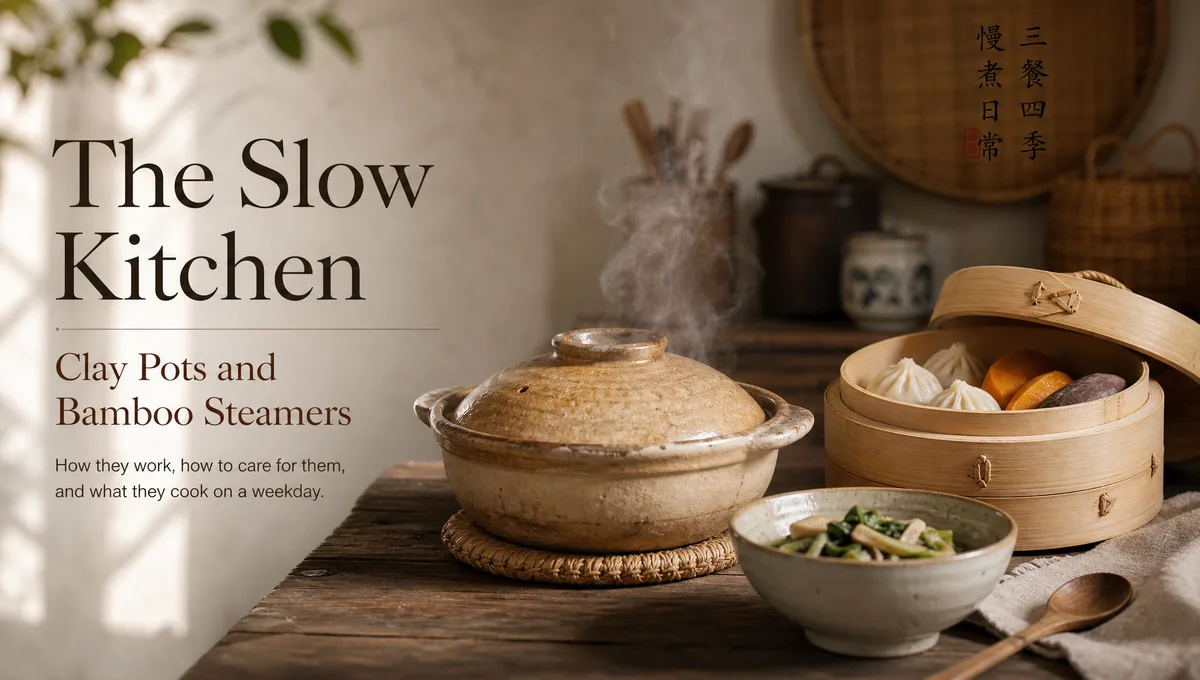
Two objects sit at the centre of an ordinary Chinese home kitchen, and neither of them is fast.
One is a clay pot, dark and heavy, with a lid that rattles when the liquid moves. The other is a bamboo steamer, light enough to lift with two fingers, made of hoops and slats.
Both are older than any appliance in the room. Both are still in daily use, which is the more interesting fact.
Two Vessels, One Idea
The clay pot and the steamer approach food from opposite directions.
A clay pot holds heat and gives it back slowly, so the contents simmer rather than boil. A steamer never touches the food with water at all. Heat arrives as vapour, and the food cooks in its own moisture.
What they share is a refusal to hurry. Neither vessel rewards a high flame, and both forgive a distracted cook in a way that a hot pan does not.
Why Clay Cooks Differently
A clay pot is fired earthenware, often unglazed on the outside and glazed inside. The material is a poor conductor. Heat moves through it slowly and leaves it slowly.
That single property produces most of the effects people value.
- The base heats evenly, so a thick sauce does not scorch in one spot
- Once hot, the pot keeps working after the flame drops to its lowest setting
- The heavy lid traps steam, so the liquid reduces less than in an open pan
- Aromatics release gently instead of frying hard in the first minute
Unglazed clay also breathes slightly through its walls. Cooks describe the result as a rounder flavour, especially in long-simmered soups. Whether you accept the explanation or not, the slow, enclosed heat is easy to taste.
Seasoning and Caring for a Clay Pot
A new clay pot needs an hour before it needs a recipe.
- Rinse it and fill it with water, then bring the water slowly to a gentle simmer
- Add a handful of rice or a spoon of starch and simmer for twenty minutes; the starch seals small pores
- Empty it, dry it fully, and rub the inside lightly with oil
- Let it sit overnight before the first real dish
Two habits keep it alive for years. Never put a hot pot on a cold surface or run cold water into it, because the shock can crack the clay. Never heat it dry: there should be liquid or oil in the base before the flame goes on.
With that care, a pot is often handed down rather than replaced.
What Belongs in a Clay Pot
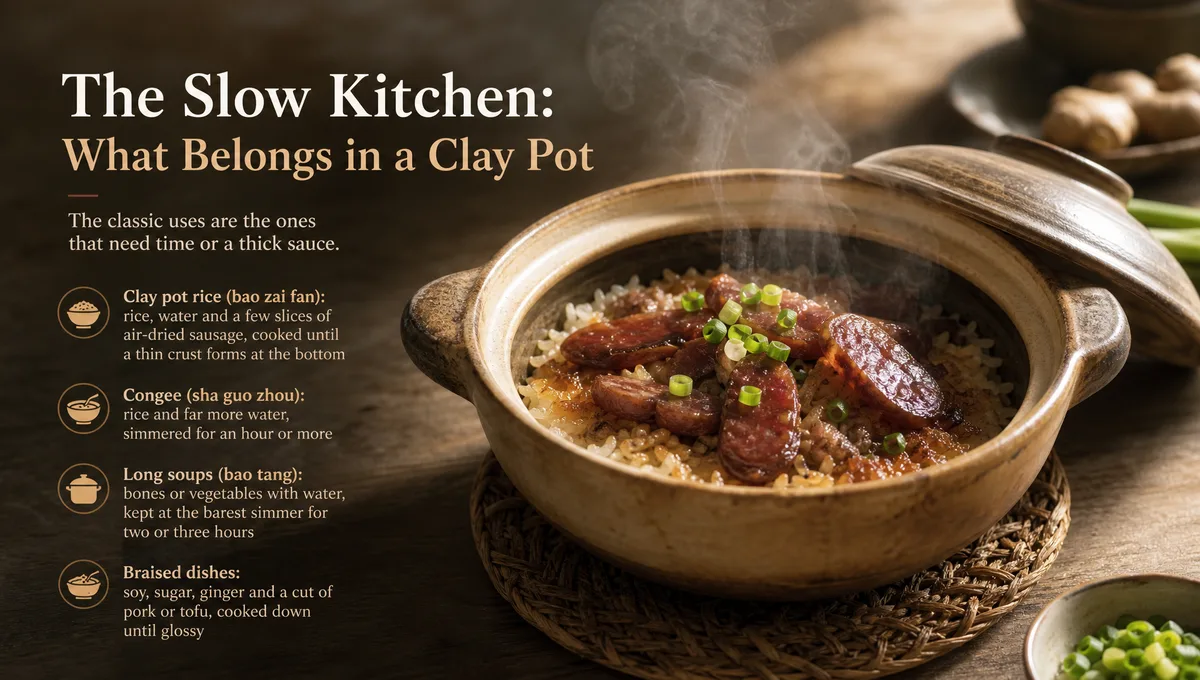
The classic uses are the ones that need time or a thick sauce.
- Clay pot rice (bao zai fan): rice, water and a few slices of air-dried sausage, cooked until a thin crust forms at the bottom
- Congee (sha guo zhou): rice and far more water, simmered for an hour or more
- Long soups (bao tang): bones or vegetables with water, kept at the barest simmer for two or three hours
- Braised dishes: soy, sugar, ginger and a cut of pork or tofu, cooked down until glossy
Our autumn piece on pear and snow fungus soup uses the same principle in a sweet register. The pot does the work; the cook checks on it twice.
Steam: The Oldest Cooking Method Here
Steaming has a long archaeological history in China. Pottery steamers with a perforated base, called zeng, appear at Neolithic sites, and examples from Hemudu in Zhejiang are usually dated to around seven thousand years ago. The shape has barely changed since: a vessel, a floor with holes, a lid.
The bamboo version came later, and it solved a practical problem. Bamboo is light, cheap, and does not drip condensation back onto the food the way a metal lid can. Stack the hoops and you can cook three dishes over one pot of water.
Layering a Bamboo Steamer
A few principles make the stacking order obvious.
- Put slow dishes at the bottom, where the steam is strongest
- Put quick dishes and leafy greens on top
- Keep strong flavours away from delicate ones unless you want them shared
- Line the base with cabbage leaves, parchment or a small plate so nothing sticks or falls through
Timing is short. A whole fish takes eight to ten minutes. Buns from frozen need twelve. A plate of greens needs three, and will keep its colour if you take it out immediately.
The pot below matters too. A wide wok or a deep pan with a tight lid holds enough water for thirty minutes of steaming, which covers most meals.
What Steam Does to Food
Steam is the least intrusive heat in the kitchen, and the results are consistent.
It keeps shape. Fish stays whole, dumplings keep their pleats, and a custard emerges smooth. It adds almost no oil, since nothing is fried. It also holds moisture in, so vegetables come out tender without going soft.
The trade-off is browning. Nothing crisps in a steamer. Cooks work around this by borrowing one thing from the pan: a splash of hot oil poured over the dish at the end, which wakes up the aromatics on top.
A Weekday Evening, Step by Step
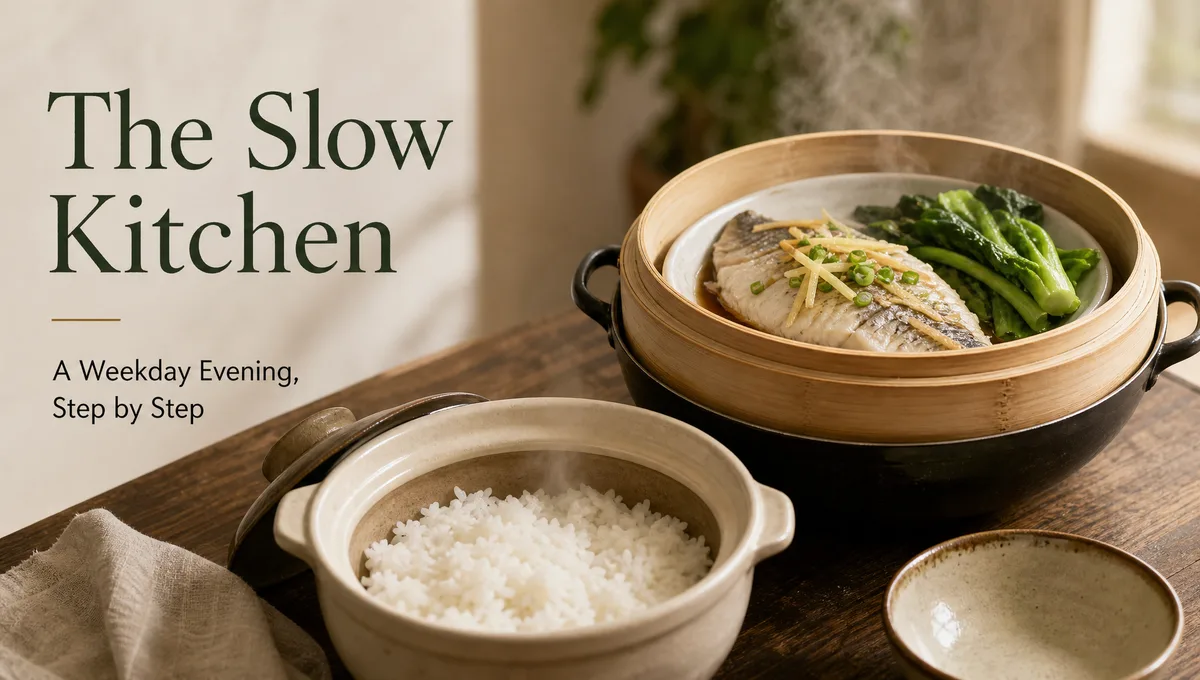
Here is the kind of meal these two vessels produce on a normal Tuesday, for one or two people.
- Start rice in the clay pot: one cup of rice, one and a quarter cups of water, medium flame until it steams, then the lowest setting for fifteen minutes
- While the rice cooks, season a fillet of fish with ginger, a little salt and a spoon of soy
- Set the steamer over a pan of boiling water and steam the fish for eight minutes
- Drop a handful of greens into the steamer for the last three minutes
- Pour a spoon of hot oil over the fish, then bring everything to the table in its own dish
Nothing is rushed, and most of the time is waiting. That is the trade the kitchen offers: fewer pans, less watching, and a meal that arrives when it arrives.
The morning version of the same patience is in our guide to the Chinese breakfast table. The wider habit belongs to seasonal eating the Chinese way.
Common Questions
Can I use a clay pot on an induction hob?
Usually not. Most clay pots need a gas flame or a diffuser plate, because the base is not flat enough to make proper contact. Check the maker’s instructions before you buy.
My clay pot cracked on the second use. Why?
Almost always a temperature shock: cold water into a hot pot, or a hot pot set on a cold stone counter. Let it cool on a wooden board.
Is a metal steamer as good as bamboo?
It works, but bamboo is better at managing condensation. A metal lid drips water onto the food; bamboo absorbs it.
Do I need a special pot for clay pot rice?
A shallow clay pot with a wide base is traditional, since it produces more of the crisp bottom layer. A deep pot works, with less crust.
What can I steam that I would not expect to?
Custard, small cakes, squash, and yesterday’s rice. Anything that would dry out in a pan usually improves in steam.
Is any of this about improving health?
No, and this site does not present food that way. These are cooking methods with a long history and a good record on flavour. Whether they suit you is a question for your own table.
Two Things Worth Keeping
A clay pot and a bamboo steamer cost very little, take up little space, and cannot be improved by technology. They simply hold heat, and they never rush.
If you take one habit from them, take the timing. Start the pot early, set the flame low, and leave the lid closed. The kitchen has been teaching that lesson for a few thousand years.