Wellness6 min read
Why Chinese Households Drink Hot Water: A Short History
Hot water, the thermos and the office kettle. A cultural history of why boiled water became the ordinary drink in China, with no claims about what it does.
By Wen Su — Writer & Editor
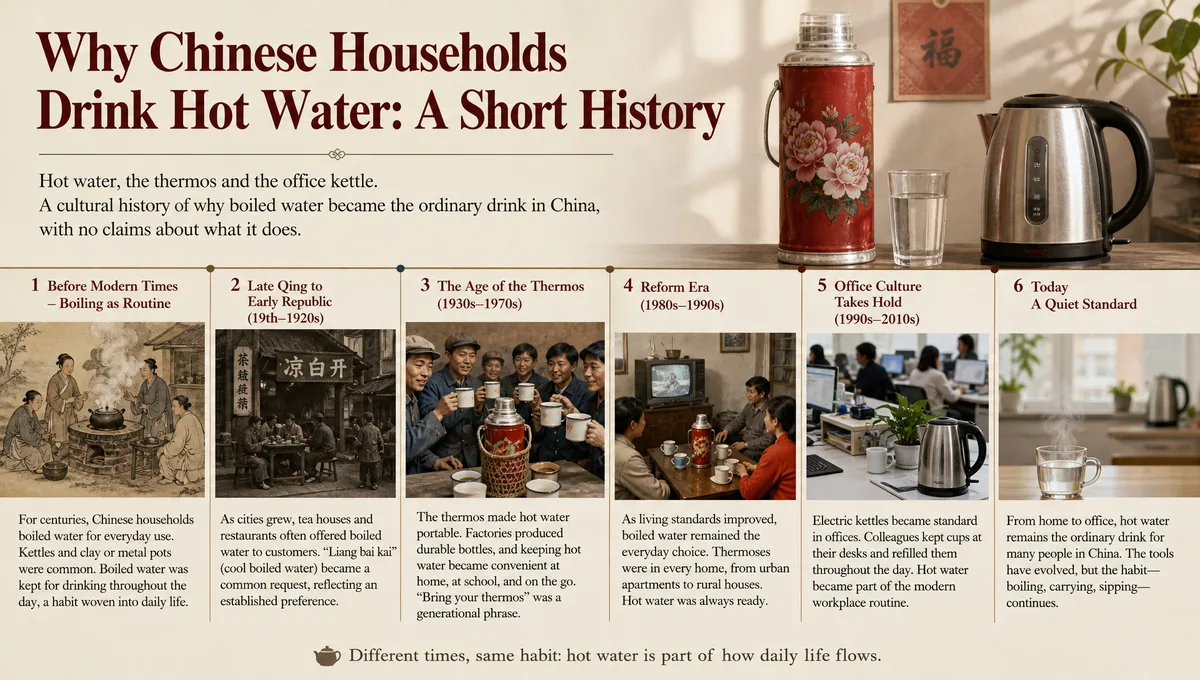
Ask a visitor to China what surprised them and one answer comes up again and again. Everyone is drinking hot water. Not tea. Water, from a thermos, in a glass, at a temperature no one in Europe or North America would choose.
It looks like a preference. It is closer to infrastructure, and the history explains why.
The Kettle Is Where the Answer Starts
The short version is that boiling water was, for a very long time, the cheapest available way to make water safe.
Urban water systems in Europe and North America took their solution in the other direction. Chlorination and sealed mains arrived early in the twentieth century, and after that the tap was simply drinkable. Cold water became normal because cold water was safe.
Chinese cities mostly did not get that plumbing first. What they got instead was the habit and the equipment for boiling. The kettle on the stove. The communal boiler at the end of a corridor. The thermos that keeps the result warm for six hours.
That is the whole mechanism. The drink is a consequence of the pipe.
A Public Health Project With a Slogan
Two campaigns did the heavy lifting, and both are worth knowing because they explain the habit’s grip.
In the 1930s, the New Life Movement pushed a list of household rules. Drinking boiled water was on it. In the 1950s and 1960s, the health campaigns that followed repeated the same instruction in simpler words: boil the water, cook the food. The phrase he kai shui, chi shu shi — drink boiled water, eat cooked food — is the kind of line that outlives the campaign that made it.
By then every work unit had its boiler room, and every train carriage had a samovar at one end. Stations, hospitals and schools all had a hot water point, and they still do. If you have ever queued at a Chinese railway station with a cup of instant noodles, you have used this system.
The result is a country where “water” defaults to a hot drink, and where a cold one has to be asked for.
Liangbaikai: Cooled Boiled Water
There is a word for this in Chinese.
Bai kai shui is plain boiled water. Liang bai kai is the same water, left to cool.
Both are ordinary terms, used in kitchens and on restaurant menus. Both describe something a Western household would not bother to define.
The existence of the second word is the tell. If you have boiled the water for safety, then the temperature becomes a matter of preference rather than purpose. Cooled boiled water is still boiled water. It arrives in summer, in a jug, at the temperature a European would call normal — and it is still not tap water.
It also answers the question outsiders ask most often. Chinese households are not committed to heat. They are committed to boiling.
The Thermos as Furniture
The object that carried the habit into ordinary homes is the bao wen ping, the glass-lined vacuum flask. In the 1960s and 1970s it was a standard wedding gift and a standard household item, filling a shelf next to the cups it served.
Several are still in use. You will see them on office desks and in hospital rooms. They turn up in the back seat of a car on a long drive, and in hotels where a kettle would be an addition rather than a substitute. The flask is unglamorous, and it has never really left.
The same logic produced the office water boiler, the kai shui jian that takes up a few square meters on many floors. It has no seating and no coffee machine. It is a tap that dispenses boiling water, and people visit it several times a day with a mug in hand.
What Arrives Without Asking
The default is visible on any restaurant table, because nobody ordered it.
A pot of hot water, or weak tea, lands before the menu does. It is free, it is refilled without a word, and asking for cold water is a request rather than a default. In many smaller places the waiter looks mildly puzzled and then brings what you asked for, because it is your table and your drink.
The same reflex runs through the health advice people give each other. A cough, a headache, a bad day at work, a broken heart: the traditional answer is duo he re shui, drink more hot water. It is warm, it is useless, and it is said with love. The meme exists precisely because the phrase arrives so reliably, from mothers and grandparents and well-meaning colleagues.
Cold Drinks Are the Newer Arrival
Ice has a longer history in China than most people assume. The imperial courts stored winter ice in cellars and moved it upriver in summer. But domestic refrigeration only spread widely in the last few decades, and cold drinks came with it.
So the generational difference you can observe now is a difference of about forty years. An iced americano in summer and a milk tea with ice are ordinary for people under thirty. To a good number of people over sixty, both are slightly strange.
The two habits now sit side by side, which is what makes the joke work.
What This Is and Is Not
It is a history of a habit, and a fairly unromantic one. Boiling water is a technology that arrived before the plumbing did, and the custom that came with it turned out to be durable.
It is not a claim about what hot water does inside your body. Chinese households do carry a set of beliefs about cold food and drink, and it would be dishonest to describe the habit without mentioning them. But they are household beliefs, treated here as custom rather than as a description of how the body works. Anything in that direction belongs with a doctor.
How to Borrow the Habit
If the kettle is the whole story, the habit travels without any of the belief attached.
- Keep a flask. Fill it in the morning and it is still hot at four in the afternoon. The object does the work, which is why it outlasted several generations of fashion.
- Use it as a pause. Boiling takes four minutes, and standing there for them is a rare piece of enforced nothing. Our piece on winter in Chinese homes describes the same kettle doing the same job on a cold evening.
- Treat tea as the upgrade, not the point. The reason gongfu tea is possible at all is that boiling water is already the default in the room.
Common Questions
Do Chinese people drink hot water in summer?
Many do, at a lower temperature than in winter. The habit is about boiled water rather than about warmth specifically.
Why a thermos instead of a kettle?
Three trips a day to the stove is three interruptions. A flask decouples the boiling from the drinking.
Is this a health practice?
It is a domestic habit with a public health history. This site describes it as custom and makes no claims about effects.
Where did the phrase “drink more hot water” come from?
From the campaigns and from ordinary household advice. It spread as a joke because it is the answer to almost everything.
What do younger people in China do now?
Many drink iced coffee and cold bottled tea, and the old advice gets mocked. The thermos is still on the shelf.
More everyday practice sits in the wellness section.