Wellness7 min read
The Twenty-Minute Boundary: Napping Without Wrecking the Night
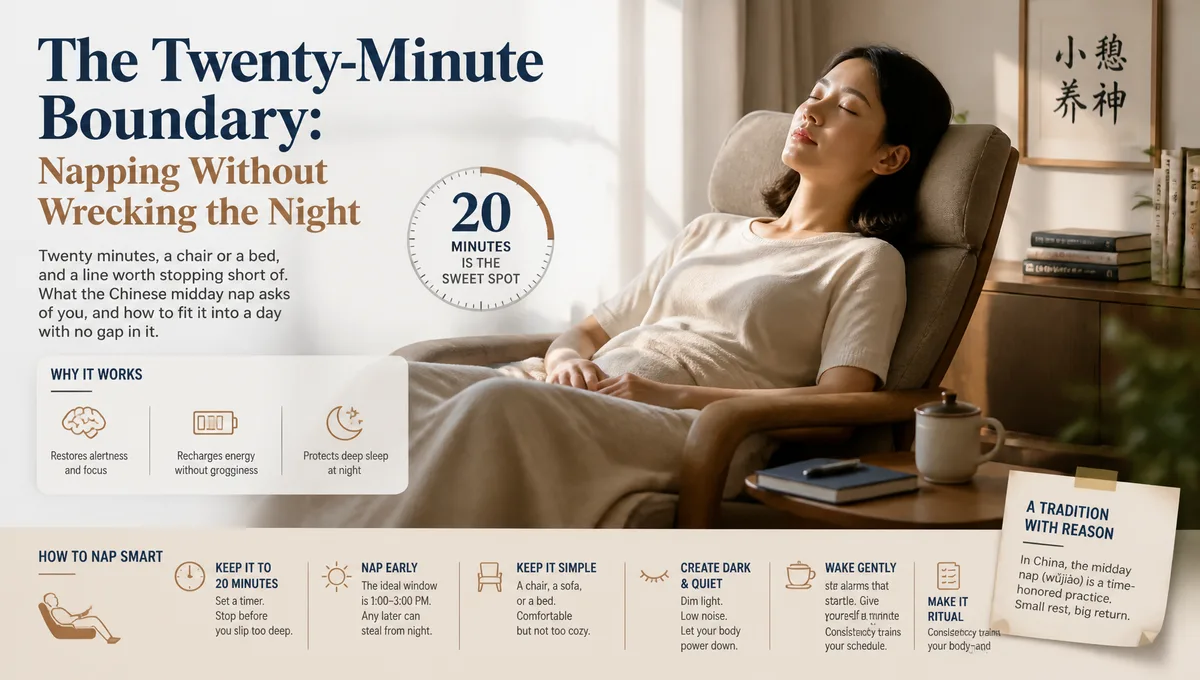
Twenty minutes, a chair or a bed, and a line worth stopping short of. What the Chinese midday nap asks of you, and how to fit it into a day with no gap in it.
By Wen Su — Writer & Editor
The first article about this habit answered the obvious question, which is whether China really stops at one o’clock. It does.
This one is about the part that arrives later, once you have decided to try it yourself. How long, exactly? On a chair or on a bed? And what do you do about the fact that your office has no nap room and your afternoon has no gap in it?
Twenty Minutes, and the Line Just Past It
Chinese practice settles on fifteen to thirty minutes. The small phrase that goes with it, mi yi huir — a short doze — carries the number in the wording. Short. Not serious. Not quite sleep.
The reasoning is arithmetic rather than medical. A nap that ends while you are still half-aware leaves you clearer than you were before it began. A nap that runs long enough to sink finishes somewhere else. The first minutes afterwards are worse than having skipped the whole thing.
So the boundary is not a target to hit. It is a line to stop short of. Most people discover the difference the first time an alarm set for twenty minutes brings them back at forty.
One detail is rarely mentioned. Many people never fall asleep at all. They close their eyes, the room goes quiet, and twenty minutes later they stand up. That counts. It is also the version most people can keep.
Chair, Bed, Recliner, Car
Ask anyone who naps regularly what they lie on and the answers wander. A folding bed under a desk. A recliner with the footrest up. The passenger seat of a car in a car park. A cushion on the floor, or one arm of a sofa.
A full bed does appear, usually in retirement. It is not the standard, though. A bed invites a longer sleep than the practice is asking for.
The recliner gets more argument than it deserves, most of it from people selling recliners. It helps for one specific reason: it holds the head so the neck can let go. If your chair already does that, nothing needs buying.
What does not work is the position most beginners try first. Elbows on the desk, head on the forearms. It looks like the school version, and in a classroom it is fine. Twenty years later it produces a stiff neck, a numb hand and very little rest.
Fitting It Into a Day With No Gap
The habit travels badly into a workplace that treats the lunch hour as time for catching up on email. That is the real obstacle, and it is worth naming rather than working around.
Three shortened versions survive a hostile schedule:
- Seated. Feet flat, back supported, hands in your lap, eyes closed, fifteen minutes. Nobody has to know it is happening. A closed door helps.
- In the car. Parked, seat tilted back a little, timer set, fifteen minutes. In harder schedules this is the most common version in the world.
- The small one. Five minutes, eyes closed, nothing else. It is not the full practice. It is also not nothing, and on a bad week it is what most people manage.
The mistake is all-or-nothing. If the only nap you will take is a perfect twenty minutes in a dark room, you will take none.
The First Week
Two things surprise people who try this for the first time.
The first is how quickly the twenty minutes go. Most beginners open their eyes convinced the alarm went off early. It did not. The interval simply passes faster than a clock suggests it should.
The second is the resistance, which tends to arrive on day three rather than day one. The first two days feel like a discovery. By the third, the whole thing looks like a waste of a decent afternoon, and that is where most attempts stop. If you want the habit, expect that afternoon and leave the timer where it is.
One more thing helps in the first week: do nothing else during the twenty minutes. No reading, no podcast, no phone within reach. The instructions are minimal on purpose, and adding to them changes the exercise.
The Retirement Trap
For readers who have stopped working, the problem inverts. Nothing stands in the way of the nap any more, and that is exactly where it goes wrong.
An hour becomes normal. Two hours happens. The nap drifts later in the afternoon, because there is no lunch hour to anchor it. By the third week the whole day has reorganised itself around an event that was supposed to take twenty minutes. The following night is worse, which makes the next nap longer, and the loop closes.
The traditional measure survives this better than willpower does. Same hour, same length, timer set before you sit down. Treat it as a fixed point in the day rather than a reward for finishing something, and it stays a nap.
There is a second version of the trap worth mentioning. Some people, newly retired, decide that napping is lazy and give up the habit entirely, on the grounds that it belonged to a working day. It did not. The custom long predates offices, and it has always been about the shape of an afternoon rather than about recovering from work.
The Night Question
People who sleep badly often avoid napping, on the reasonable theory that it borrows from the night. The tradition’s answer is not to drop the nap. It is to move it and cut it: earlier in the afternoon, and shorter than usual.
Two things matter. The hour, because a nap at five in the afternoon sits far closer to bedtime than one at twelve thirty. And the length, because twenty minutes and ninety minutes are different events that happen to share a name.
This is a description of a traditional practice, not medical guidance. If sleeplessness is a regular feature of your nights rather than an occasional one, that belongs with a doctor. No midday habit replaces the conversation.
What This Is Not
Not a productivity technique, and not a claim about what it does inside your body. The tradition describes a way of arranging an afternoon. Anything beyond that belongs to people who study sleep for a living.
Three Small Set-Ups
- Set the timer before you close your eyes. Deciding how long to rest while you are already tired is how twenty minutes turns into fifty.
- Get up when it goes, even if you have only just settled. The instruction belongs to the alarm, not to you.
- Keep the same hour. A nap that drifts around the afternoon never becomes a habit. Twelve thirty to one is the traditional window and it is hard to improve on.
Common Questions
How long should a midday nap be?
Fifteen to twenty minutes is the usual answer. Short enough that you are still half-aware when it ends, which is rather the point of it.
Should I lie down, or is a recliner enough?
Either, provided your head is supported. A firm chair with the feet flat works. Elbows on a desk does not.
What if I cannot fall asleep?
Most people who keep this practice do not. Resting with your eyes closed for twenty minutes is the practice, not a consolation prize.
Does napping make it harder to sleep at night?
It can, especially if it runs late or long. The traditional fix is to move it earlier and shorten it, not to stop.
How do I nap at work?
Seated, fifteen minutes, door closed, timer set. Everyone in an office with a nap culture does roughly this, and nobody announces it.
The Version You Will Actually Keep
The Chinese midday nap is not a technique with stages. It is a gap in the day, kept short on purpose. It survives because it asks for so little: a supported head, a timer, and twenty minutes that do not have to produce anything.
Our piece on how the country stops at one o’clock covers where the custom comes from. The evening foot soak is the other half of the same idea, a short ritual that marks the end of something. More gentle practice sits in the wellness section.