Wisdom7 min read
Autumn in Chinese Wisdom: Harvest, Letting Go and the Second Half of Life
Autumn is when Chinese writers talk about aging: harvest and loss in one breath. Three classical ideas about gathering, letting go and ending well.
By Ming Chen — Editor & Researcher
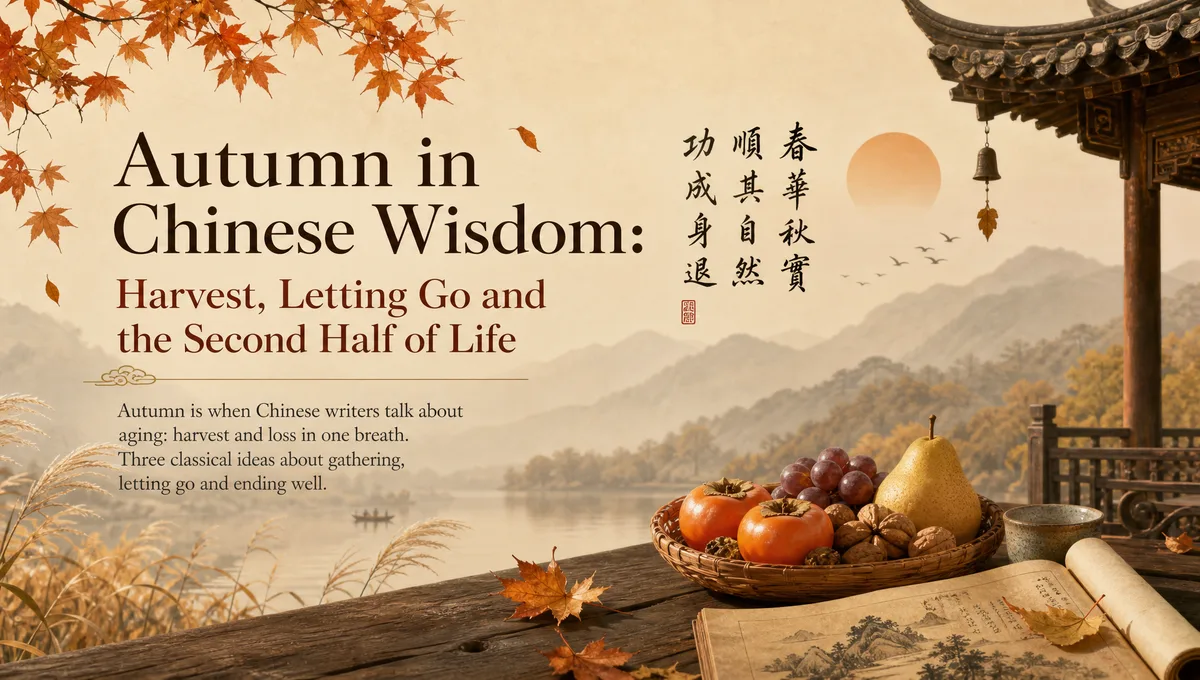
Autumn is the season Chinese writers use to talk about getting older.
That is not a coincidence of weather. Spring is for starting, summer is for growing, winter is for keeping quiet. Autumn is when the year counts what it has. A person past fifty is at the same point in the year as late September: more behind than ahead, and clearer about what matters.
Three classical ideas run through that season. One is about what to store. One is about what to drop. One is about how to finish. All three are older than any self-help shelf, and all three are short.
Harvest Is a Decision, Not a Mood
The oldest line about the seasons in Chinese is not a poem. It is a sentence from the historian Sima Qian, in the introduction to his Records of the Grand Historian.
Spring brings growth, summer ripens it, autumn harvests, winter stores. He calls this “the great pattern of heaven” — not a metaphor, just how a year works.
Farmers understood the hard part. Harvest sounds generous, but a harvest is a series of decisions. Some of the field goes into the barn. Some goes back into the soil. Some is left to rot because carrying it costs more than it is worth.
The same arithmetic applies to a life with forty working years behind it. Ask what actually produced something this year. Not what you were busy with — what produced.
Write three things down. A skill that still earns. A relationship that still gives. A habit that still holds. If a fourth thing does not fit on the list, it is winter storage, not harvest.
The kitchen version of this idea is in our piece on Chinese seasonal eating, where the autumn shopping list is short on purpose.
Zhuangzi’s Autumn Floods: the View From Bigger Water
The most famous autumn scene in Chinese philosophy is a flood.
In the Autumn Floods chapter of the Zhuangzi, the rains come and every small river pours into the Yellow River. The river god looks at the widened water, decides that all the beauty in the world has gathered in him, and sails downstream feeling pleased.
Then he reaches the sea. He looks north, sees no far shore, and stops. He turns to the sea god and says, in effect: I had been taking myself seriously.
The sea god’s answer is the line people remember. A well frog cannot be told about the sea, because it is bound by its well. A summer insect cannot be told about ice, because it is bound by its season. Neither is stupid. Each is limited by where and when it lives.
That is a useful mirror for anyone over fifty. Experience is real, and it is also a well. You have seen a great deal, and a summer insect has seen a great many summers — none of them ice.
The practical version is one sentence long: replace I have seen enough to judge with I have not seen this yet. It costs nothing and keeps the year from closing early. The rest of the book is in our Zhuangzi parables.
The Seasonal Classic: Earlier Nights, Slower Mornings
Chinese households have a second autumn text, this one about daily rhythm.
The Huangdi Neijing, a classical medical and cosmological text compiled over two thousand years ago, devotes a passage to the three autumn months. Its advice is domestic and mild: go to bed earlier, get up with the chickens, keep food regular, and let the temper settle — rong ping, “calm and even”.
It is worth being precise about what this is. The passage is a description of how a settled household organised its autumn, not a health instruction, and this site does not give medical advice. Read it the way you would read an almanac: as a rhythm that people found workable.
Two of its ideas travel well across cultures.
The first is earlier nights in autumn. The light drops, and the household moves its evening forward by design rather than by accident. Thirty minutes is enough to feel it.
The second is the emotional part. Rong ping asks for a quieter temper in a season when everything is being cut back. Autumn is the time to stop adding arguments.
Letting Go Is Not Losing: the Old Man at the Border
Chinese has a story for the autumn lesson in loss, and everyone learns it as a child.
An old man at the frontier loses his horse. His neighbours offer sympathy; he asks how they know it is bad luck. The horse returns with a wild companion. The neighbours congratulate him; he asks how they know it is good luck. His son rides the new horse, falls, and breaks a bone. Then war comes, and the men who can walk are conscripted.
Nothing in the story stays in one category. That is why it is called sai weng shi ma, and why it is the first entry in most collections of Chinese proverbs.
Autumn is the same idea wearing weather. The tree drops its leaves, and no one calls it a failure. It is simply not paying the cost of carrying foliage through winter.
Once a year, in autumn, drop one thing on purpose. A project that no longer produces anything. A courtesy that has become a habit. An old version of yourself that other people keep addressing. One item is enough; the point is that the choice is yours rather than the season’s. The full story is in the old man at the border, and the practice of not forcing is in wu wei.
Ending Well: Finishing Without Clinging
The third idea is about how things stop.
The Tao Te Ching gives it in nine words: when the work is done, step back. That, it says, is the way of heaven. The line has been read for two thousand years as advice about power. Fill the cup to the brim and you will spill it. Keep hammering the point and it will blunt.
The Chinese phrase for a good finish is shan shi shan zhong: a good beginning and a good end. It is used about careers, marriages, projects and long friendships. Notice what it does not ask for. It does not require the ending to be dramatic or early. It requires the ending to be clean.
Clean has three parts in ordinary life. Hand over what you were holding. Settle what is owed. Say the sentence you have been avoiding.
Our beginner’s guide to the Tao Te Ching covers the whole book, including this chapter.
Three Small Autumn Practices
None of them take an afternoon, and none require believing anything.
- Write the harvest. Three things that produced something this year. Keep the list where you will see it in December.
- Drop one thing early. Choose one obligation the season would have taken from you anyway, and end it deliberately.
- Move your evening thirty minutes earlier. Two weeks is enough to know whether it suits you. If it does not, stop.
There is a fourth, for people who like to finish what is open. Pick the one unfinished thing you would most regret leaving untidy. Give it a clean ending this month.
Common Questions
Is this medical advice? No. The seasonal passage is a classical text about household rhythm, and this article treats it as cultural history. For anything to do with your health, ask a doctor.
Where should I start with the Zhuangzi? With the Autumn Floods chapter. It is short, it is funny, and it does not need a teacher. Burton Watson’s translation is the usual first door.
Why does autumn make people reflective? The season’s cultural association with harvest and closing is very old, and it survives in poetry, proverbs and holidays. That is a cultural explanation, not a claim about mood or mind.
Does gong cheng shen tui mean I should retire early? No. It means not occupying a place after your work there is finished. Many people read it as a reason to leave at the top; others read it as a reason to hand over a role while staying involved.
Do I need to follow the lunar calendar or the solar terms? No. Take the method rather than the dates: notice your own season, and pick one small thing to keep and one to put down.
The Year Turns Quietly
Autumn in this tradition is not decline. It is settlement — the two weeks a year when the books are closed.
The three ideas fit together in one sentence. Harvest what produced, drop what did not, and finish what you started cleanly.
The year is two-thirds gone. That is the correct reading of where it stands, and there is still a quarter of it to use well. More of this corner of the tradition is in our Culture & Arts section, including proverbs about growing older.