Wisdom5 min read
A Distant Relative Is Not as Good as a Near Neighbour
A Chinese proverb ranks the neighbour above the relative. What that says about old streets, new towers, and why distance can beat blood.
By Wen Su — Writer & Editor
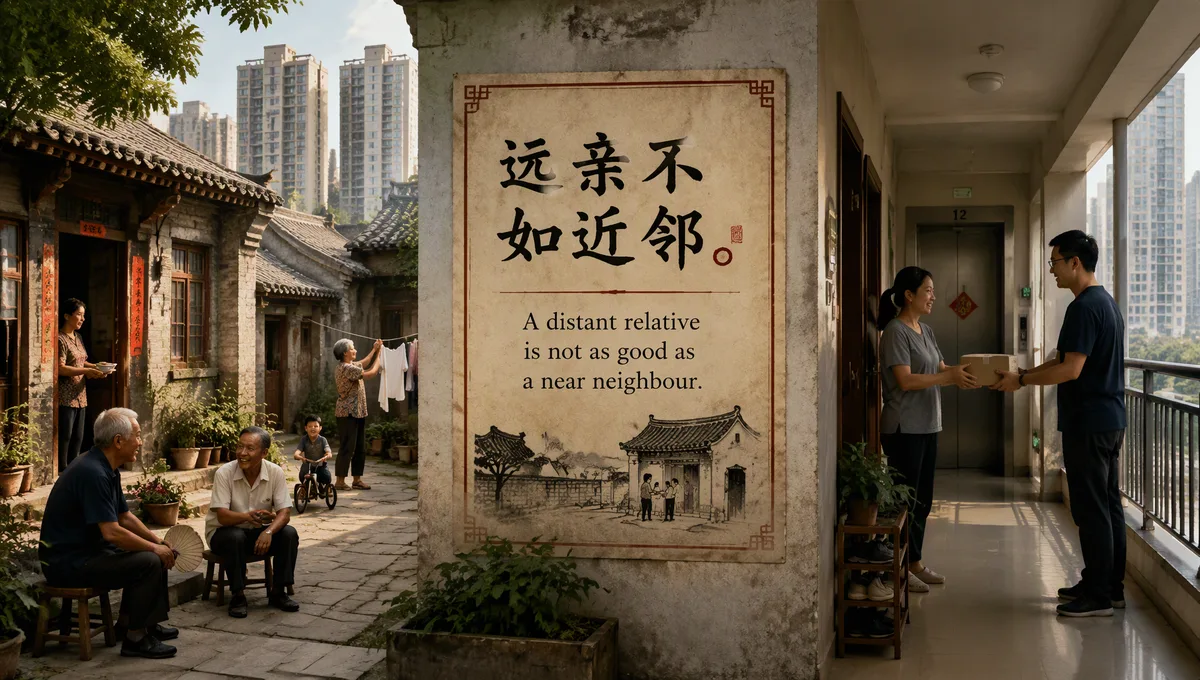
Most sayings about family put blood first. The Chinese one people actually quote on moving day puts the neighbour there instead:
Yuan qin bu ru jin lin.
A distant relative is not as good as a near neighbour. It sounds like a small practical point. It has been carrying a whole way of living for a very long time.
The Proverb That Ranks a Neighbour First
The sentence is precise. It does not say relatives are useless. It says that when something needs doing now, the person next door beats the one three provinces away. A key borrowed. A child watched for an hour. A hand needed to carry something heavy.
Distance is the whole point. Blood does not travel. A neighbour is already there.
A Handful More
The same idea turns up again and again, each time from a different angle.
One warns about timing: yuan shui jiu bu liao jin huo, distant water cannot put out a near fire. Help that is too far away to arrive in time is, for that moment, no help at all.
Another prices the neighbour above the house: qian jin mai wu, wan jin mai lin. A thousand pieces of gold buy the house; ten thousand buy the neighbour. The neighbour is treated as part of the purchase, and the more expensive part.
The last one is about running into someone: di tou bu jian, tai tou jian. Lower your head and you do not see them; raise it and there they are. It is why a quarrel with a neighbour is never quite over: you will meet again tomorrow, in the lift or at the gate.
Why Neighbours Mattered So Much
These sayings come from a world where people did not move much. A street, a courtyard, a lane of houses held the same families for generations, and the neighbour was a fact of life rather than a choice.
In that world the neighbour lent things that would otherwise have to be bought. The neighbour watched the door during a funeral, helped lift a roof beam at a wedding, and noticed whether the old person next door had come out that morning.
That is not sentimentality. It is infrastructure, and the proverbs are its operating manual.
Mencius’s Mother Moved Three Times
The most famous neighbour story is not about staying. It is about leaving.
Mencius’s mother moved house three times, the story goes, because of the neighbours. First the family lived near a cemetery, and the boy played at funerals. Then near a market, and he played at haggling. Only when she moved near a school did he begin to imitate scholars.
The story is known by a short name: Meng Mu san qian, “Mencius’s mother, three moves.” It became the standard explanation for why a neighbourhood matters to children, and why a good neighbour is worth moving for.
The High-Rise Version
The proverb survives, but its setting has changed. In a modern tower the neighbour is a door across a corridor, not a family who shares a courtyard wall. People pass each other in the lift and exchange the same few words.
Yet the saying is still used, and not only by the old. It turns up when a pipe bursts and someone downstairs helps, when a package is left at the wrong door, when a parent needs a child collected. The neighbour is still the nearest help. The tower has just made the distance shorter and the knowing thinner.
When the Proverb Is Quoted
It is a giving phrase and a receiving phrase. A neighbour uses it when refusing thanks for a small help. A person uses it when apologising after a quarrel, to say the relationship matters more than the argument.
Either way it does the same quiet work: it lowers the stakes. A neighbour is not family, so the duties are lighter, and it is exactly that lightness that keeps a street livable.
Common Questions
Is “distant relative, near neighbour” a rule or a complaint? Both. As a rule it justifies helping and being helped. As a complaint it notes that relatives far away will not be there in time, whatever the intention.
Does it still hold in cities? The setting has changed, but the logic has not. The nearest help is still the nearest person, and in a tower that is the neighbour down the corridor.
Is this the same as “good fences make good neighbours”? Not quite. The Western saying values clear boundaries. The Chinese one values proximity and small mutual help. Both are about making cohabitation work, from opposite directions.
Did Mencius’s mother really move three times? The story is recorded in the Han dynasty, centuries after Mencius, and is best read as a parable about environment rather than a diary entry.
How many of these proverbs are still in daily use? The first two, yuan qin bu ru jin lin and yuan shui jiu bu liao jin huo, are ordinary speech. The others are quoted more rarely but still understood.
The Neighbour the Proverb Assumes
The proverb assumes a neighbour who is close enough to hear a knock. In that one detail it says more than any advice column: much of a good life is simply who is near enough to help.
Two pieces sit naturally beside this one. Face and the step down is about the small courtesies that keep a relationship from curdling. Sayings about time gathers another set of proverbs the same generation grew up with. The rest is in the Culture section.