Wisdom4 min read
Zhuangzi's Butterfly Dream: What the Passage Actually Asks
The butterfly dream is Zhuangzi's most famous passage. What it actually says, the word at the end, and why it reads differently after fifty.
By Ming Chen — Editor & Researcher
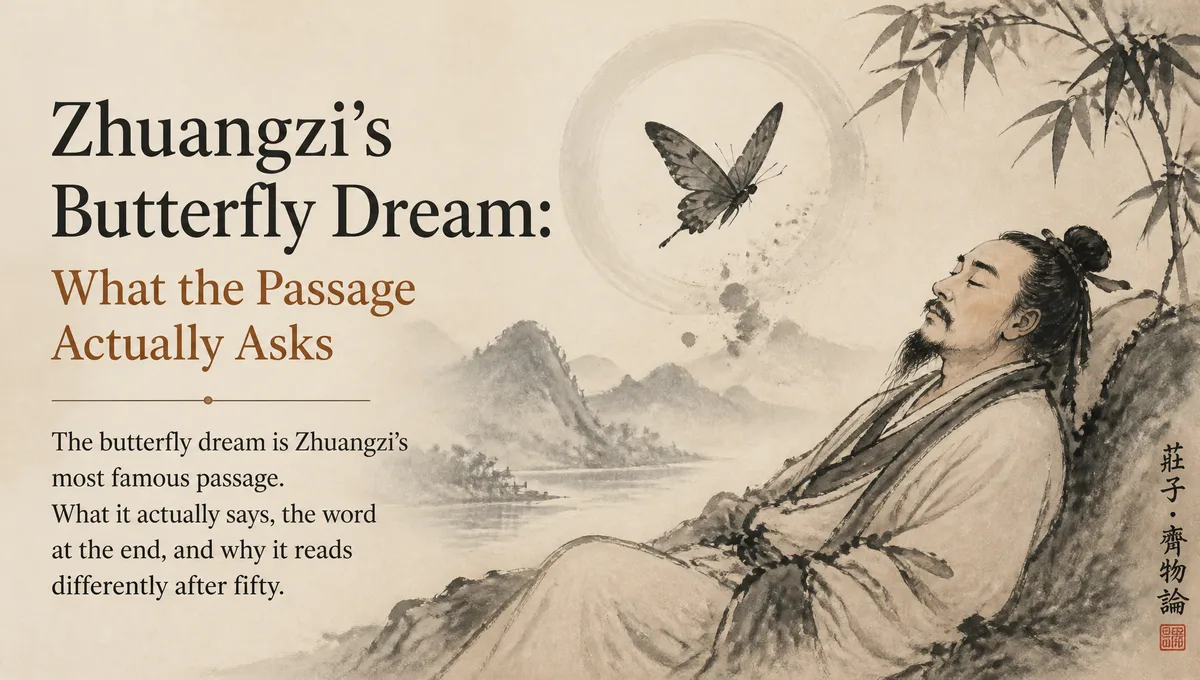
When Zhuangzi dreamed he was a butterfly, he left behind the most famous four lines in Chinese philosophy.
Most people know the ending. A man wakes from a dream and cannot be sure which side of it he is on. The question has been repeated for twenty-three centuries and never answered, on purpose.
The passage is usually read as a riddle about reality. What everyone skips is the last word.
The Passage, Read Closely
The whole thing is four sentences, at the very end of the second Inner Chapter, On the Equality of Things.
Zhuangzi — personal name Zhuang Zhou — dreams he is a butterfly. The butterfly flutters about, happy, content, doing exactly as it pleases. It has no idea it is a man named Zhou.
Then he wakes. And there he is, solid and unmistakable, Zhou again.
Now comes the question. Was he Zhou dreaming he was a butterfly, or a butterfly now dreaming it is Zhou? Between the two, the passage admits, there must be some distinction.
Then it names that whole tangle in a single phrase: wu hua, “the transformation of things.”
The Last Word
That final phrase is the key, and most retellings drop it.
The famous question — am I a man or a butterfly? — sounds like a puzzle about what is real. But the passage does not stop at the puzzle. It closes with a single term: transformation.
Zhou and the butterfly are not two creatures fighting over who is real. They are two shapes the same current takes. The dream is not asking you to choose. It is asking you to notice that the choosing may itself be the mistake.
Not a Riddle About Nothing Being Real
It is tempting to file the passage under early skepticism, a Chinese cousin of the worry that we might all be dreaming.
The text resists that filing. Zhuangzi is not saying the world is an illusion. He is saying the line between one state and another is looser than you think, and that the loosening is not a loss.
The dream is not a nightmare. The butterfly is happy. That detail carries the whole passage. Waking is not a rescue from unreality; it is simply the next shape.
Two States, One Life
For a reader past fifty, the passage lands differently than it does at twenty.
A life already holds several transformations. The worker and the retired person. The parent and the grandparent. The person you were at thirty and the person writing this down. Each phase felt solid while you were inside it.
The butterfly dream is the old text that says those were not separate people. They were the same current, changing shape, and the change was never a failure.
What Wu Hua Lets You Put Down
The practical gift of the passage is small but real.
If you are not a fixed thing, then no single version of you is the final one. A career is not a verdict. A season of life is not an identity. You are allowed to wake up slightly different, without treating the earlier person as a lie.
That is a strange kind of comfort, and it is the one the passage actually offers.
Reading It at Different Ages
The same four lines mean different things each decade.
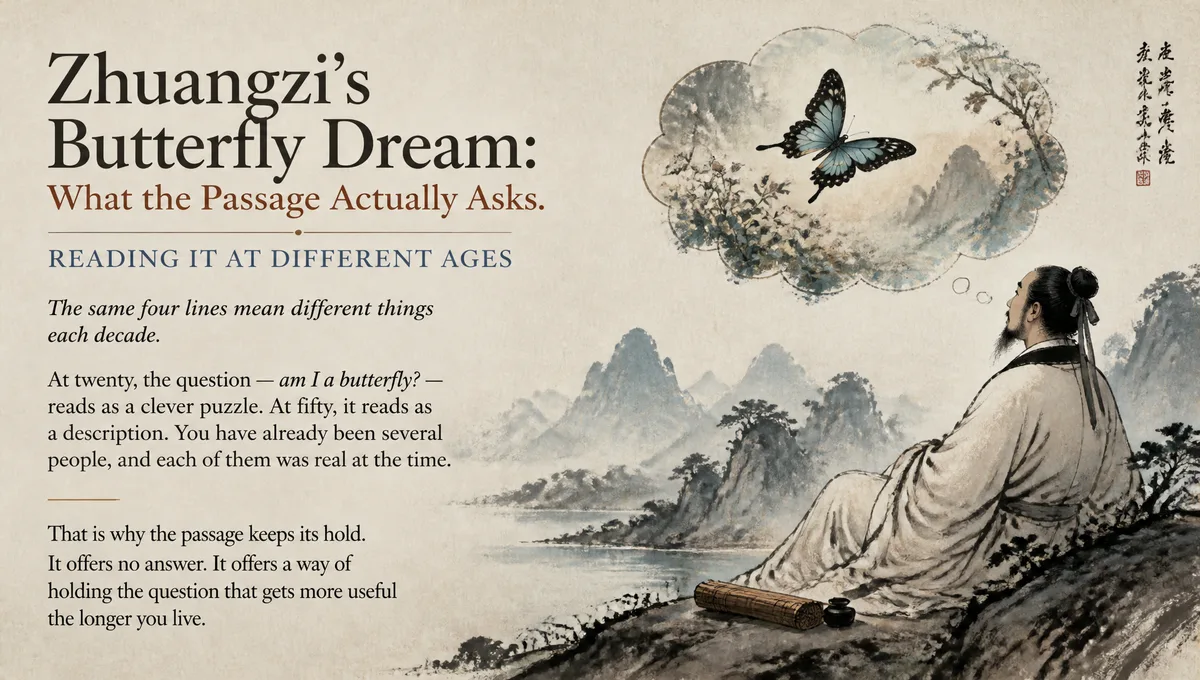
At twenty, the question — am I a butterfly? — reads as a clever puzzle. At fifty, it reads as a description. You have already been several people, and each of them was real at the time.
That is why the passage keeps its hold. It offers no answer. It offers a way of holding the question that gets more useful the longer you live.
Common Questions
Is the butterfly dream about skepticism?
Only partly. It is closer to a claim about change than a claim about illusion. The last word is transformation, not doubt.
What does wu hua mean?
“The transformation of things.” The idea that beings change into one another — a man into a butterfly, one phase of a life into the next — without any single shape being the real one.
Which chapter is it in?
The end of the second Inner Chapter, On the Equality of Things. Our overview of the book and its other parables sets the scene.
Do I need to read the whole book first?
No. The passage stands alone, which is one reason it has travelled so far.
Is this related to the other Zhuangzi stories?
Yes. The useless tree makes a similar move about usefulness. Both ask you to stop grading your life on one fixed scale.
The Question That Does Not Need Settling
The butterfly dream is famous because it refuses to conclude. It asks the one question — who, exactly, am I? — and then points out, gently, that the question only hurts if you insist on a single answer.
For the other half of the Taoist pairing, see the Tao Te Ching. For the same instinct applied to an ordinary week, see wu wei.