Wisdom7 min read
Win Without Fighting: What the Art of War Says About Ordinary Conflict
Thirteen chapters, six thousand characters, one preference: not to fight at all. What Sunzi's Art of War advises, and which parts to leave out.
By Wen Su — Writer & Editor
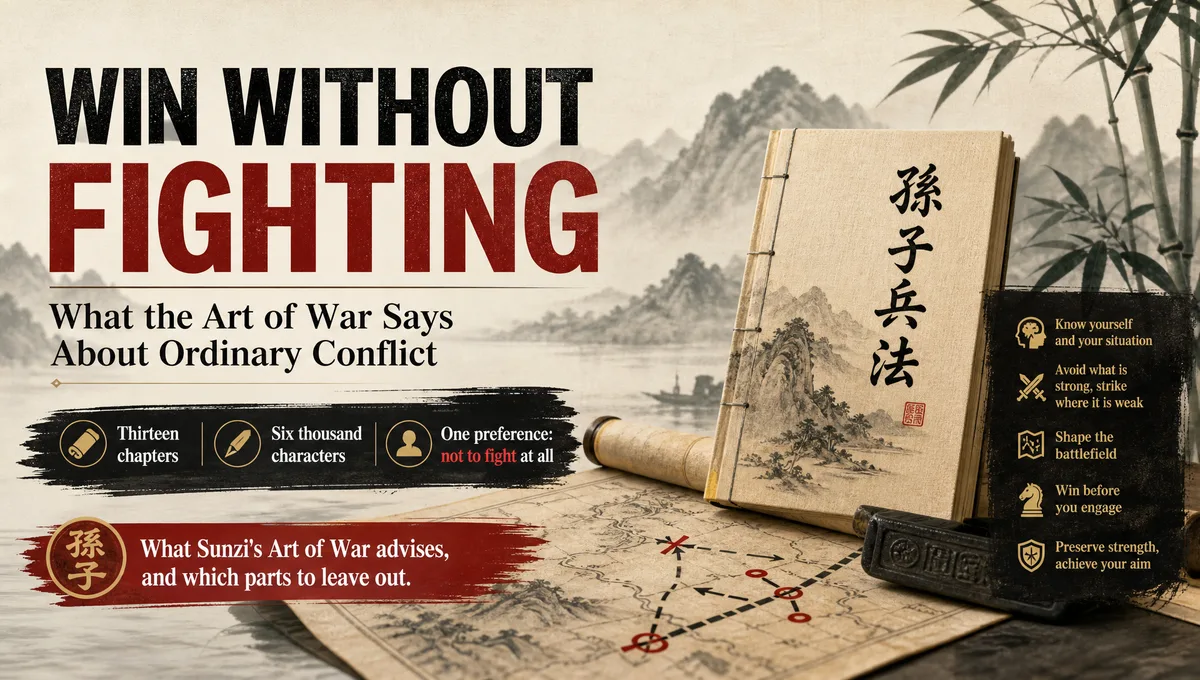
The most quoted line in Chinese strategy is not a battle cry. It is an argument for skipping the battle.
Sunzi bingfa, the Art of War, is thirteen chapters and roughly six thousand characters. It fits into one long sitting. Two and a half thousand years on it is still read, mostly by people who are not soldiers. Managers, coaches, negotiators, and anyone trying to end an argument without losing it.
That last use is where most of the damage happens. The book itself comes first, then the part that travels.
The Book and the Man
Tradition gives it to Sun Wu, a strategist from the state of Qi who served King Helü of Wu in the fifth century BCE.
The story that made him famous comes from the Records of the Grand Historian, written some four hundred years later. The king asked Sun Wu to demonstrate his method on the women of the palace. He split them into two companies, made the king’s two favourite concubines their captains, and explained the drill.
They laughed. He explained it again, more slowly. They laughed again. He then had the two captains executed, on the grounds that an order repeated twice and disobeyed is the officer’s fault.
The king objected. Sun Wu is said to have answered that a commander in the field may decline certain orders. The companies drilled correctly after that.
Treat the anecdote as an anecdote. What it reports about the book is accurate, though. This is a text about authority, discipline and cost, written with very little warmth.
Six Thousand Characters
In 1972, workers digging near Linyi in Shandong opened a Han dynasty tomb at Yinqueshan. The bamboo slips inside included texts of the Art of War close to the version read today. Beside them lay a separate book attributed to Sun Bin, the descendant.
The find settled an old argument. Some scholars had held that Sun Wu and Sun Bin were one person. The tomb produced two texts and two names in the same box.
The book itself reads like notes rather than a treatise. It repeats itself. It lists. Whole paragraphs are a single opinion with no argument attached.
Win Without Fighting
The line everyone half-remembers sits in the chapter on attacking by stratagem:
Shi gu bai zhan bai sheng, fei shan zhi shan zhe ye; bu zhan er qu ren zhi bing, shan zhi shan zhe ye.
A hundred battles, a hundred victories: not the highest skill. To make the other side bend without fighting: the highest skill.
Notice the verb. Qu means to bend rather than break. The aim is a changed position, and the other side intact. In a family, a workplace, a long friendship, that difference is everything.
The same chapter sets out a ladder of costs:
Shang bing fa mou, qi ci fa jiao, qi ci fa bing, qi xia gong cheng.
Best is to defeat the plan. Next the alliances. Next the troops. Worst is to besiege a walled city, because a siege eats months and men and often fails anyway.
Put into an ordinary disagreement, fa mou means changing the terms on which it is being argued. Not winning the exchange. Removing the thing that made it a fight.
Know Both Sides
Zhi bi zhi ji, bai zhan bu dai is normally rendered as “know your enemy and know yourself, and you will win a hundred battles”.
That is not what it says. Dai means peril. The sentence promises that in a hundred engagements you will not be in danger. Safety, not victory.
This is a pattern in the book, and the reason it has lasted. It makes small claims. It is interested in the downside.
First Make Yourself Hard to Beat
The clearest statement of that interest comes in the chapter on disposition:
Xian wei bu ke sheng, yi dai di zhi ke sheng. Gu yue: sheng ke zhi, er bu ke wei.
Make yourself impossible to defeat first. Then wait for the enemy to become beatable. Victory can be known in advance. It cannot be manufactured.
The two halves are not equal. Your readiness is yours to arrange. The other person’s mistake, apology or change of mind is not on your schedule.
Anyone who has waited years for an apology from a sibling knows the shape of this. The preparation is yours. The timing never was.
Leave a Way Out
Two lines in the chapter on manoeuvre read oddly in a military text:
Wei shi bi que, qiong kou wu po.
When you surround an army, leave a gap. Do not press a cornered enemy.
The reasoning is practical rather than merciful. A force with no exit fights to the death, and that costs the winner more than the gap would have. So the book recommends building the exit on purpose.
It is the same move as giving someone a way to step down. That mechanism is worked through more fully elsewhere on this site: face and the step down is about the sentence that lets a person leave without losing everything.
Do Not Act From Anger
The last chapters are the least quoted and the most useful.
Zhu bu ke yi nu er xing shi, jiang bu ke yi yun er zhi zhan. Nu ke yi fu xi, yun ke yi fu yue; wang guo bu ke yi fu cun, si zhe bu ke yi fu sheng.
A ruler must not raise an army out of anger. A general must not fight out of resentment. Anger can turn back into joy, and resentment back into good humour. A destroyed state cannot be restored, and the dead cannot be brought back.
The structure of that argument is worth borrowing even if you never command anything. The feeling is reversible. The consequence is not. So wait, because the feeling passes, and the sentence you said at the table does not.
The chapter closes by telling the wise ruler to be careful and the good general to be wary. It is the least romantic ending in the book.
What to Leave Out
One chapter opens with bing zhe, gui dao ye — war is the way of deception — then lists the deceptions. Appear incapable when capable. Appear near when far. Bait with profit. Disorder the opponent.
Import that into a marriage and it will corrode. The book’s ethics assume a lethal contest between organised armies, with a decisive encounter at the end. Most ordinary conflict has no such ending. It has next Sunday, and another one after that.
Two further confusions are worth clearing.
The Art of War is not the Thirty-Six Stratagems. That is a later collection, a list of tricks with no single author. Because the two are quoted together so often, people assume they are one book.
And the famous line is almost always quoted in half. Bai zhan bai sheng sounds like praise until the next clause takes it away.
Common Questions
Is the Art of War the same as the Thirty-Six Stratagems? No. Thirteen chapters from one tradition, against a later list of thirty-six tricks. Different books, different purposes, usually sold together.
Did Sunzi exist? He is named in the Records of the Grand Historian and in earlier texts. The biography is thin and was written centuries later. Most scholars read the book as a text that grew over time rather than one author’s manuscript.
How long is it? Thirteen chapters, roughly six thousand characters in the received version. Shorter than a magazine feature, and it reads faster.
Is “know yourself, know your enemy” really about winning? No. The clause promises that you will not be in danger, which is a smaller and much more durable claim.
Can it be used at work? Partly. The parts about cost, preparation and avoiding a fight translate well. The deception chapter translates badly, and the person quoting it in a meeting is usually telling you something about themselves.
Which line gets misused most? Bu zhan er qu ren zhi bing, adopted as a slogan by people who then spend the entire meeting fighting.
The Smallest Version
If you keep one idea from the book, keep the accounting. Every chapter asks the same question in different words: what will this cost, and is there a smaller move that gets the same result.
That question is why the text outlived the wars it was written for.
Two pieces nearby continue the thread. Losing a horse, gaining a horse is about the older habit of refusing to call an outcome good or bad too early. The doctrine of the mean applies the same instinct to conduct. The rest sits in the Culture section.