Wisdom6 min read
Face and the Step Down: How a Chinese Argument Ends
Face rules quietly in Chinese family, work and social life. What mianzi and lian mean, why a way out matters, and when giving face goes too far.
By Wen Su — Writer & Editor
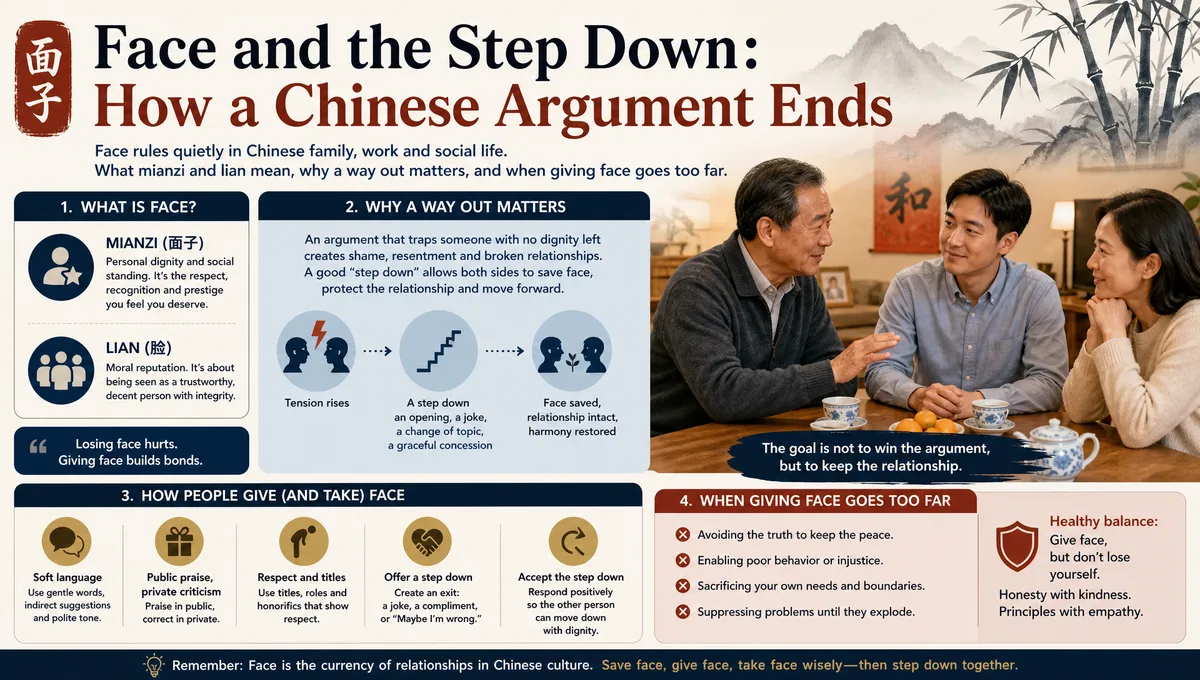
An argument in a Chinese household often ends without anyone saying who was right.
A third person pours tea. Someone changes the subject. A phrase appears — gei ge tai jie xia, give him a step down — and the disagreement dissolves rather than resolves.
To a reader raised on direct confrontation, this looks like avoidance. It is better understood as a system, with rules and costs, and it starts with two words English flattens into one.
Two Kinds of Face
English uses face for two things Chinese keeps apart.
- Mianzi — social standing, reputation, the position you hold in other people’s eyes. It can be given, borrowed, built or lost within an afternoon.
- Lian — moral character, the part of you that people judge as decent or not.
Losing mianzi is embarrassing. Losing lian is a verdict. A public mistake costs face; cheating a friend costs the other thing entirely, and it is much harder to recover.
That difference explains a lot of behaviour. People will spend money, time and comfort to protect mianzi, because it is a form of credit that other people grant. They will usually refuse to sacrifice lian even when it would be profitable.
The Step Down
The most useful phrase in the whole system is tai jie, a step or staircase.
To give someone a step down is to offer a way out of a corner they have talked themselves into. The offer does not require admitting error. It creates a path: the person can stop, sit, and let the matter rest.
Common forms:
- A question instead of an accusation — did you mean…?
- Blaming a circumstance rather than a person — the traffic was terrible
- Moving the discussion to a later date — let us look at it again after the holiday
- Handing the decision to a third party who can soften it
- Simply refilling a cup and changing the subject for ten minutes
None of these is a lie. Each one lowers the temperature enough for the other person to stop defending a position.
Why Directness Costs More Here
In a society where standing is granted by others, a public correction takes something from the person corrected. That is why the correction is often private, and why it comes wrapped in qualification.
Two habits follow from it.
Indirect refusal. Let me think about it is usually a no. So is it may not be convenient. Chinese speakers learn to read the temperature of a sentence rather than its literal content, and a blunt no is read as a signal that the relationship has been downgraded.
Middlemen. When the stakes are high, a third person carries the message. Family disputes, business negotiations and landlord arguments often run through an intermediary. The intermediary protects both sides: neither has to say the hard thing aloud.
Our piece on the old man at the frontier makes a related point about not reacting to the first version of an event. The habits around the shared table come from the same instinct: keep the meal going, and the relationship survives the argument.
The Costs of the System
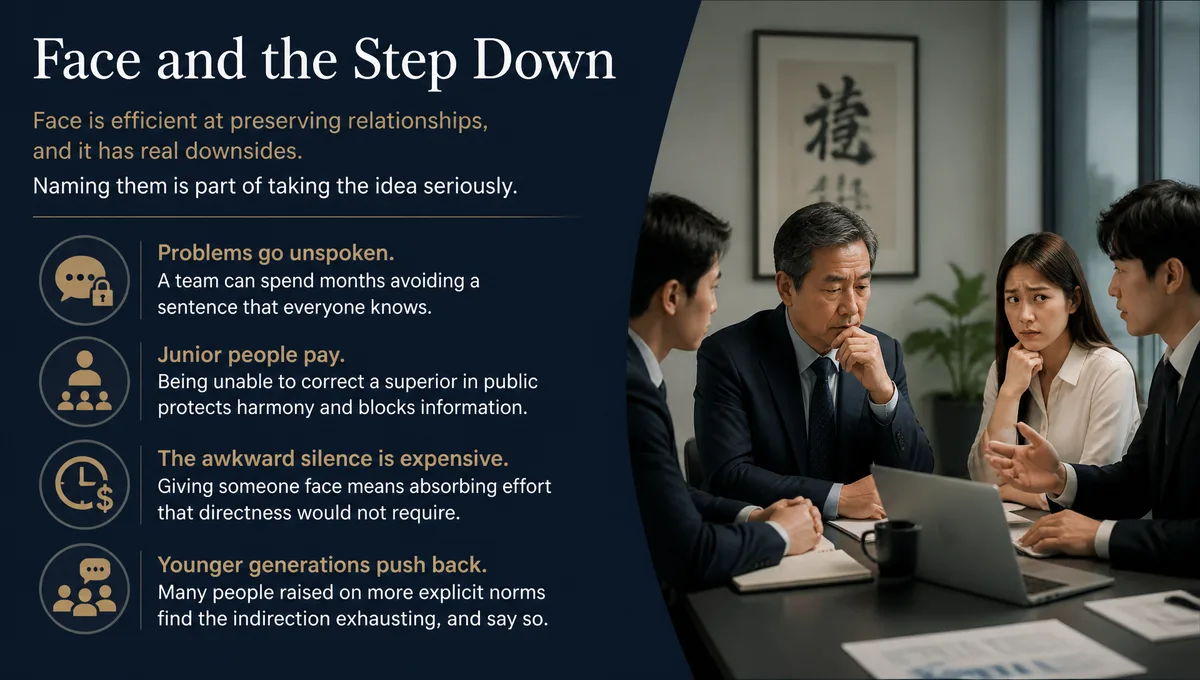
Face is efficient at preserving relationships, and it has real downsides. Naming them is part of taking the idea seriously.
- Problems go unspoken. A team can spend months avoiding a sentence that everyone knows.
- Junior people pay. Being unable to correct a superior in public protects harmony and blocks information.
- The awkward silence is expensive. Giving someone face means absorbing effort that directness would not require.
- Younger generations push back. Many people raised on more explicit norms find the indirection exhausting, and say so.
None of this makes the system irrational. It makes it a trade: smoother relationships in exchange for slower honesty.
Reading It as an Outsider
Four signals are worth learning if you work or live across the gap.
- Silence is not agreement. It often means the person has decided not to say the true thing yet.
- A compliment may be a request. Your son is so good at maths can be the opening of a favour.
- The word no arrives late. Expect it in the third conversation, not the first.
- Praise in public, correct in private. The reverse is read as an attack, whatever your intention.
If you are the one who needs a step down, ask a question that lets the other person supply it. In practice this sounds like I may have understood the timeline wrong — could you walk me through it? You have created the exit; most people take it.
When Giving Face Goes Too Far
There is a line, and Chinese speakers draw it too.
Giving someone a way out is a courtesy. Repeatedly covering for a person who keeps making the same mistake is something else. The test is simple: does the step down protect the relationship, or does it protect the mistake?
The same rule applies to receiving. A person who never allows a neutral explanation to stand is exhausting the patience that mianzi depends on. Face is a shared resource; it works because everyone keeps depositing into it.
Common Questions
Is face the same as saving face in English?
Partly. English saving face is usually about avoiding embarrassment. The Chinese concept is broader: it includes status that others actively grant, and it applies to groups as well as individuals.
Can a manager give face and still give feedback?
Yes, and the usual method is the private conversation. Public praise, private correction. Many Chinese workplaces run on exactly this split.
Do younger Chinese still care about face?
They care about it, and they question it more openly. Urban and international workplaces are gradually moving towards more explicit feedback, especially among people under thirty-five.
What is the Chinese phrase for a step down?
Tai jie, literally a step. Gei tai jie xia means to give someone a way out of an awkward position.
Is indirectness dishonest?
It is a different allocation of effort. Directness spends comfort to save time; indirectness spends time to save comfort. Both can be honest or manipulative.
The Argument That Ends Properly
The aim of this system is not to avoid the truth. It is to keep the relationship intact long enough for the truth to be useful.
That is why the tea gets poured, the topic gets changed, and the real conversation happens three days later on a walk. The disagreement is not cancelled. It is moved somewhere it can be survived.
More on how this culture handles time, loss and obligation sits in the wisdom section, including the proverbs about time and wu wei in daily decisions.