Wisdom4 min read
The Analects for Beginners: Three Lines to Start With
The Analects is not a system but a voice. What the book actually is, and three passages to read first — learning, the teacher in everyone, and the silver rule.
By Ming Chen — Editor & Researcher
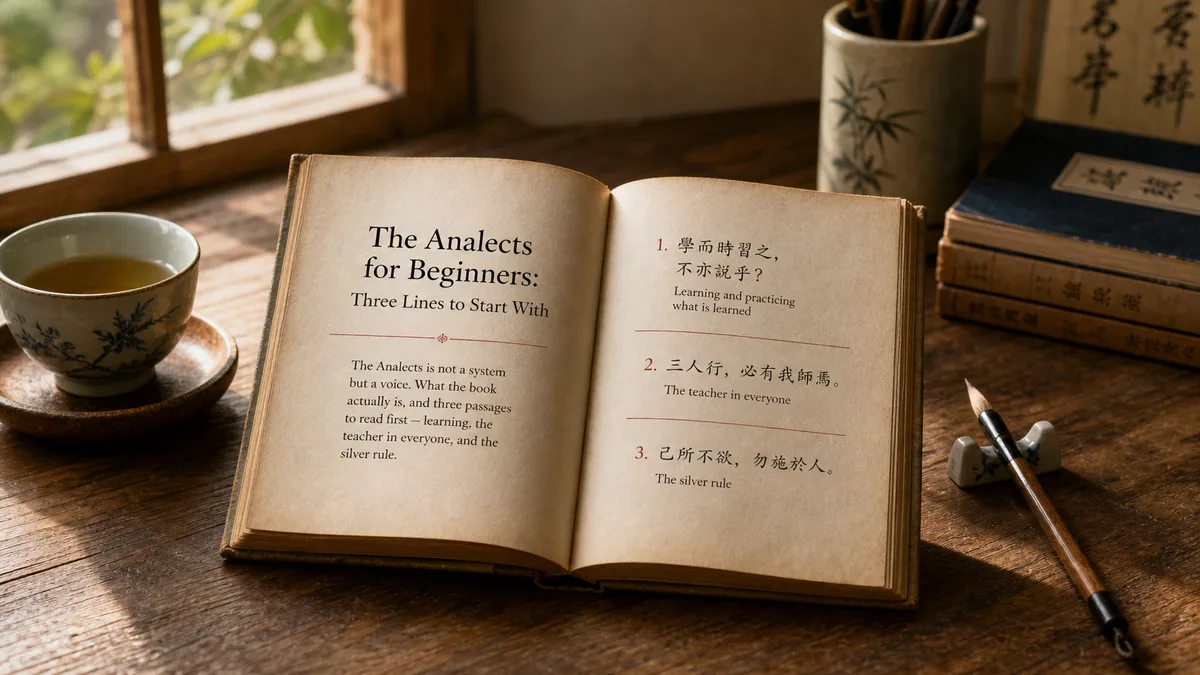
The Analects is the most famous book most people have never actually opened.
Everyone has heard of Confucius. Far fewer have read him, and the reason is not laziness. The book does not behave like other famous books. It has no plot, no argument, and no chapters that build on one another. It is a pile of short sayings and small scenes, and that is exactly what makes it worth opening.
What the Book Actually Is
The Analects (Lunyu) is a collection of the sayings and conversations of Confucius (Kongzi), recorded by his students and their students after his death.
It is arranged into twenty books, and those books are arranged into hundreds of short passages, some only a line long. A conversation may be three sentences. A teaching may be one.
There is no system to piece together, and the book never pretends otherwise. It is closer to a notebook of a teacher’s voice than to a philosophy written in a study.
Why It Reads Scrappy
Readers trained on Western philosophy often find the book disappointing at first. Where is the argument? Where is the definition?
The answer is that the Analects was never meant to be read as an argument. It is teaching remembered, not teaching organised. The voice matters more than the structure.
That is why the usual advice is the opposite of the usual advice: do not start at the beginning and read straight through. Dip in. The book was assembled that way, and it rewards reading that way.
Three Lines to Start With
Three passages give the flavour of the whole, and each stands alone.
On learning. The book opens with it: xue er shi xi zhi, bu yi yue hu — “To learn, and then to practise what one has learned, is that not a joy?” Notice the word practise. Learning is not finished when the page is closed.
On teachers. San ren xing, bi you wo shi yan — “When three walk together, one of them is bound to be my teacher.” The line runs both ways. Everyone has something to teach, and the honest learner takes the good in people and notices the bad in themselves.
On doing no harm. The line is ji suo bu yu, wu shi yu ren: do not do to others what you would not want done to yourself.
It is the negative version of the golden rule, and it is easier to keep than the positive one. It does not ask you to imagine what others want. It only asks you not to hand them what you yourself would refuse.
How to Read It
The practical method is uncomplicated.
Read one passage at a time. Let it sit. If a passage does nothing for you, move on — the book has hundreds more. If one lands, come back to it.
This is not a method the book merely tolerates. It is how the book was built. A student remembered one thing well; another remembered a different thing. The reader is doing the same.
The Person the Book Keeps Describing
One figure keeps reappearing, and knowing the name helps.
The junzi is often translated “gentleman”, which is too small a word for it. It means the person of genuine quality — not noble by birth but by conduct, and it is the person the Analects keeps describing in contrast to the small-minded person.
The book is not really a list of rules. It is a long portrait of that person, drawn one short scene at a time. That is why the fragmentary form works. You are not given a definition; you are shown the person, again and again, and asked to notice the difference.
What Not to Expect
Do not expect a rulebook. The Analects rarely hands down commands; it asks questions and describes the person who answers them well.
Do not expect a self-help manual either. The book is old, and its world is not yours. But the questions it keeps returning to — what do I owe other people, what is worth learning, how should I spend a life — have not gone anywhere.
Common Questions
Do I need to know Chinese history first?
No. A short introduction and a good translation are enough. The passages above read clearly without any background.
Which translation should I use?
Any modern, readable one. The differences between translations matter less for a first read than simply spending time with the text.
Is this related to the other Confucian texts?
Yes. The Analects is the central one. The Zhongyong, a shorter companion text, works the same idea of measure. And the practice of the three daily questions comes straight out of this book.
Why read a two-thousand-year-old book?
Because the questions it keeps are the ones that do not date. The answers may, but the asking stays useful.
Start With One Line
The best way into the book is not a reading plan. It is one line, read slowly, and then the next one.
For the other side of the same tradition, see Confucius at fifty. For the daily practice the book gave rise to, see the three questions.