Wisdom6 min read
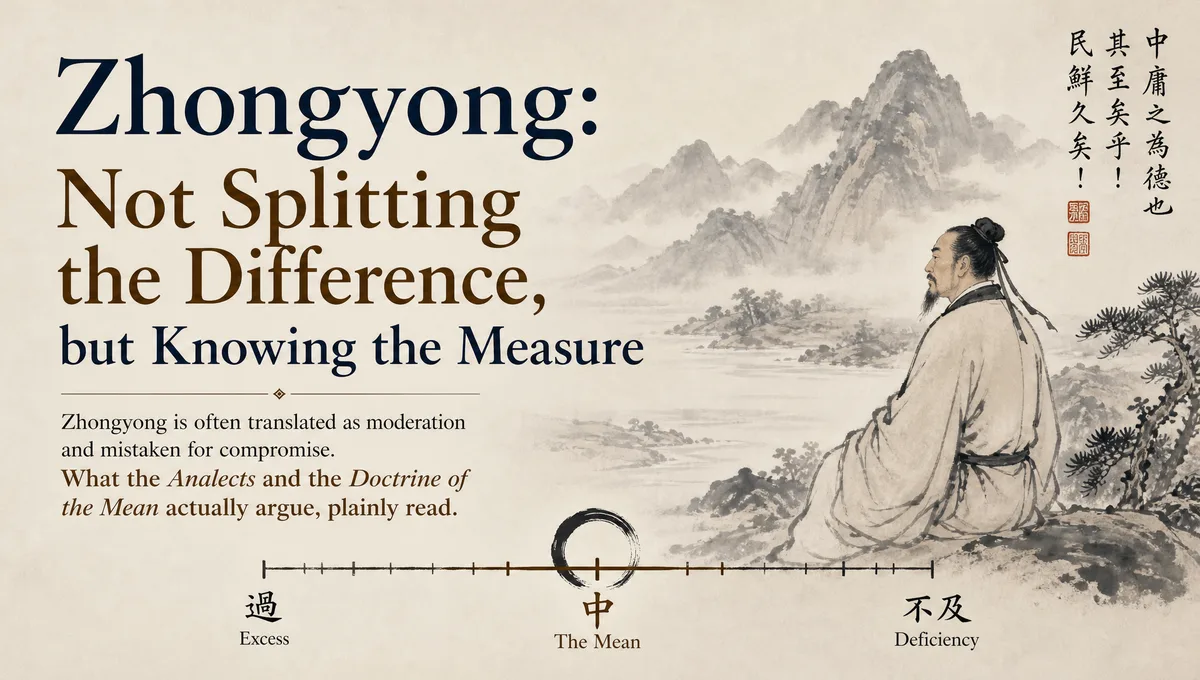
Zhongyong: Not Splitting the Difference, but Knowing the Measure
Zhongyong is often translated as moderation and mistaken for compromise. What the Analects and the Doctrine of the Mean actually argue, plainly read.
By Ming Chen — Editor & Researcher
Ask a Chinese speaker what zhongyong means and you will usually get one of two answers. The first is a compliment: steady, balanced, sensible. The second is a complaint: someone who never takes a side.
Both readings are old, and the second one is what the text spends its time arguing against.
Two Sources, One Word
The term appears in two places that later readers treat as one tradition.
- A short passage in the Analects (6.29), where Confucius says zhongyong as a virtue is of the highest order, and adds that it has long been rare among people
- A whole chapter of the Book of Rites, later treated as a separate book and known in English as the Doctrine of the Mean
The second text supplies the definitions that matter. It says: holding the two ends, use the middle for the people. It also describes the state before feeling arises as zhong, centred, and the state when feeling arises in due proportion as he, harmony.
Neither line is about averaging. Both are about fit.
What It Is Not
Three misreadings are worth clearing out first, because they are the ones that make the idea sound useless.
It is not splitting the difference. If two people want ten and zero, the average is five, and five may be exactly wrong. Zhongyong asks what the situation calls for, not what the midpoint is.
It is not passivity. The text is full of action: governing, serving a parent, dealing with friends. It is a set of instructions for doing things well, not for avoiding them.
It is not moral relativism. The measure is not “whatever works for you”. Confucian writing is confident that some responses are fitting and others are not, and that the difference can be judged.
The Measure Changes
The key phrase in the Doctrine of the Mean is shi zhong: being centred according to the time. The same quality that is right in one setting is wrong in another.
The book makes this concrete with a comparison. A person can be generous to the point of ruin, or thrifty to the point of meanness; both are the same virtue out of measure. The problem is not the virtue. The problem is the amount, and the amount depends on the circumstances.
Two more ideas follow:
- Appropriateness beats consistency. Doing the same thing in every situation is not a virtue; it is a habit that has stopped noticing the situation.
- The measure is learned slowly. Nothing in the text suggests this is easy. Confucius himself says the virtue is rare, and the Doctrine describes the ordinary person as overshooting or falling short almost all the time.
Our reading of three chapters of the Tao Te Ching arrives at a similar place from a different direction: knowing what is enough, and knowing when to stop.
How It Shows Up in a Life
The idea is abstract until it is applied, so here are four places it does visible work.
In a family argument. The fitting response is rarely the strongest true statement available. Our piece on face and the step down covers the mechanics of ending an argument without a verdict.
In work. A manager who gives the same feedback the same way to everyone is not being fair. The measure is the person and the moment.
In conversation. Knowing when to stop explaining is part of the skill. So is knowing when the other person actually wants the long version.
In your own week. Rest without guilt, and work without grinding, are both versions of the same judgement about amount. The slow kitchen makes the point with a pot of soup: the heat is right or it is not, and no average saves the dish.
A Western Parallel, and Its Limit
Readers often connect zhongyong with Aristotle’s doctrine of the mean. The resemblance is real: both locate virtue between extremes and both insist that the right amount depends on circumstances.
The difference is worth noticing too. Aristotle frames the mean as a quality of a person’s character, developed by habit. The Confucian text frames it as a way of holding a situation: two ends, one fitting response, and a strong emphasis on timing and relationship.
That difference shows up in practice. Where the Greek version asks what kind of person am I becoming, the Chinese version tends to ask what does this moment require of me.
Reading It Plainly Today
If you want something usable rather than a doctrine, take these three moves.
- Name both ends. What is the over-response here, and what is the under-response?
- Ask what the situation requires. Not what is fair in general; what is fitting now.
- Then do it fully. Zhongyong is not a half-measure. Once the fitting response is clear, it is carried out without apology.
The last point is where most modern readers stumble. Moderation in English suggests lukewarm. In this tradition, the fitting response can be firm, expensive and uncomfortable. What it cannot be is automatic.
Common Questions
Is zhongyong the same as the golden mean?
Close, but not identical. The overlap is the idea of a fitting amount between extremes. The difference is the emphasis on timing, relationship and the specific situation rather than on character formation.
Does it mean I should never take a strong position?
No. It means the strength of the position should match the situation. Some situations require a clear refusal, and the text would call a vague answer a failure of measure.
Who wrote the Doctrine of the Mean?
Tradition attributes it to Confucius’s grandson Zisi, and the received text was edited into its present form much later, in the Han period. Like most classical Chinese books, it is a layered document.
Is it a religious idea?
It is discussed both as ethics and, in later Confucian writing, as a metaphysical claim about how the world is ordered. For everyday use, the ethical reading carries most of the weight.
What is the Chinese phrase for knowing when to stop?
Zhi zhi. It appears in the Tao Te Ching rather than the Analects, and it is the practical cousin of this idea.
The Measure, Not the Middle
Zhongyong is easy to mock when it is read as fence-sitting, and it deserves better. It is a discipline of judgement: two ends in view, one fitting response, chosen fresh each time.
That is also why Confucius says the virtue is rare. Anyone can pick the middle of a range. Knowing the measure for this situation, with these people, today, is a skill that takes a lifetime and still misses sometimes.
More classical reading sits in the wisdom section, including wu wei in daily decisions, proverbs about time and what Confucius meant about fifty.