Wisdom7 min read
Chinese Proverbs About Time: One Says Rush, One Says Don't
An inch of time is an inch of gold, yet another proverb says not to hurry. What Chinese sayings about time mean, and which to keep.
By Ming Chen — Editor & Researcher
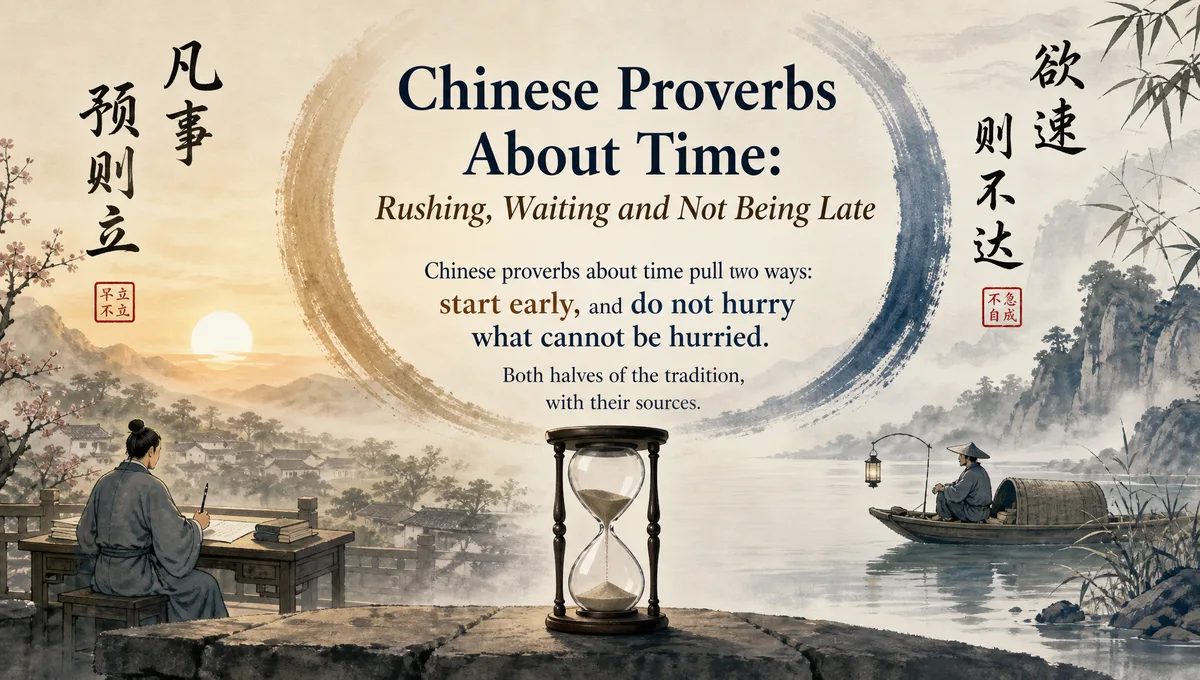
Ask a Chinese grandparent for advice about time and you may get two answers that cancel each other out.
Start early. Do not hurry.
Both come from proverbs, and both are quoted with the same confidence. The tension is not a contradiction. It is the main thing the tradition has to say.
Two Instructions, One Tradition
The sayings divide neatly into two families.
The first family pushes. It says time is scarce, mornings matter, and delay has a price.
The second family pulls. It says some things take the time they take, and forcing them ruins the result.
Together they form a rule that is easy to state and hard to follow: hurry the beginning, not the middle. Begin when the season opens. Then leave the pot alone.
The Rushing Half
Start with the pushing sayings, because they are the ones people quote most.
An inch of time is an inch of gold (yi cun guang yin yi cun jin). The line appears in the Zengguang Xianwen, a Ming-dynasty collection of popular sayings. Gold can be earned again. The hour cannot be bought back.
A year’s plan begins in spring; a day’s plan begins at dawn (yi nian zhi ji zai yu chun, yi ri zhi ji zai yu chen). This is agricultural advice before it is moral advice. If the planting is late, the harvest is late, and no amount of effort in August fixes it.
Rise early and light three things; rise late and rush three ways (zao qi san guang, wan qi san huang). The image is domestic: water, fire, the day’s first chores. Get up ahead of the day and everything falls into place. Get up behind it and you spend the morning catching up.
If you are young and do not work, you will grieve when you are old (shao zhuang bu nu li, lao da tu shang bei). The line comes from a Han-dynasty song, the Changge Xing, and it is the most quoted warning about deferral in the language.
Tomorrow, and tomorrow, and how many tomorrows there are (ming ri fu ming ri, ming ri he qi duo). A Ming poem by Qian Fu about the man who puts everything off until the next day. It is a poem children still memorise.
Read as a group, these sayings share an assumption. Effort has a season. Time spent now buys a result later, and the trade can only be made in one direction.
The Not-Rushing Half
Then there is the other family, which is just as old.
Haste defeats the purpose (yu su ze bu da). The line is from the Analects of Confucius, and it is a warning about method rather than about speed. A job done too fast misses its own requirements.
Pulling up a seedling to help it grow (ya miao zhu zhang). From Mencius, and one of the sharpest stories in Chinese writing. A farmer thinks his crop is growing too slowly. He walks the field and pulls each seedling up a little, then goes home tired and proud. In the morning the crop is dead.
Slow work produces careful work (man gong chu xi huo). The saying is used about embroidery, carpentry, ceramics and cooking, and it is not a compliment for laziness. It says that fine results have a floor on the time they need.
When the melon is ripe, the stem lets go (gua shu di luo). Ripeness arrives when the conditions are complete, not when the schedule says so.
An impatient person cannot eat hot tofu (xin ji chi bu liao re dou fu). Not philosophy, just a table truth: rush the hot dish and you get burned.
Why Both Halves Are True
The sayings are not in conflict once you notice what each one describes.
The first family is about starting. Beginnings are cheap to move and expensive to delay. Preparing soil, opening a book, beginning a fitting appointment: all of these respond to urgency.
The second family is about finishing. Growth, recovery, fermentation, learning and craft do not. They have their own rate, and pressure does not change it.
One more idea from the tradition supports the same point. In the Zhuangzi, usefulness is often the ability to stop working at the right moment. Our guide to wu wei follows that thread. The same patience shows up in the story of the old man at the frontier. Its point is that nobody can yet tell whether an event is good or bad.

Time as a Season, Not a Line
Western proverbs tend to picture time as a container or a line. You spend it, waste it, save it, lose it. The clock is the standard metaphor.
The older Chinese picture is more mixed. Alongside the warnings about lost hours sits a calendar of twenty-four solar terms, which treats the year as a loop of predictable turning points. Our guide to the solar terms describes the system. Farmers waited for the term, not for a date they had chosen.
That is why the same tradition can insist that time is precious and that fruits fall when they fall. Preciousness applies to the decision. The natural rate applies to the work.
What the Proverbs Leave Out
Two caveats are honest to state.
First, these sayings come from agrarian and craft households. Their assumptions fit some lives better than others. A crop does not care whether you are tired. A shift worker on a night schedule hears “rise early” differently, and the proverb is not built for that schedule.
Second, proverbs are compressed. They are useful for remembering and useless for analysis. “Slow work produces careful work” says nothing about which tasks deserve the extra hours. That judgement stays yours.
Using Them Without Pretending
If you want something practical from the two families, try this division.
Decide fast. Set the start date, buy the ticket, send the message, open the document. The pushing sayings are for this part, and they are right about it.
Finish slow. Once the work has begun, protect the middle from your own impatience. Sleep on the draft. Let the glaze dry. Give the reader the extra day.
“An inch of time is an inch of gold” and “haste defeats the purpose” can both be true on the same day. One governs the decision to sit down. The other governs what you do once you have.

Common Questions
What is the most common Chinese proverb about time?
“An inch of time is an inch of gold” is probably the most quoted. It is short, it rhymes, and everyone learns it at school.
Does “haste defeats the purpose” mean I should never hurry?
No. The saying is about method. A process cannot be compressed past the point where its own steps are complete.
Are these sayings religious?
Most of them are not. They come from proverbs collections, poetry, and the small philosophical books of the classical period. Some overlap with Buddhist and Daoist writing, but the popular versions are practical rather than devotional.
Which one should I apply to learning something new?
Both, in order. Start the practice today, then let the skill arrive on its own schedule. Our piece on proverbs about growing older makes the same point about late beginnings.
Is “one day at a time” the same idea?
It is close. The Chinese family of sayings is more interested in when to hurry than in denying that hurry is ever useful.
Two Hands on the Same Clock
Taken together, the proverbs are not advice about speed at all. They are advice about which part of a task is yours to control.
Begin on time. Then get out of the way. That is the whole instruction, and it has survived for two thousand years because the middle of a task is exactly where people get impatient.
More of this kind of thing sits in the wisdom section, including the Dao De Jing for beginners if you would like the philosophical version of the same lesson.