Wisdom6 min read
Fifty and Knowing Heaven's Mandate: Reading Confucius's Own Timeline
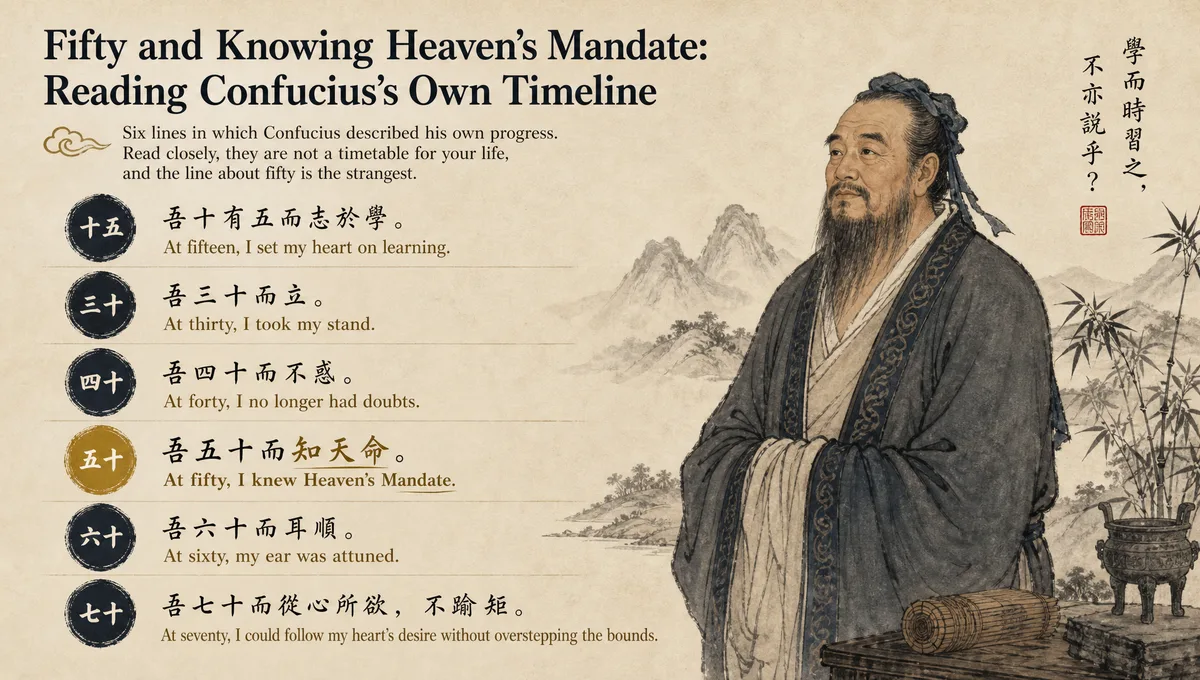
Six lines in which Confucius described his own progress. Read closely, they are not a timetable for your life, and the line about fifty is the strangest.
By Ming Chen — Editor & Researcher
No sentence about turning fifty is quoted more often in Chinese, and no sentence is put to more misleading use.
It appears in birthday speeches and on book covers, almost always as encouragement. At fifty you will understand. What the original says is narrower, odder and more useful than that.
The Passage
The line is in the Analects, book two, chapter four. Confucius is speaking about himself, in six clauses:
At fifteen I set my mind on learning. At thirty I stood on my own feet. At forty I was no longer in doubt. At fifty I understood the mandate of Heaven. At sixty my ear was attuned. At seventy I could follow what my heart wanted without stepping over the line.
That is the whole passage. It is the only place in the Analects where Confucius describes his life as a sequence of stages. Everything else we know about him comes from what his students wrote down.
Six Lines About One Man
Read as a schedule, the passage is oppressive. Read as an autobiography, it is something else.
He says wu (I). Not ren (people). Nowhere does he suggest that the ages apply to anyone else, or that the stages arrive on time.
He was old when he said it. By the traditional reckoning he died at seventy-three, so the sentence is a retrospective, delivered from the far end. The last stage he names lasted three years.
The numbers are round. Fifteen, thirty, forty, fifty, sixty, seventy — the shape of a life as a person remembers it, not a measurement.
What later tradition did with these six clauses is the problem. They became a curriculum, then a checklist, then a source of quiet worry for anyone who reached fifty without a settled sense of purpose. None of that is in the text.
What a Mandate Is
Tianming (the mandate of Heaven) is a compound. Tian is Heaven, and ming is a command, a charge, or a fate — the word carries all three.
In early use the phrase was political. The mandate of Heaven was what legitimised a dynasty, and losing it explained why dynasties fell. Confucius uses the same word for something more personal and harder to pin down.
The two layers that matter for the passage are these. First, a mandate is what you are for: the work a life is meant to do. Second, a mandate is what you are given, which includes what you are not given. Knowing it means accepting the boundary as well as the task.
Confucius is confident elsewhere that Heaven is on the side of the moral order. He says that Heaven gave him his character, and that Heaven is the only one who knows him. What he does not claim is that Heaven tells him what will happen.
The Year It Happened
The timing is worth noticing, because it is not the timing of success.
By the traditional chronology, Confucius was about fifty-one when he took his first serious official post, as magistrate of Zhongdu in his home state of Lu. Within a few years he was in charge of public works, then of justice. By 500 BCE he was representing Lu at a diplomatic meeting with the neighbouring state of Qi.
He was fifty-five when he left Lu for fourteen years of travel, having failed to reform the government he served. Which is to say: the insight came before the failure, not after it, and did not spare him the failure.
Anyone who reads “at fifty I understood” as a promise that the second half gets easier should look at what the second half actually contained.
What the Line Does Not Say
It does not say he was content. The word is zhi, to know — a cognitive claim, not an emotional one.
It does not say he had finished. The very next clause describes work still ahead: at sixty, his ear was attuned. If anything, the sequence implies that hearing took another ten years to settle.
And it does not say the knowing was permanent. The Analects is a record of a man still revising his positions late in life, still asking for more time to study.
Reading It at Fifty
Three uses, in order of practicality.
Separate what is still yours from what is not. This is the plain content of zhi ming (knowing the mandate). Some things at fifty are decisions you have not made yet. Others are settled, and the energy spent arguing with them is the expensive kind. Telling the two apart is a skill, and it is the one the passage is actually about.
Do not take the checklist personally. If you are fifty and cannot name your purpose in one sentence, you have not failed a test. The test was invented by people quoting this passage badly.
Notice where the sequence ends. Not at achievement. It ends with cong xin suo yu, bu yu ju — doing what the heart wants without stepping over the line. That is a description of ease, and it took the author until seventy.
One more detail sits next to the passage and complicates it. In another chapter, Confucius asks for a few more years to study the Book of Changes, and adds that with them he could avoid major mistakes. Commentators disagree about how to read the number there, but the wish is plain: at fifty-something, learning was not finished, and he knew it.
Common Questions
Is tianming the same as fate? Partly. Fate is the half about what you will not get. The other half is about what you are for, and it is the half people skip.
Was Confucius claiming to be a sage? No. Elsewhere in the Analects he explicitly declines the label, and says that what he has is a love of learning. The passage is a report of progress, not a claim of arrival.
What does er shun mean? Literally “the ear follows”. Older English versions render it as an obedient organ, which is both ugly and imprecise. The sense is closer to hearing what is said without immediately arguing with it.
Was fifty a retirement age in old China? No. Later codes set retirement at seventy, and Confucius himself was still travelling and teaching into his late sixties.
Does this apply to women? The passage describes one man. Its use on this site is as a mirror rather than a rule, and a mirror does not care who looks into it.
Why is it quoted so much at birthdays? Because the first three clauses make a tidy toast, and the last three get left out. The last three are the interesting ones.
A Timetable You Did Not Sign
You are not Confucius, and the passage was not addressed to you. That is exactly why it is worth reading.
Take the half that is usable: know what you are for, and know what you will not get. Leave the half that was never there — the idea that this was supposed to happen by a particular birthday, on schedule, to everyone.
If the mirror is useful, two others on this site hold it up in different ways. The doctrine of the mean is about not going too far in either direction. The habit of self-examination is about the daily version of the same question. For the longer view of age in Chinese writing, start with proverbs about growing older. More sits in the Culture section.