Wisdom6 min read
Three More Chapters of the Tao Te Ching: 8, 11 and 44
Chapters 8, 11 and 44 of the Tao Te Ching in plain English: water, empty space and knowing when to stop, with the older manuscript variants.
By Ming Chen — Editor & Researcher
The Tao Te Ching is eighty-one short chapters, and most readers meet it as a book of moods. A line lands, you nod, and the next page drifts past.
A better way in, at least for a first serious pass, is to read a few chapters closely and let them argue with each other. This piece takes three that do exactly that: chapter 8 on water, chapter 11 on empty space, and chapter 44 on knowing when to stop.
Why These Three
They are short, they are concrete, and they cover the three moves the book keeps making.
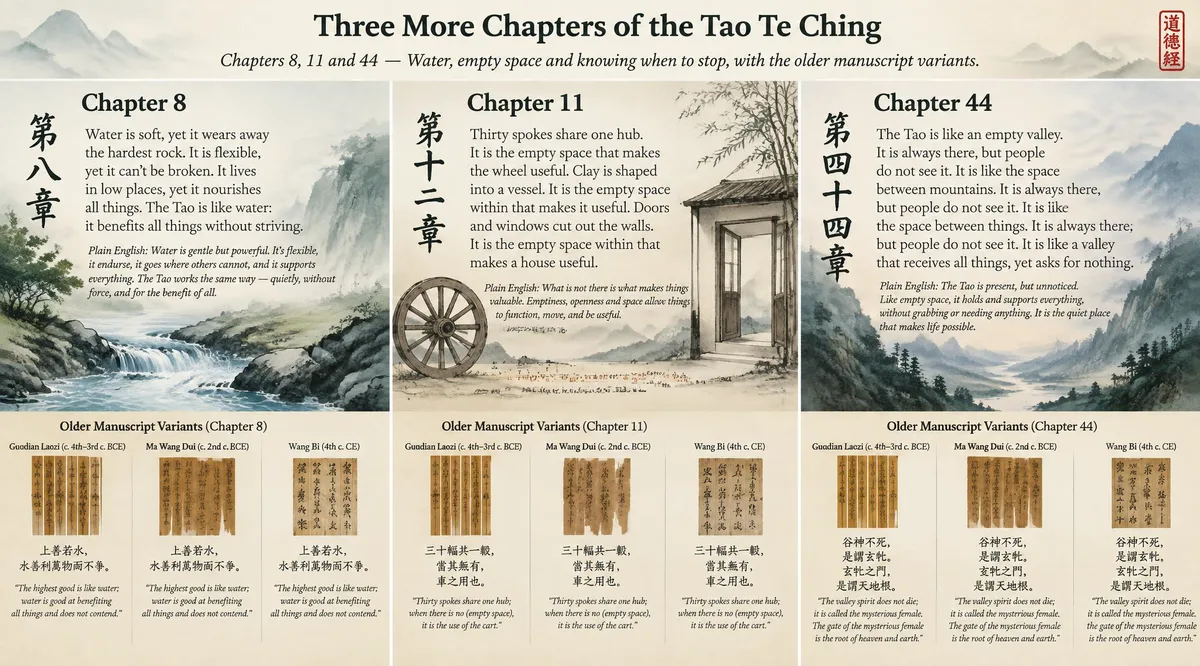
- Chapter 8 describes a way of acting: yield, work, do not compete
- Chapter 11 describes a way of building: the useful part is the gap
- Chapter 44 describes a way of stopping: know what is enough
Read together, they answer a question that comes up in ordinary life at fifty, sixty and beyond: how much of my effort is producing something, and how much is just me pushing?
Chapter 8: The Highest Good Is Like Water
The chapter opens with a line almost every Chinese reader knows.
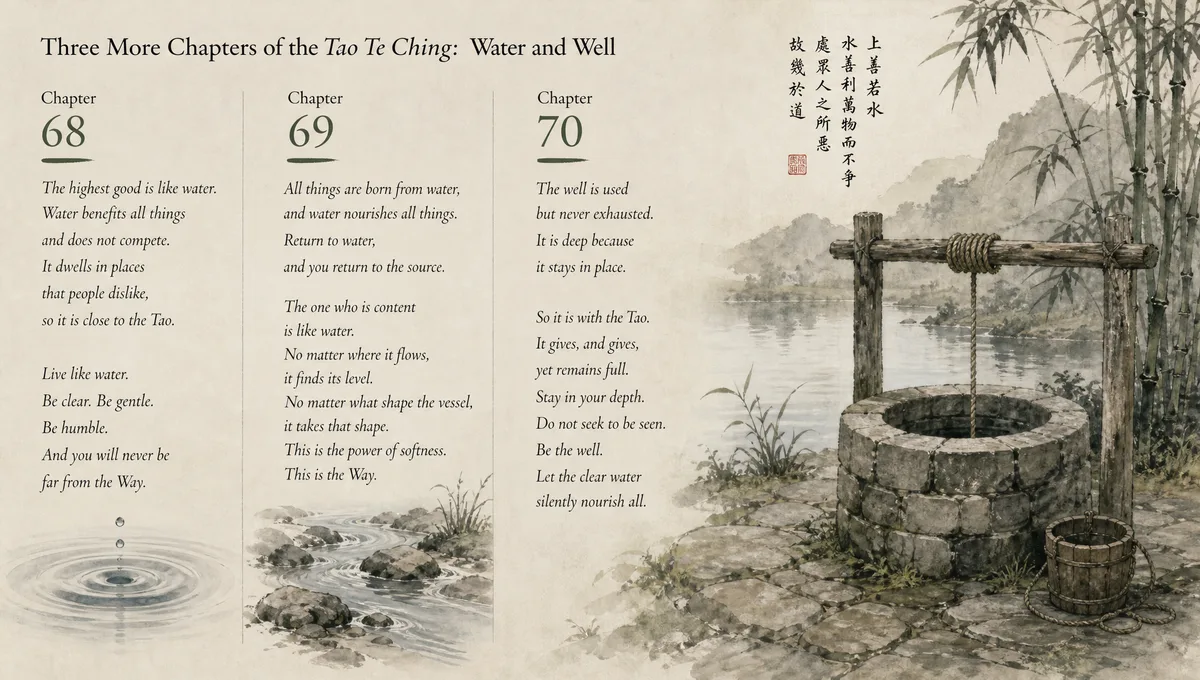
The highest good is like water. Water benefits the ten thousand things and does not contend.
Then it does something unusual for a wisdom text. Instead of elaborating, it lists seven ways to be like water:
- In dwelling, keep to the low ground
- In mind, keep to the deep
- In giving, keep to warmth
- In speech, keep to truth
- In order, keep to good governance
- In work, keep to competence
- In action, keep to the season
The list is practical and almost administrative. Water is not praised for being soft in the abstract. It is praised for going where it is needed, doing the work, and not turning the work into a contest.
The closing line is the hinge: because it does not contend, it is not blamed. Our earlier piece on the Tao Te Ching for beginners goes through the book’s shape; the wu wei guide follows this same idea into daily decisions.
Chapter 11: The Space Is the Useful Part
Chapter 11 turns to objects, and it makes a point that still surprises people.
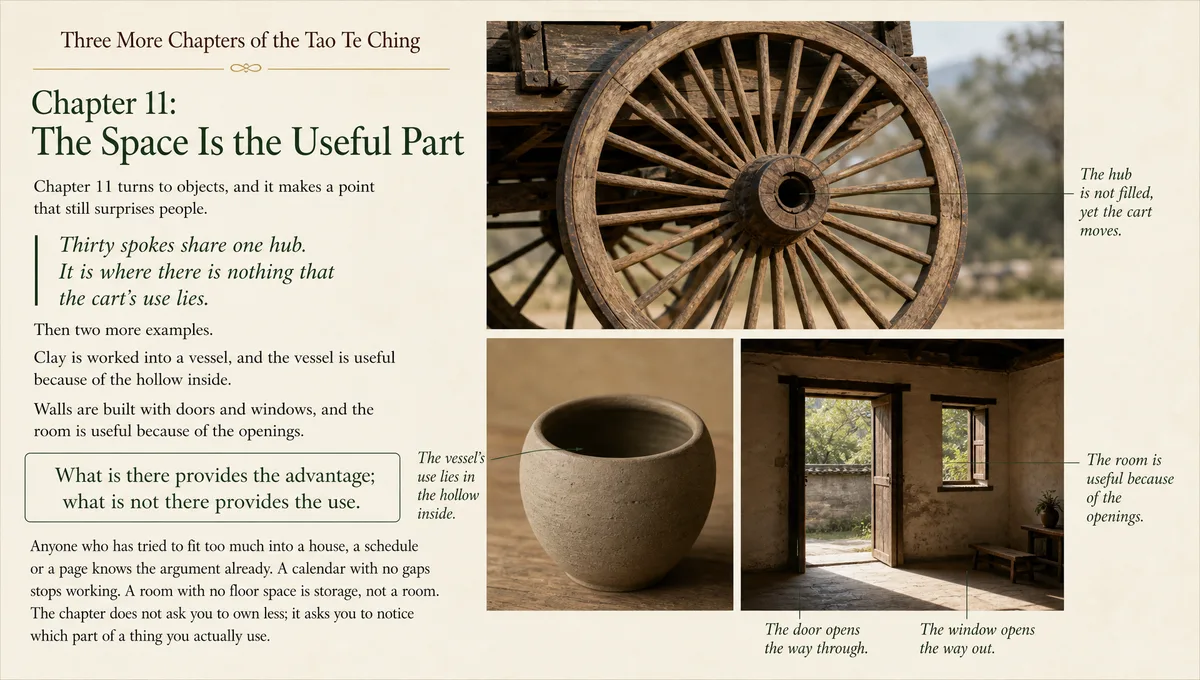
Thirty spokes share one hub. It is where there is nothing that the cart’s use lies.
Then two more examples. Clay is worked into a vessel, and the vessel is useful because of the hollow inside. Walls are built with doors and windows, and the room is useful because of the openings.
The last line states the rule: what is there provides the advantage; what is not there provides the use.
Anyone who has tried to fit too much into a house, a schedule or a page knows the argument already. A calendar with no gaps stops working. A room with no floor space is storage, not a room. The chapter does not ask you to own less; it asks you to notice which part of a thing you actually use.
Chapter 44: Know When to Stop
Chapter 44 asks three blunt questions.
Fame or your own self: which is closer? Your self or your goods: which is more? Gain or loss: which is the trouble?
The answers are not given, because the reader is meant to notice that the questions are uncomfortable. Then the chapter supplies its conclusion in two lines that read like a proverb:
Know what is enough and you will not be disgraced. Know when to stop and you will not be in danger, and you may last a long time.
Two words carry the weight. Zhi zu, knowing enough, is about appetite. Zhi zhi, knowing to stop, is about timing. The first is a matter of taste; the second is a matter of judgement, and it is the harder of the two.
Our piece on proverbs about time reaches a similar place from the other direction: the trouble is rarely starting too late, and often finishing too late.
How the Manuscripts Differ
The familiar eighty-one-chapter text was not the only version in circulation.
- In 1973, silk manuscripts from Mawangdui were excavated, dating to around 200 BCE, with the De half placed before the Dao half
- In 1993, bamboo slips from Guodian in Hubei were found, about 800 characters, roughly 300 BCE, and they contain no chapters 8, 11 or 44 in the form quoted above
That last detail matters. The Guodian slips show that the book was still forming, and that some of the chapters people quote most confidently belong to a later layer. It does not make the received text wrong. It makes it a historical document rather than a revelation.
Reading It Without the Varnish
Three habits help, and none of them require any belief about the author.
Read the concrete image first. Water, spokes, clay, a doorway. Each chapter starts with something you can picture, and the abstraction comes second.
Watch the verbs. The book is more interested in how to act than in what to think: dwell, give, speak, stop.
Keep the contradictions. The text is inconsistent on purpose. It praises usefulness and then praises being useless. Both are true at different moments, and the reader is expected to hold them.
Common Questions
Who wrote the Tao Te Ching?
Tradition names Laozi, but the text is clearly composite, and the manuscripts suggest multiple hands and layers over one or two centuries. Reading it as one person’s doctrine creates problems the text itself does not have.
Is it a religious book?
It became one, in organised Taoism, and it is also read as philosophy and as poetry. For a general reader, the plain sense of the chapters tends to be more useful than the ritual framing.
Which translation should I use?
More than one, and it helps to read two side by side. Short texts invite interpretation, so differences between translations often reveal the translator’s choices rather than the Chinese.
Is chapter 11 really about empty space in buildings?
It is about function in general, using objects as examples. The household version is the easiest one to test in your own week.
What does wu wei mean here?
Not passivity. The phrase means acting without forcing: doing what the situation allows, and not adding effort that turns work into conflict. Chapter 8’s water is the image for it.
One Book, Three Instructions
Taken alone, each of these chapters sounds like advice. Taken together, they form a small system: act like water, leave the gap open, and stop before the situation forces you to.
That is also a fair description of what the text is for. Not a doctrine to accept, but a set of moves to practise — which is why readers return to it at different ages and find different chapters waiting.
More of this kind is in the wisdom section, along with the Zhuangzi parables for readers who prefer stories to maxims.