Wisdom6 min read
Zhuangzi and the Tree Nobody Cut Down
Zhuangzi's useless tree survived because no carpenter wanted it. What the parable actually argues, and why it is not a case for laziness.
By Lian Zhao — Copy Editor
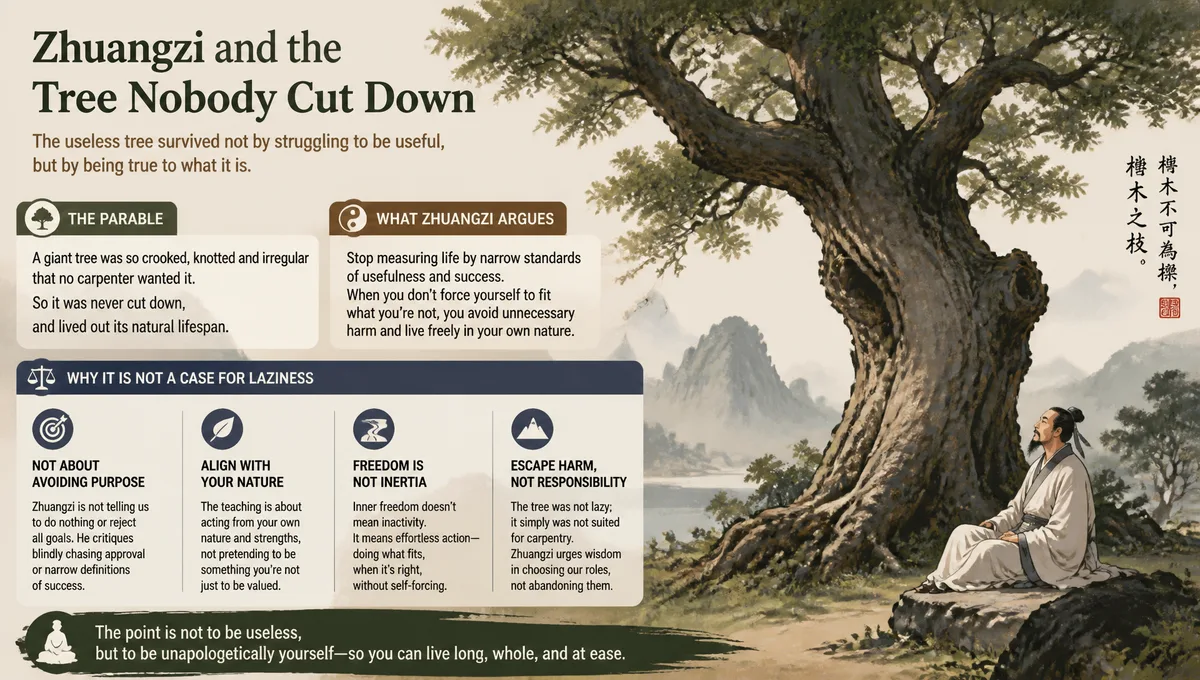
There is a tree in the Zhuangzi that survives for one reason. Nobody can think of a use for it.
A carpenter walks past it, does not even turn his head, and explains why. The wood is good for nothing: a boat made from it would sink, a coffin would rot, a door would warp, a pillar would fill with beetles. To be that useless, he says, is why it has lived so long.
That is the setup. What the story actually argues is stranger than the slogan people take from it.
Three Parables, One Question
The theme of usefulness runs through the book in at least three places, and they do not agree with each other neatly.
- In the world of men (Renjian Shi), the great oak at a village shrine is useless, and survives
- In free and easy wandering (Xiaoyaoci), a huge gourd is useless for holding water, and a gnarled tree is useless for timber
- In the mountain tree (Shanmu), a mountain tree is spared for being useless, and then a goose is killed for being unable to honk
The third one is the joke, and the whole point of this piece.
The Oak at the Shrine
The oak is enormous. Its canopy shelters thousands of cattle; a hundred men could stand under it. The carpenter Shih passes by without stopping, and when his apprentice asks why, he delivers the list of failures above and moves on.
That night the tree appears to him in a dream and argues back. The tree points out that useful trees are the ones that get taken: pear, pear-apple, orange, pomelo, the fruit trees are stripped and broken for their fruit. The useful ones, the tree says, do not reach the age it has reached.
The tree is not claiming to be superior. It is making a narrower claim about survival: being wanted is expensive.
The Gourd and the Gnarled Tree
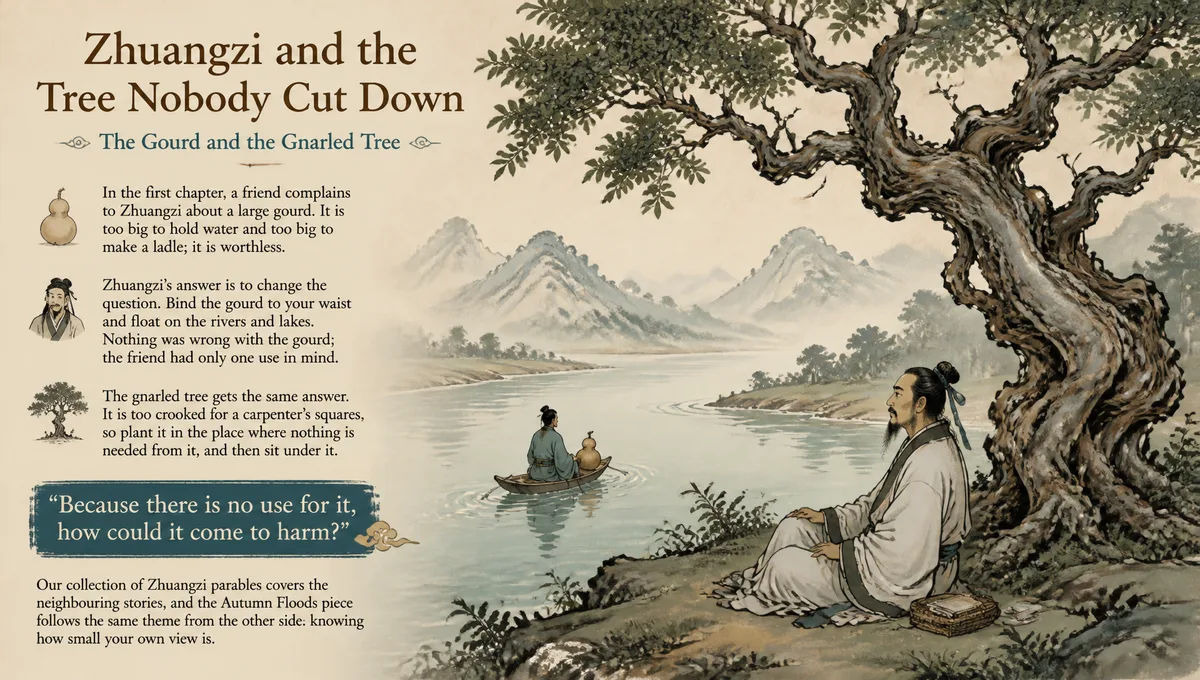
In the first chapter, a friend complains to Zhuangzi about a large gourd. It is too big to hold water and too big to make a ladle; it is worthless.
Zhuangzi’s answer is to change the question. Bind the gourd to your waist and float on the rivers and lakes. Nothing was wrong with the gourd; the friend had only one use in mind.
The gnarled tree gets the same answer. It is too crooked for a carpenter’s squares, so plant it in the place where nothing is needed from it, and then sit under it. The chapter ends on the phrase that readers remember: because there is no use for it, how could it come to harm?
Our collection of Zhuangzi parables covers the neighbouring stories, and the Autumn Floods piece follows the same theme from the other side: knowing how small your own view is.
The Goose That Ruined the Clean Answer
Then the book plays its best trick on the reader.
Zhuangzi is walking in the mountains and sees a tree too useless to fell. He remarks that this tree survives by being useless. Later, at a friend’s house, the host wants to kill a goose for dinner and asks which one. The servant answers: the one that cannot honk.
The next day a student puts the two events together. The mountain tree survived by being useless. The goose died for being useless. Which position should a person take?
Zhuangzi laughs and says: I would take a place between useful and useless. Then he immediately admits that this, too, is unstable, and carries its own entanglements.
That admission is the real teaching. There is no rule about usefulness that keeps you safe, because usefulness is set by whoever needs something that day.
What the Story Does Not Say
Two misreadings are common enough to be worth naming.
It is not an argument for being idle. The oak was not lazy; it grew slowly for a long time. The point is about being wanted, not about doing nothing. Zhuangzi’s own life, as far as we know it, was full of argument, teaching and travel.
It is not a rule that useless always wins. Chapter to chapter, the book keeps flipping the outcome. The reliable reading is the one Zhuangzi gives the student: the categories are unstable, so keep some distance from the category.
Reading It at Sixty
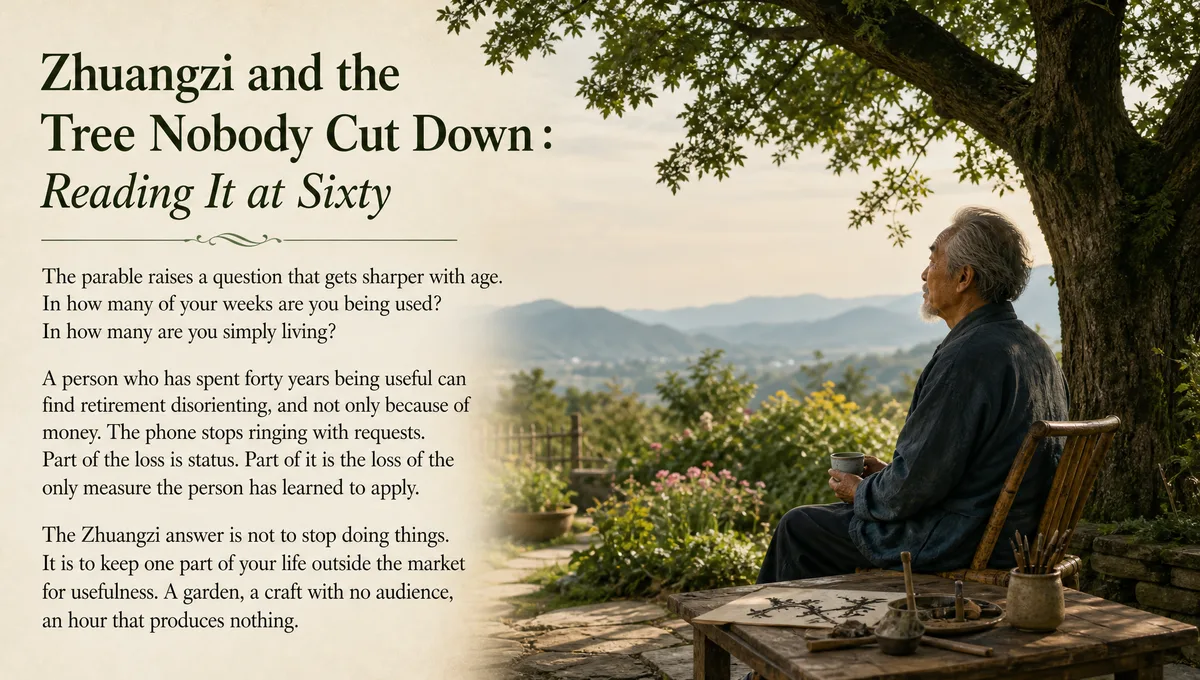
The parable raises a question that gets sharper with age. In how many of your weeks are you being used? In how many are you simply living?
A person who has spent forty years being useful can find retirement disorienting, and not only because of money. The phone stops ringing with requests. Part of the loss is status. Part of it is the loss of the only measure the person has learned to apply.
The Zhuangzi answer is not to stop doing things. It is to keep one part of your life outside the market for usefulness. A garden, a craft with no audience, an hour that produces nothing.
Common Questions
What is the Chinese phrase for “useless”?
The word in these stories is wu yong, no use. The related idea the book turns over is yong zhi yong, the use of the useless: the value of what no one is currently asking you for.
Which Zhuangzi chapter is the tree in?
The great oak and the carpenter appear in Renjian Shi, the fourth chapter. The gnarled tree and the large gourd are in Xiaoyaoci, chapter one. The mountain tree and the goose are in Shanmu, chapter twenty.
Is this the same as “idleness for its own sake”?
No. The argument is about who gets to define your value, not about the value of doing nothing. Our wu wei guide takes the practical side of that question.
What does “between useful and useless” mean?
It means refusing to settle into either category, and accepting that this refusal is itself imperfect. Zhuangzi says as much in the same sentence.
Where should a modern reader start with the Zhuangzi?
With the short parables, not the long arguments. Chapter one and chapter four are the usual doors.
The Tree Is Still Standing
The story survives because it cuts against the grain of every résumé and every family expectation. It does not say that usefulness is bad. It says that a life measured only by usefulness will eventually be harvested.
The tree, being no good to anyone, was left alone. That is the joke, and after a certain age it stops being funny and starts being practical.
More classical reading sits in the wisdom section, including the proverbs about time and the Three More Chapters of the Tao Te Ching.