Wisdom8 min read
Zhuangzi's Autumn Floods: the River God Who Had Never Seen the Sea
Autumn Floods opens with a flooded river and ends with an argument about a fish. It gave Chinese three everyday idioms — and a quieter way to hold your limits.
By Lian Zhao — Copy Editor
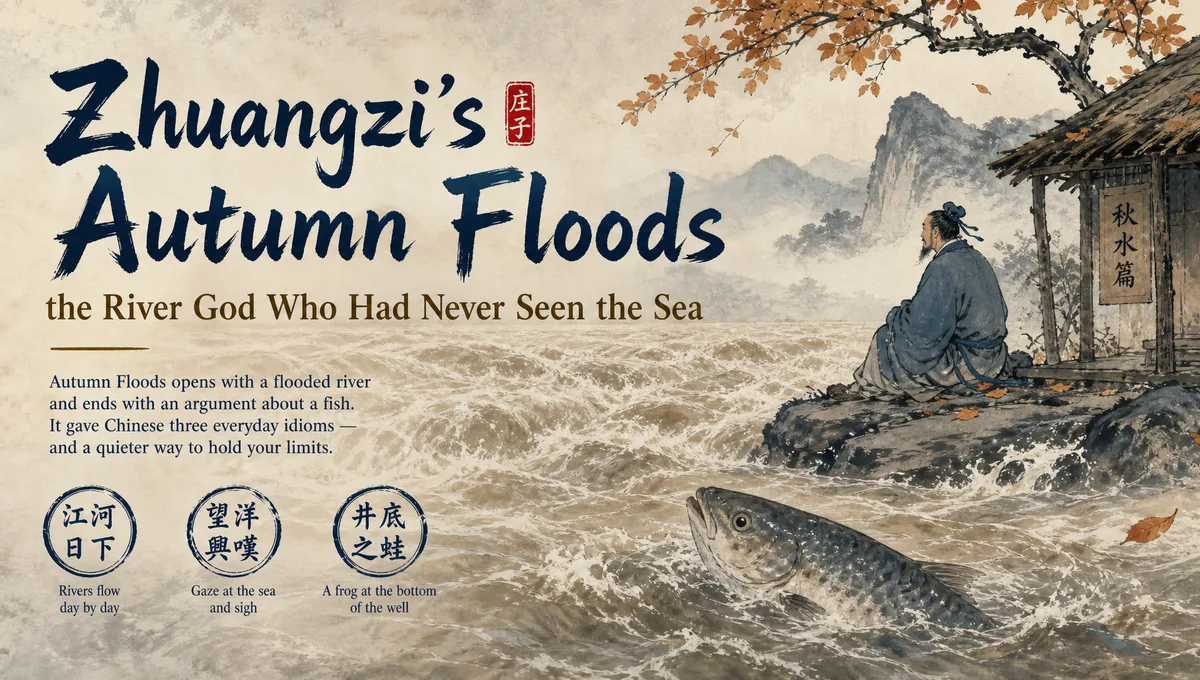
Autumn on the Yellow River is a season of water.
The rains arrive, the tributaries fill, and the river rises until the far bank turns into a blur. Chinese farmers watched this happen every year for thousands of years. It is written into the calendar of solar terms as a named part of the year, not as a disaster, but as an appointment.
One chapter of the Zhuangzi opens with that flood. It is the seventeenth chapter, part of the Outer Chapters, written down in something close to its present form more than two thousand years ago. It is also, by common agreement, one of the funniest things in Chinese philosophy.
It begins with a river god who is having a very good day.
A Flood, Not a Metaphor
“When the autumn flood came, all the hundred streams poured into the Yellow River.”
That is the first line. The water grows so wide that from one bank you cannot tell a cow from a horse on the other side. The old Chinese is exact about this detail. It is not a poetic image of bigness. It is a description of an actual river in an actual month.
This matters for reading the chapter. The Zhuangzi is often treated as pure fable, and it is full of talking animals and arguing philosophers. But this opening is a report. Autumn flooding was the largest annual event in the landscape of northern China, and everyone who first heard this story had seen it.
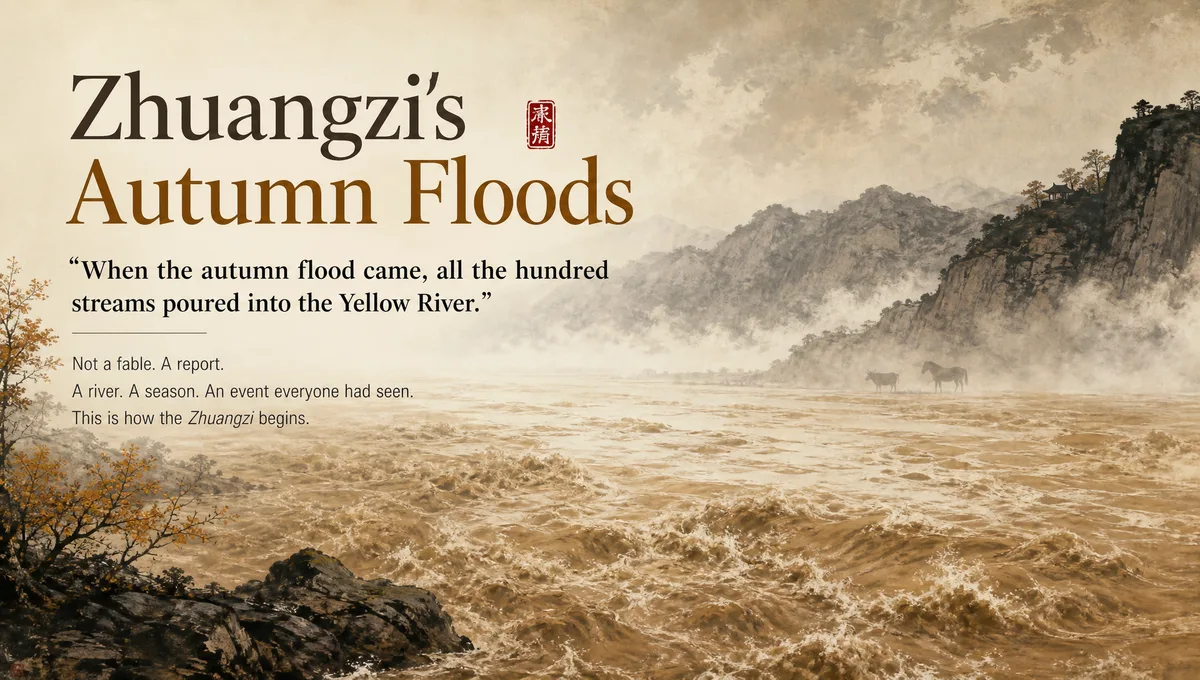
The chapter takes that physical fact and asks a philosophical question with it. How big is big?
The River God’s Good Mood
The god of the river, He Bo, looks at his own water and concludes that all the beauty in the world has gathered in him. Then he sails downstream, pleased with himself.
It is easy to read this as a lesson about vanity. The chapter is gentler than that. He Bo is not a fool. He has simply never seen anything larger, because nothing larger has ever come to him. His mistake is one of measurement, and it is not yet a moral failing.
Then he reaches the North Sea.
He looks east and sees no far shore. He turns to the god of the North Sea, whose name is Ruo, and sighs. The Chinese phrase is wang yang xing tan — and this is where most readers today get the story slightly wrong.
Two Idioms and One Misreading
Wang yang xing tan is now used to mean feeling helpless in front of something overwhelming. That is the modern sense, and it is a small act of forgetting.
In the original, wang yang is an old expression for looking up, or for gazing out at open water. The sigh that follows is not defeat. It is recognition — the sound a person makes when a private opinion meets a larger world.
What Ruo says next is the part people quote for the rest of their lives. A well frog cannot be told about the sea, because it is bound by its well. A summer insect cannot be told about ice, because it is bound by its season. A scholar of one corner cannot be told about the Way, because he is bound by what he was taught.
Three beings, three limits: space, time, and instruction. The frog and the insect became two of the most familiar idioms in Chinese, and neither is an insult. A summer insect is not a failed insect. It has simply never met winter.
The Argument Is About Rulers, Not Size
The dialogue does not stop there. It runs for seven rounds in most readings, getting stranger and more abstract, until it arrives at the line that holds the whole chapter together.
Seen from the Way, things are neither noble nor base.
That is the argument. Not “the sea is greater than the river,” but something more uncomfortable: the ranking was never in the things. It was in the ruler you brought with you. Change the ruler and the ranking disappears.
For a reader past fifty this is a lighter teaching than it first sounds. The question “am I still useful?” already contains a ruler, and usually one that was handed over by somebody else — an employer, a market, a number in an account. The Zhuangzi does not answer the question. It asks who lent you the ruler.
Autumn Without Sorrow
Chinese poetry has a long tradition of reading autumn as sadness. The template was set early by Song Yu, whose Nine Arguments opens with a line about the breath of autumn and never quite recovers. Falling leaves, cold light, the year closing down: for most of Chinese literature, autumn is the season of the sigh.
The Zhuangzi goes the other way. In this chapter autumn is the moment of maximum water and maximum view. Nothing has been lost yet. The river is at its widest, and the man standing on the bank has just discovered that his map is too small.
Both readings are old, and both are available. Our piece on autumn in Chinese wisdom follows the second one, through harvest, letting go, and finishing cleanly.
The Chapter Ends With a Fish
Here is the strangest thing about the Autumn Floods. After all that water and all that cosmic scale, the chapter ends with two friends arguing on a bridge.
Zhuangzi and Huizi are standing over the Hao River. Small fish dart about below. Zhuangzi says: look how the fish swim at ease — that is the joy of fish. Huizi, who argues for a living, replies: you are not a fish, how can you know what makes fish happy? Zhuangzi answers: you are not me, how can you know that I do not know?
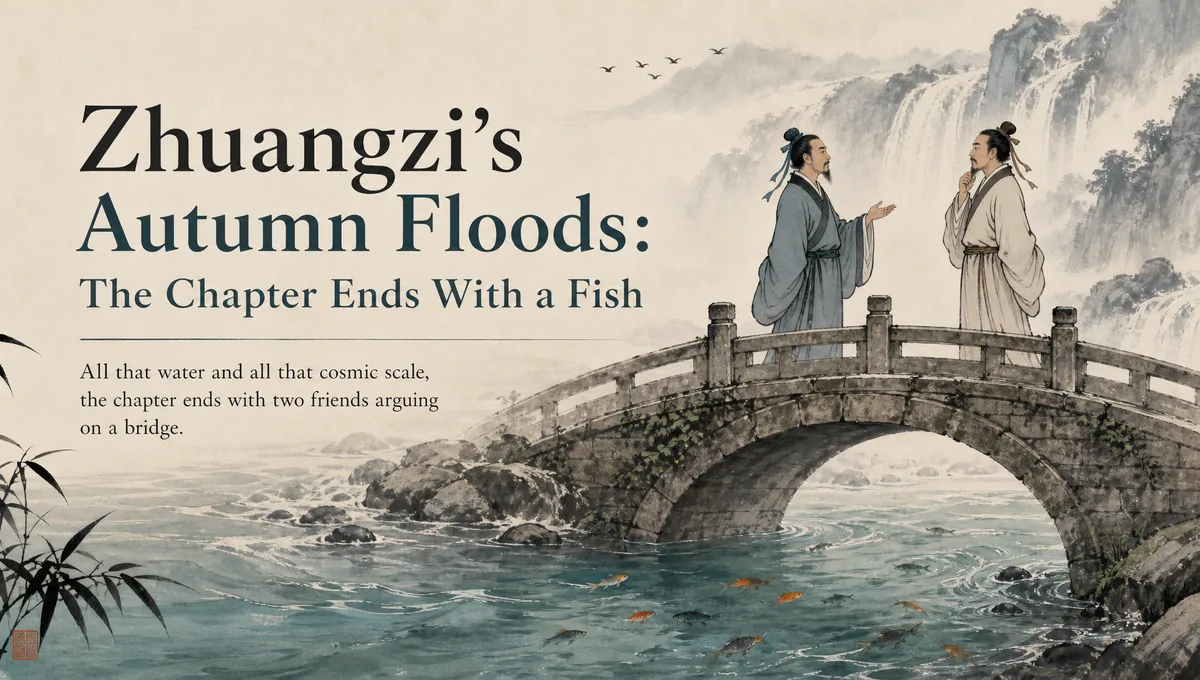
The chapter never settles the argument. It just stops, in daylight, on a bridge.
That ending is the whole method. The view from the sea does not finish in abstraction. It comes back to the one thing in front of you — a river, a fish, a friend who disagrees — and leaves you there, watching.
Three Small Practices
None of them take an afternoon.
- Name your river. Write down the one measure you use to decide whether a year went well. Income, health, how often the family calls, how you look in a photograph. Naming it is the whole exercise.
- Visit the sea once a week. Read or listen to one thing outside your own field. Do not grade it, do not decide whether it was worth the time, and do not look for the lesson.
- Use the summer insect line on yourself. When a subject comes up that you have never met, say “I have not seen this yet” rather than “I have seen enough to judge,” and leave it there. The sentence costs nothing and keeps a door slightly open.
Common Questions
Is the Autumn Floods chapter hard to read?
It is one of the easier chapters, and one of the shortest. It has a flood, a frog, an insect and a fish, and no specialised vocabulary. Burton Watson’s translation is the usual first door into the book.
Does wang yang xing tan really mean something different today?
The modern sense — helplessness before something vast — is the common one. The original scene is closer to looking up and being corrected. Both readings share the same posture: standing small in front of something large. Only the emotion changed.
Where do the well frog and the summer insect come from?
The same passage, three lines apart. Ruo lists them together with the scholar of one corner, and the three limits are space, season and teaching. Chinese uses the first two constantly and has largely forgotten the third, which is arguably the one aimed at adults.
What does “seen from the Way, things are neither noble nor base” mean in ordinary life?
It means the ranking you are using is a choice. That is not the same as saying all choices are equal. It is saying that when a comparison makes you smaller, it is worth asking where the comparison came from.
Is this a religious text?
No. The Zhuangzi is a philosophical work of the fourth century BCE, and it argues rather than preaches. You can read the chapter as literature, as psychology, or as an early essay on how perception works. None of those readings require believing anything.
The River Keeps Moving
Autumn is the yearly reminder that size depends on the bank you are standing on. The river was the same river all along. Only the man changed, and only because he travelled a little further than usual.
If you want more of this voice, read our guide to the Zhuangzi. Its cast includes a butterfly, a cook and a tree nobody wanted. The drier, older book behind it is covered in our beginner’s guide to the Tao Te Ching.
The rest of this corner of the tradition lives in our Culture & Arts section, including what a lost horse can teach you about a bad week.