Arts7 min read
Chinese Colour Names: Moon White, Lotus Pink and Ochre
Chinese colour names come from silk, minerals, flowers and weather. What moon white, lotus pink and ochre mean, and why the names still matter.
By Wen Su — Writer & Editor
Open an old Chinese dye manual and you will not find red, blue or green.
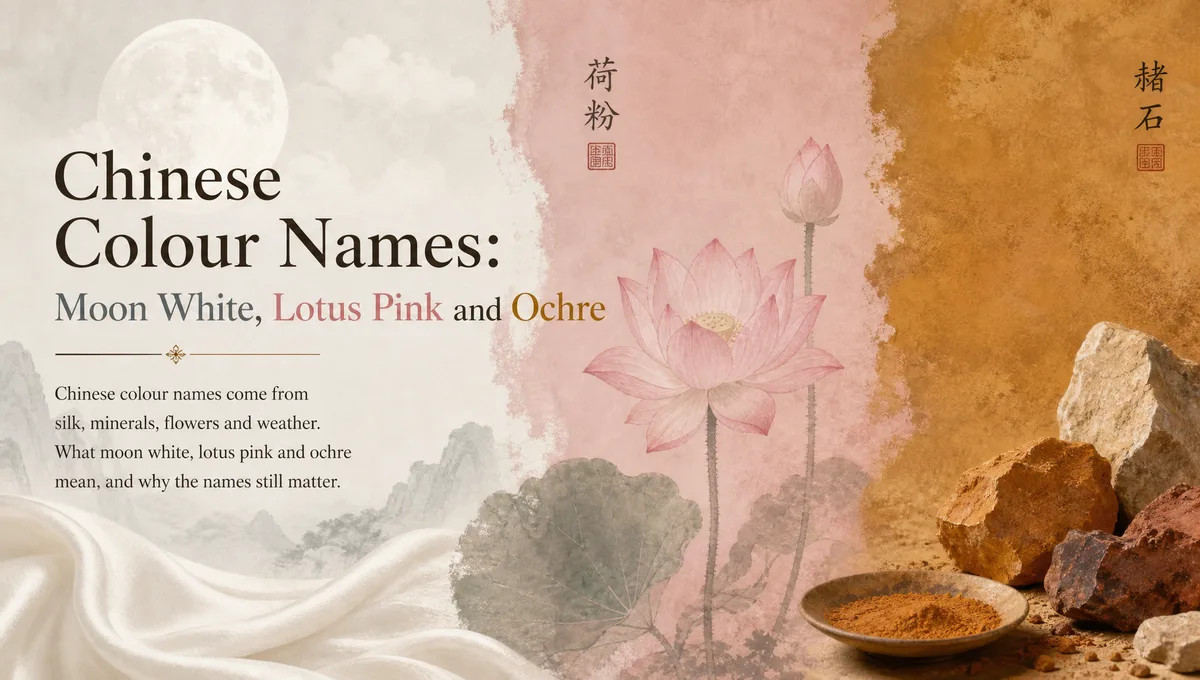
You will find moon white, lotus pink, crab-shell green, crow blue, autumn fragrance and a hundred names like them. Each one points at something in the world: a flower, a stone, a sky after rain, a shell on a market stall.
That habit is the subject of this piece. The names are not a quirky detail from the past. They are a working colour system, and it is still legible today.
Names Borrowed From the World
A traditional palette here rarely describes colour as an abstract value. It describes the object that shows the colour.
- Moon white (yue bai) — pale blue-white, from moonlight
- Lotus pink (ou he se) — the soft mauve of a lotus stem
- Crab-shell green (xie ke qing) — grey-green, from a shell
- Bamboo green (zhu qing), willow yellow (liu huang), autumn fragrance (qiu xiang)
- Crow blue (ya qing) — near black with a blue cast
Several of these names sit in the oldest Chinese dictionary, the Shuowen Jiezi from around 100 CE. Its radical for silk thread (mi) covers more than two hundred characters, and many of them name a colour or a dyeing process. That is a strong hint about where the vocabulary grew: in the textile workshop, not the painter’s studio.
By the nineteenth century, a professional embroidery manual such as Xuehuan Xiupu could list more than eighty named colours, each one matched to a physical sample. An embroiderer held the thread beside the sample and reached for the right name. With no printed colour charts, the name was the colour chart.
Moon White: A Blue So Pale It Looks White
Moon white is the best-known example of the system, and the easiest to misread.
The colour is a white with a faint blue cast, produced by dipping silk into a very weak indigo bath, once or twice, and letting it oxidise in the air. Indigo sits on the surface of the fibre. A short dip gives a whisper of blue; a longer one gives a deep blue.
Moon white was common on everyday clothing in the Ming period. Photographs of surviving robes show why the name fits. Under a warm indoor lamp, the fabric reads as white. Walk outside, and the blue appears.
A European palette might call it off-white, pale blue or eggshell. Each of those names describes the colour and loses the image. Moon white carries the light source with it.
Lotus Pink, Crab-Shell Green and Other Borrowed Colours
The borrowing habit runs in every direction.
Lotus pink comes from the plant, and the story of that plant runs through Chinese writing and design. Our guide to paper cutting shows how the same lotus, fish and pomegranate motifs were cut into window papers with the same care that dyers took over a shade.
Crab-shell green, bamboo green and willow yellow all come from the garden or the market. Autumn fragrance is a yellow-brown with a green undertone. It is the colour of a dried leaf at the moment it stops being yellow.
Names like these travel well across centuries. A modern reader can picture a crab shell. The same reader cannot easily picture three abstract swatches of similar grey-green, which is what a numbered palette would give.
Ochre, Cinnabar and the Mineral Palette
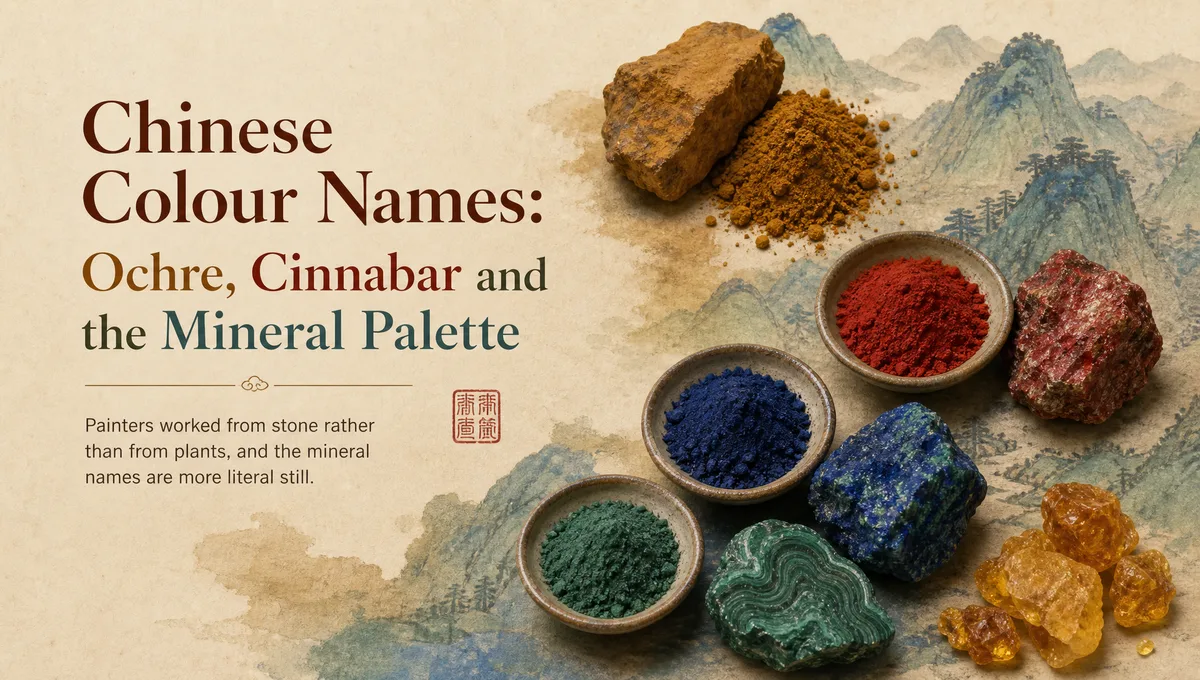
Painters worked from stone rather than from plants, and the mineral names are more literal still.
- Ochre (zhe shi) — iron oxide, red-brown, dug from the ground
- Cinnabar (zhu sha) — a bright red mineral, ground for seal paste and for painting
- Azurite and malachite (shi qing, shi lv) — blue and green copper minerals, layered in blue-green landscape painting
- Gamboge (teng huang) — a yellow resin traded from Southeast Asia
The practical difference between the two families matters. Mineral colours sit on the surface and keep their tone for centuries. Plant colours sink into the fibre and fade. That is why the blue-green landscapes still look the way they did, while most dyed fabric from the same dynasties survives only as fragments or as descriptions.
Sky Blue After Rain
One name is a description of a moment rather than an object.
Yu guo tian qing means “the blue of the sky after rain”. A story attached to Ru ware, the pale celadon made for the Northern Song court, says an emperor was asked what colour the new vessels should be. The answer was this phrase.
Ru ware is exceptionally rare. Fewer than a hundred pieces are usually counted. The phrase, by contrast, is everywhere: in ceramic talk, in tea talk, in descriptions of glaze.
You can read it as poetry, or you can read it as a specification. On a clear day, step outside just after a rain shower and look up. The colour is a pale grey-blue with almost no violet in it. A glaze that matches it would need very low iron and a reduced firing. Both readings are the point.
Why the Names Survived
Three things kept the vocabulary alive.
First, poetry. Classical verse is full of colours that double as images, and the images had to stay recognisable for the line to work.
Second, the calendar. Han-era thought arranged colours in a seasonal cycle, with green for spring, red for summer, white for autumn and black for winter. A palette organised by season is easy to remember and easy to teach.
Third, craft transmission. Dyeing and embroidery passed down by hand, and hands need names. Popular books and online colour dictionaries have recently collected hundreds of them again. You now see the names on tea packaging and in design briefs.
How to Use These Names Today
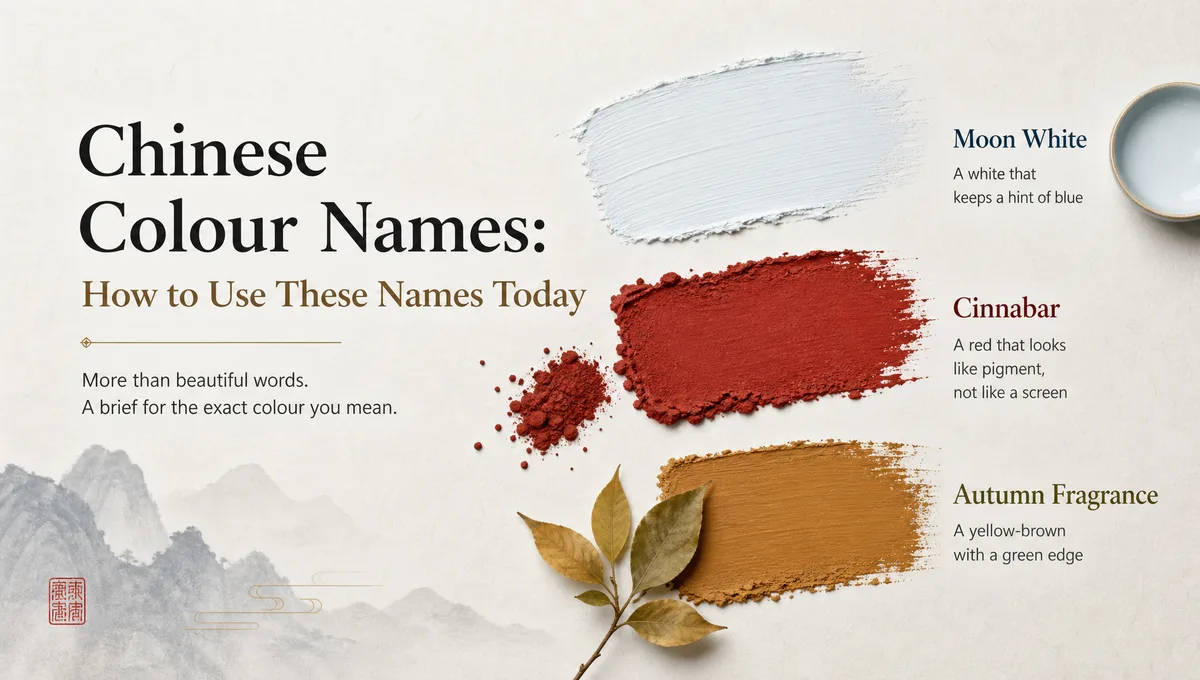
If you work with colour, the traditional names offer something a hex code cannot: a brief.
- Moon white asks for a white that keeps a hint of blue
- Cinnabar asks for a red that looks like pigment, not like a screen
- Autumn fragrance asks for a yellow-brown with a green edge
Two cautions are worth keeping. The same name did not always mean the same colour, because workshops differed and dyes differed. And the names describe relationships, not measurements — a photograph of moon white silk on a bright day will not match one taken in a dim room.
Use the name to set a direction, then trust your eye for the value.
Common Questions
Is moon white actually blue?
Yes, but faintly. It is a white with a cool blue cast, and it can read as plain white under warm light.
Do these colours have exact codes?
No. Traditional Chinese colour names describe a range, and surviving examples vary. Later Chinese sources sometimes assign approximate values, but those come from the twentieth century, not from the dye workshop.
Where can I see them?
Museum textile collections, blue-green landscape paintings, and celadon ceramics. Chinese colour names survive best where the original material survives.
Can I use these names in English writing?
You can, and it is often clearer than a set of numbers. Define the name once when you first use it, then keep using it.
Why do plant colours fade and mineral colours not?
Mineral pigment sits on the surface as particles of stone. Plant dye forms a weaker bond with the fibre and is more exposed to light and washing. The difference is chemistry, and the older painters worked around it.
A Working Vocabulary
Chinese colour names are a reminder that a palette can be built from things rather than from values. Moonlight, a lotus stem, a crab shell, a sky after rain: each one carries its own light and its own season.
If this way of naming appeals to you, two more guides fit here. Our piece on calligraphy practice covers the tools where ink and stone meet. The tea ritual shows the same attention in a single cup. More in this vein sits in the arts and culture section.