Arts4 min read
Chinese Carved Lacquer: Time, Layer by Layer
Carved red lacquer is built a coat at a time — dozens of layers, each dried before the next, then carved. Why it is slow, and what the red means.
By Wen Su — Writer & Editor
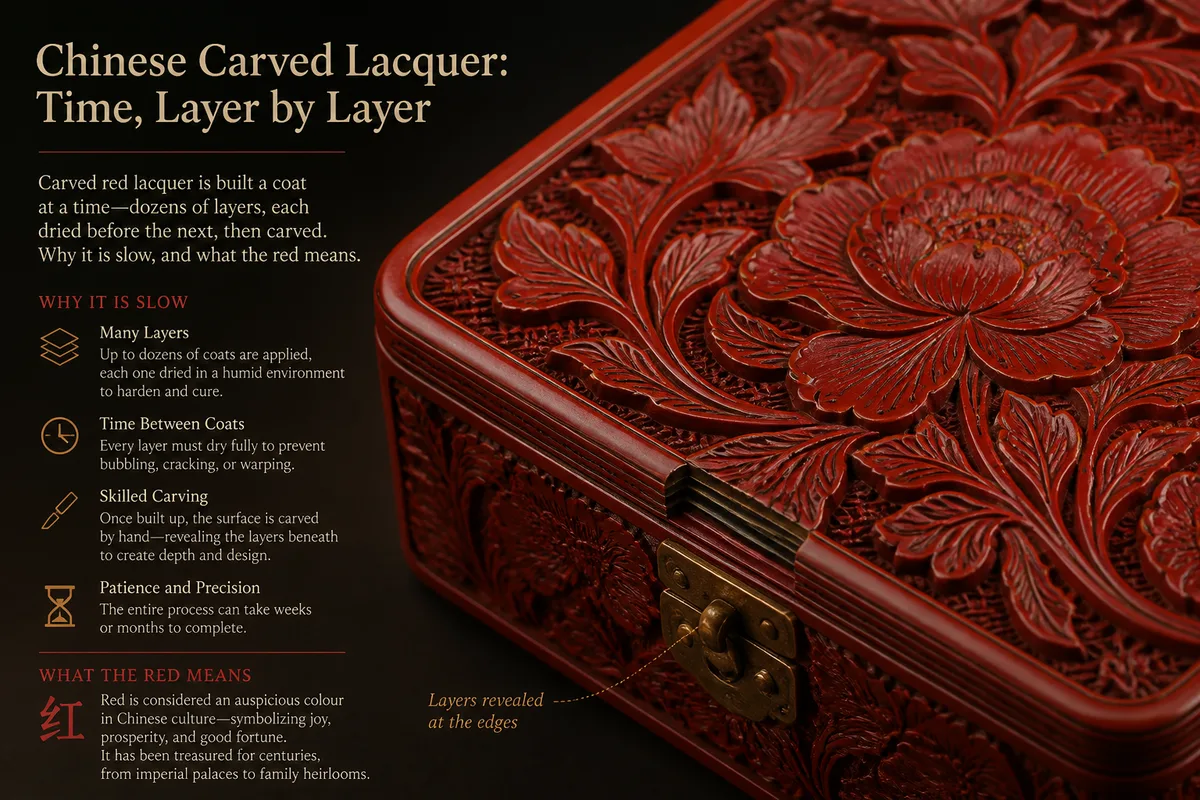
When you look at a carved lacquer box, you assume it was whittled from something solid. It was not. It was painted, one thin coat at a time, until the paint itself became thick enough to carve.
That single fact explains the whole craft: the months of waiting, the red, and the reason old pieces still glow. One coat is thinner than paper, and a finished carving can be a hundred coats deep.
The Sap That Becomes Paint
Chinese lacquer is not what we call paint. It is the sap of the lacquer tree, tapped like maple syrup and then refined.
It has been used in China for seven thousand years, which makes it one of the oldest materials in continuous use. It was the first plastic, in a way — a liquid that hardens into a surface that seals wood, resists water, and lasts for centuries.
The colour does the rest. Lacquer, dyed and brushed thin, dries to a hard, deep gloss that no modern varnish quite matches.
The Colour Red
The most famous lacquer is red, and the red has a source: cinnabar, a mineral ground to powder and mixed into the sap.
Red was not an accident of taste. In China it has always been the colour of celebration, protection and good fortune — the same red you see on paper cuttings and New Year decorations. A red lacquer box was a wedding gift and a court object before it was anything else.
The Carving: Ti Hong
Carved red lacquer has its own name: ti hong, “carving red.”
The idea is simple and almost absurd. You build up lacquer — dozens of coats, sometimes over a hundred — until it is several millimetres thick. Then you carve into it, the way a carver works wood or jade, cutting flowers and dragons and landscapes into the layers.
The result looks like sculpture. It is actually paint, patiently thickened into something you can cut.
Why It Takes a Year
The slow part is the drying, and it cannot be hurried.
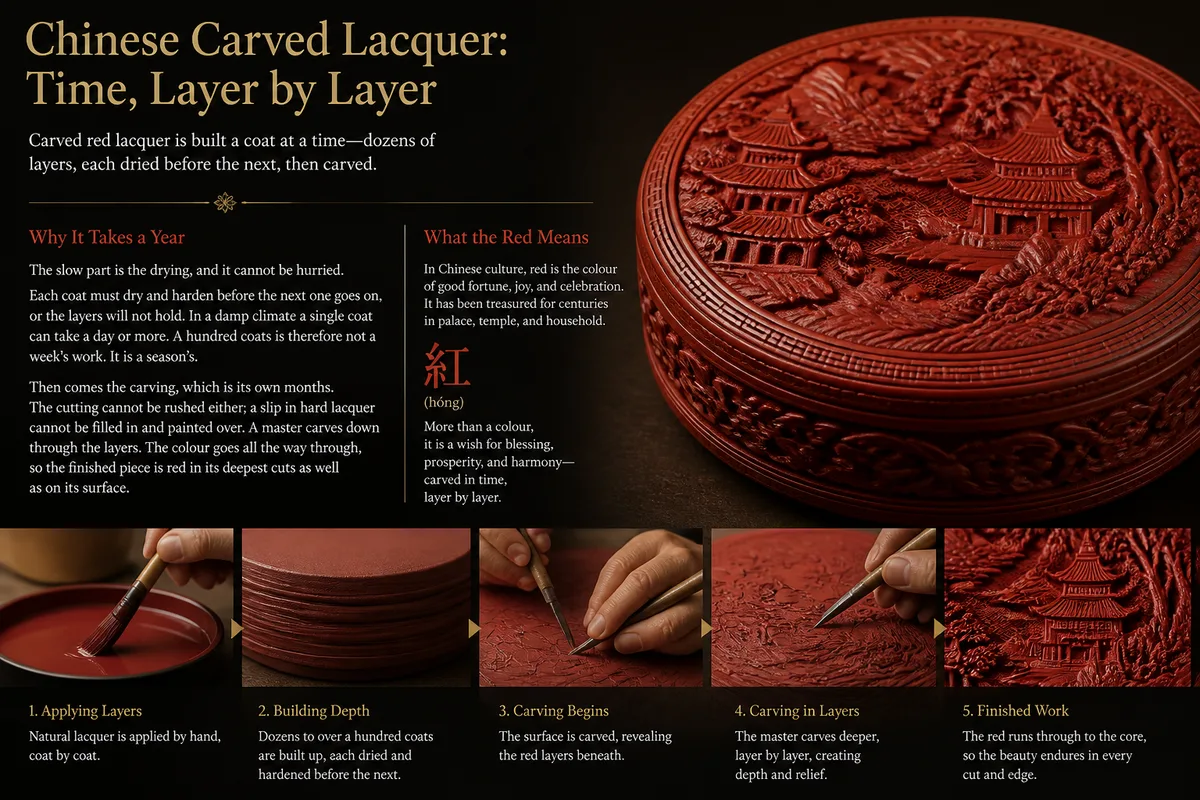
Each coat must dry and harden before the next one goes on, or the layers will not hold. In a damp climate a single coat can take a day or more. A hundred coats is therefore not a week’s work. It is a season’s.
Then comes the carving, which is its own months. The cutting cannot be rushed either; a slip in hard lacquer cannot be filled in and painted over. A master carves down through the layers. The colour goes all the way through, so the finished piece is red in its deepest cuts as well as on its surface.
The Process, Step by Step
Here is how a piece is made, in broad strokes.
- Shape a core from wood and seal it
- Brush on a coat of lacquer and let it dry completely
- Repeat, coat after coat, until the surface is thick enough to carve
- Carve the design down into the hardened lacquer
- Polish, and let the colour deepen with age
None of the steps is hard on its own. The craft is hard because the last step must wait for the first one to be repeated a hundred times.
Why It Survived
Lacquer survived because it works. A lacquered surface seals wood against water and insects, and it hardens into a finish that outlasts the object it covers. Bowls and boxes recovered from ancient tombs still show their colour.
The craft also survived because it was worth keeping. A piece that takes a year to make was never cheap, and it was never thrown away. It became an heirloom by default.
Common Questions
Is carved lacquer still made?
Yes, though the fine pieces are now expensive because they take so long. Machine and moulded lacquer exist, but the carved kind is still done by hand.
Why is it always red?
It is not always red — lacquer also comes in black and other colours. But red is the signature, because of cinnabar and because of what red means in China.
How can you tell old lacquer from new?
Old lacquer deepens with time, and the layers show at the edges of the carving. Newer pieces are often brighter and more uniform.
Do you need special tools?
For the painting, only brushes and a dust-free room. For the carving, the same tools a wood or jade carver uses.
A Year, Compressed Into a Box
Carved lacquer is a reminder of how much work can hide inside a small object. A box that fits in one hand may hold a year of waiting. Run a finger over the carving, and what you feel is not stone or wood but a hundred unhurried mornings, laid down one at a time.
It pairs naturally with the other unhurried Chinese crafts — the blue and white porcelain fired and painted in Jingdezhen, or the slow thread of Suzhou embroidery. More of these crafts live in the Culture & Arts section.