Arts7 min read
Blue and White: How Persian Cobalt Became China's Colour
The most Chinese-looking porcelain in the world was born from imported cobalt and a foreign market. How blue-and-white came to be, and why it travelled so far.
By Lian Zhao — Copy Editor
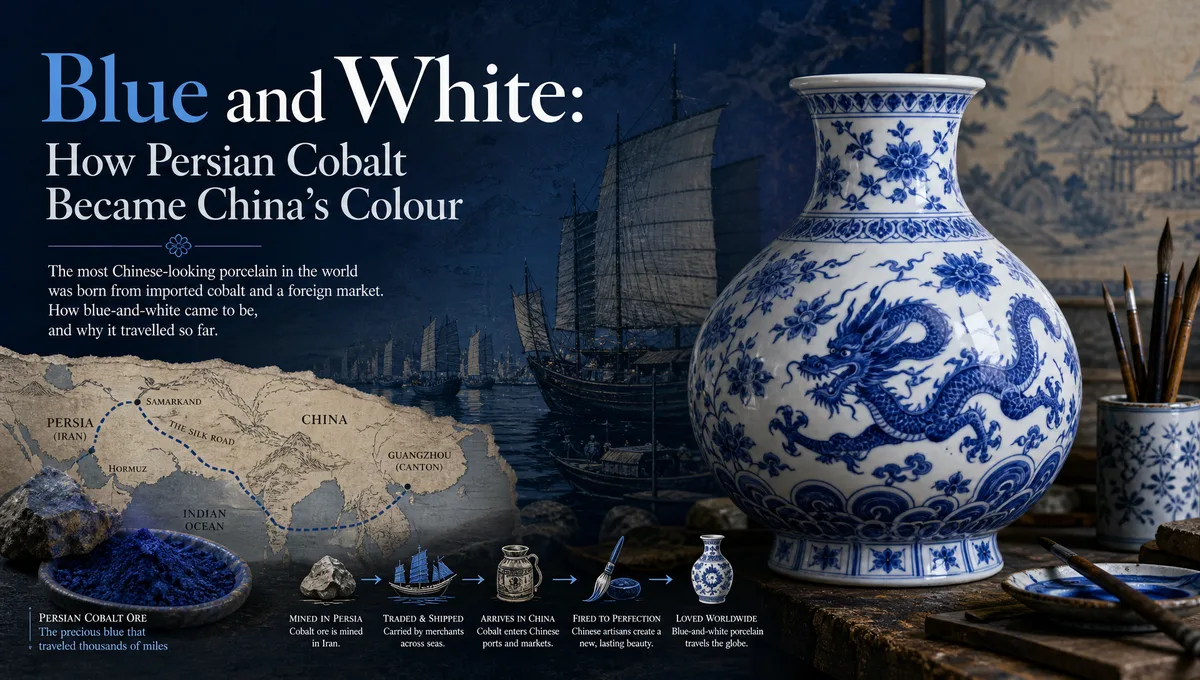
Show someone a blue-and-white plate and ask where it comes from, and the answer arrives instantly. China. It is the shorthand version of the country’s art, all the way down to the word china meaning porcelain in English.
The blue in it came from Persia.
That is not a trick question or a footnote. It is the shape of the whole story, and it explains why this particular pottery looks the way it does.
Two Materials and a Very Hot Kiln
Porcelain is not simply finer earthenware. It is a different material, made from two rocks rather than one.
The Chinese used a fusible stone, ground and washed, for the body. Into it they mixed a white clay that fires hard and stays white. That clay takes its modern name, kaolin, from a village near Jingdezhen in Jiangxi province. It is a little like naming bread after one bakery.
The mixture matters because of temperature. Earthenware and most European stoneware were fired below 1,200 degrees Celsius, which limits how thin and translucent a vessel can be. Porcelain goes higher, around 1,300, and comes out vitrified: non-porous, ringing, able to hold a wall you can see light through.
The blue is painted onto the raw body, and then a clear glaze goes over it before firing. The image sits under the glass. That is why it never wears off the way a painted surface does.
The Blue Was Imported
Cobalt was not native to Chinese pottery in any quantity. The Islamic world had used it for centuries, in glass and in ceramics. The pigment that reached China in the fourteenth century was Persian.
Chinese potters called it sumali qing, sometimes written sunibo qing. The names record where it came from rather than what it was. It behaved unlike anything they had worked with before. It ran slightly, sat deep in the glaze, and left dark iron flecks where it pooled.
Those flecks are now one of the ways a piece is dated. A smooth, even blue usually means a later period and a different source of cobalt. A blue with depth, edge and a little roughness usually means earlier.
Made for Somebody Else
The first great wave of blue-and-white belongs to the Yuan dynasty, roughly the fourteenth century. It was made at Jingdezhen at the scale of an export industry, and much of the output was never intended for Chinese tables.
The shapes say so. Large flat dishes. Wide-mouthed jars. Heavy plates sized for shared rice and meat rather than for the individual bowls of a Chinese meal. Vines and scrolls in dense bands that fill the whole surface. These are forms that belong to a Middle Eastern table, and they were ordered in quantity by a market that knew what it wanted.
Here is the part that does not fit the usual assumption about craftsmanship. A tradition now read as the essence of Chinese design began as contract work for buyers abroad, using a pigment shipped in from the other end of a trade route.
The Town That Made It
One reason the scale was possible is that Jingdezhen was not a village of potters. It was an industrial town organised around kilns, and it stayed that way for centuries.
Work was divided into separate trades. One set of hands prepared the clay. Another threw the bodies on the wheel. Another trimmed the foot rings. Another painted, and painting itself split into specialists, some doing outlines and others filling in the blue. A separate crew built the saggars, the clay boxes that protected each piece in the fire.
The firing was done in long ascending kilns built up a hillside. Heat travelled through a stack of chambers, which gave the whole town a means of production no single workshop could match. When a European visitor first described the place in the eighteenth century, the thing that astonished him was not the quality. It was the quantity.
That arrangement is why a small Chinese inland town could serve a market on the other side of the ocean on a schedule.
Then the Chinese Liked It Too
Taste turned, as it does. By the Ming dynasty blue-and-white had moved from the export lines into the mainstream. The wares of the Xuande period in the fifteenth century are still the ones collectors name first.
There is a small language clue to why it suited Chinese eyes. The word qing covers a range that English splits apart: green and blue, and by extension the fresh, the young, the pale. The name of the technique, qing hua, is usually rendered “blue-and-white”. It literally means blue-and-white patterns, which is what they are. Pictures on a white field, held apart by a colour the potter could not see until the kiln cooled.
And Then It Went Everywhere
From the sixteenth century, ships carried it to Europe, where it arrived in the same holds as tea and spice. Demand outran supply immediately.
Attempts to copy it followed. Persian potters made versions. Vietnamese kilns produced their own. In the Netherlands, Delft potters managed the look if not the material, and their tin-glazed imitations became a national industry in their own right.
By then the object had completed the trip. A Chinese plate, made with Persian pigment in shapes designed for Islamic dining, was being copied in Europe to serve European food. The copy was being sold next to the original.
Why the Word Is “China”
English speakers have called porcelain china since the seventeenth century, a shortened form of “china ware”. The pottery arrived before a word existed for it, so the country’s name did the work.
The habit survives in other languages too, and it tells you something about the impression the material made. A substance that could be fired this thin, this white, and this strong had no European equivalent for a long time. Anything that good was simply from there.
How to Look at One
Notice the blue before anything else. If the pigment has depth, a slight fuzz at the edges and a few dark speckles, it is doing what imported cobalt does.
Then look at the foot ring, the bare circle where the vessel stood in the kiln. It should be clean and slightly raw, a small unglazed ring on an otherwise glazed object.
Finally, look at the pattern and ask what it is for. Dense scrolling vines that fill every part of the surface are often shapes made for export. Spare sprays and a single branch are more often for a Chinese eye, with an empty section left quiet — the same habit of leaving space that shapes ink painting.
Common Questions
Is blue-and-white the oldest Chinese porcelain?
No. White wares, green wares and many others came much earlier. Blue-and-white is a fourteenth-century development, and it is the one that travelled furthest.
Where did the cobalt come from?
Persia and the surrounding region, imported along the same trade routes the finished dishes travelled. Chinese names for the pigment preserve the origin.
Why did the Chinese not use cobalt before?
They did, sparingly, and mostly as an accent. What changed in the Yuan period was scale, supply, and a foreign market willing to pay for it.
Is Delftware real porcelain?
Not in the technical sense. Delft is earthenware with a tin glaze, which is what allowed it to be made in Europe at all. The look is close. The body is different.
How can I tell an early piece from a later one?
Broadly, by the blue and the shapes. Deep, uneven blue with iron flecks and large Islamic-market forms point earlier. Even blue and Chinese table shapes point later.
The Most Travelled Object in the House
There is a case for describing blue-and-white as the first object with a genuinely global life. It was made in one place from materials gathered in another, shaped for a third, copied in a fourth, and it ended up in the kitchens of all of them.
Worth remembering the next time a blue plate seems to be the most native thing in the cupboard. It is a piece of trade history with a pattern on it, and the story is better than the shorthand. Our piece on how tea is brewed looks at another object that carried a whole culture abroad. More of this sits in the culture & arts section.