Arts6 min read
Empty Space in Ink Painting: Why Nothing Is Something
Ink painters leave parts of the paper empty on purpose. What liu bai is, how Ma Yuan used it, and why the blank in a Chinese painting is not unfinished.
By Ming Chen — Editor & Researcher
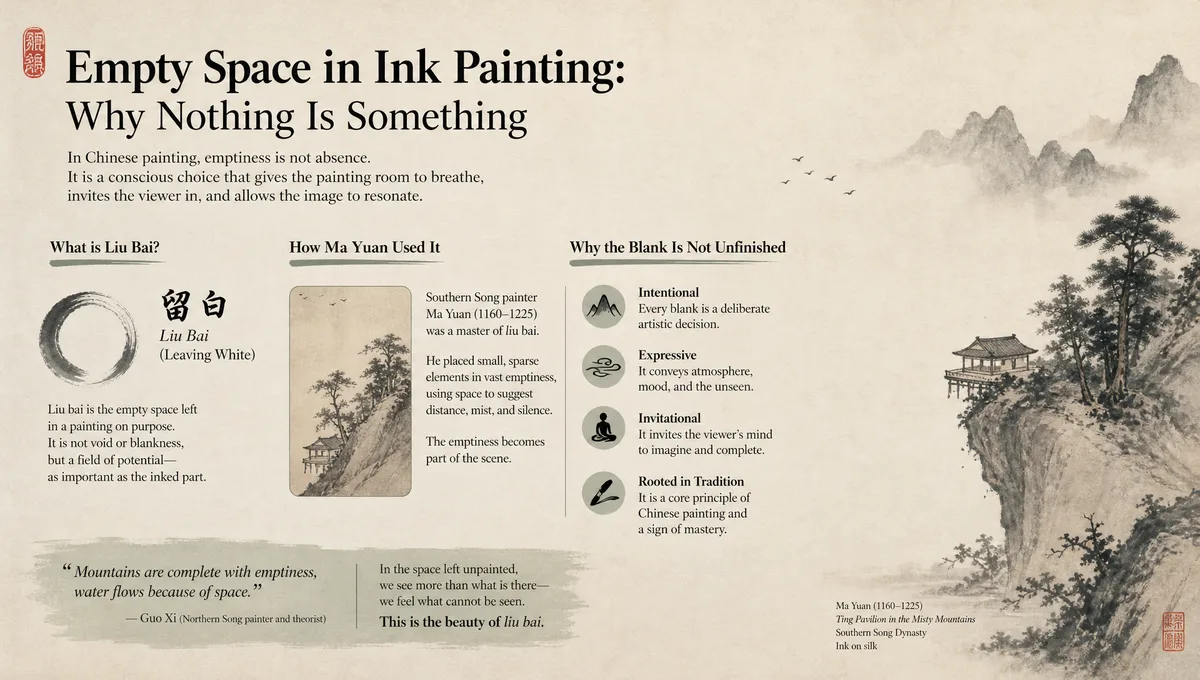
Stand in front of a Song dynasty ink painting and the first thing you notice is how little is on the paper.
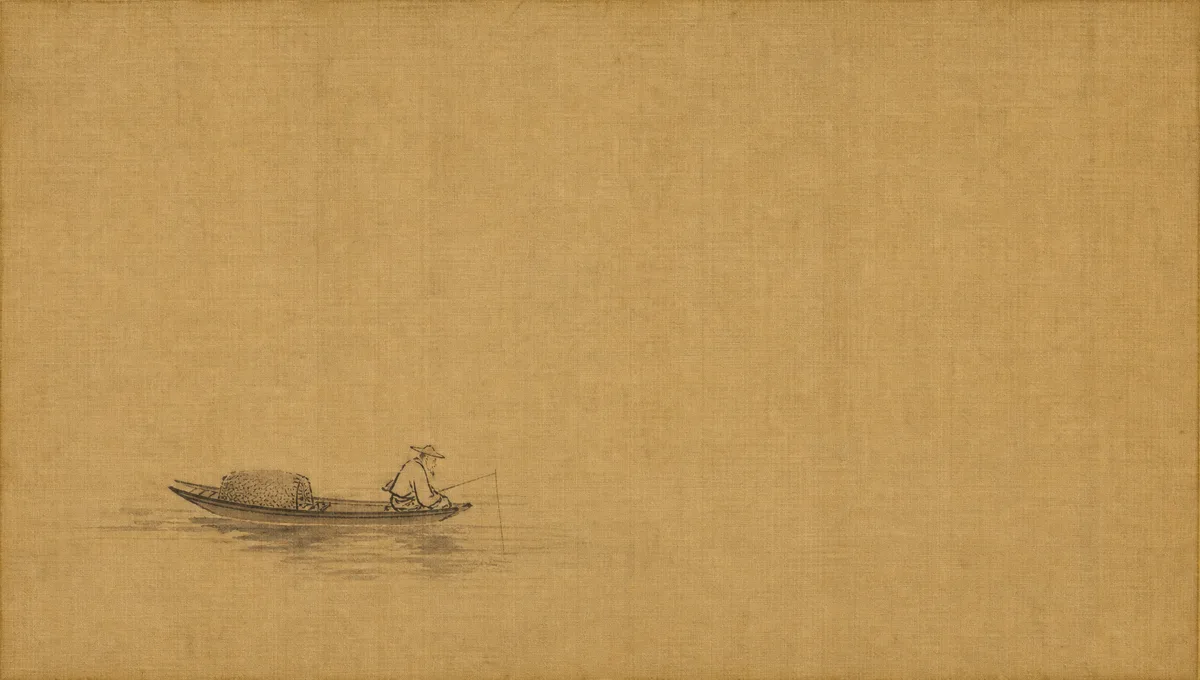
A boat. A figure. Two or three lines suggesting water. The rest of the silk is empty, and the emptiness is doing the work of an ocean.
Western viewers often assume the artist ran out of time or materials. The blank is deliberate, it has a name, and it carries a set of rules.
What Liu Bai Means
Liu bai means left white: the part of the painting the artist chose not to fill. It is not the same as an unfinished area, because it is decided before the brush goes down.
Two practical facts follow from that.
- The blank has to be shaped. Its edges matter as much as the ink edges.
- The blank has to be sized. Too little and it reads as a gap; too much and the picture loses its structure.
Painters used blanks for things that are hard to draw well: water, cloud, mist, distance, silence. A bay described by one curved line and nothing else lets the viewer supply the rest, and most viewers supply something better than the painter could have drawn.
The Classic Example
The most quoted case is a small scroll usually titled Solitary Angler on a Cold River, attributed to Ma Yuan, a court painter of the Southern Song.
The composition is startling. A narrow boat sits low and left of centre, with one old man bent over a line. Around the boat are a few short strokes of wash. Everything else is untouched silk.
Read the blank as water and the painting becomes a cold river at dusk. Read it as nothing and the picture is a sketch. The scroll is stored in a museum in Tokyo, and it is one of the standard arguments for restraint in the whole tradition.
Ma Yuan and his contemporary Xia Gui gave their names to a shorthand phrase: one corner of Ma, half a side of Xia. It describes pictures that place the subject off centre and let the rest stay open.
Why It Developed Here
Three streams feed the habit.
Ink itself. Black ink on paper or silk gives you a limited range of values. A painter who cannot rely on colour and detail learns to organise a picture around contrast instead: some ink, and a great deal of not-ink.
Landscape subjects. Mist, water and distance are the main subjects of the tradition, and all three resist description. The alternative to painting fog badly is leaving a band empty and letting the eye accept it.
The philosophy underneath. The idea that what is absent can be useful runs through Chinese thought. The Tao Te Ching makes the argument with objects: a wheel needs its empty hub, a room needs its openings. Our reading of chapters 8, 11 and 44 goes through that passage line by line, and it is the same argument a painter makes with paper.
A later slogan from the Qing period states the studio version: treat the white as if it were black. Whether the phrase came from painting or from calligraphy theory, the instruction is the same — plan the empty parts with as much care as the ink.
Where the Empty Space Goes
Blanks are not spread evenly. In practice they concentrate in recognisable places.
- Upper third — sky or distant water
- Between near and far — the gap that separates foreground from background
- Along a diagonal — the channel the eye travels through
- Below a heavy passage — a counterweight to dense ink
Scrolls add a fourth dimension that photographs hide. A hand scroll is unrolled a section at a time, so the blanks act as pauses between passages, and the viewer controls the pace of the reading.
Common Misreadings
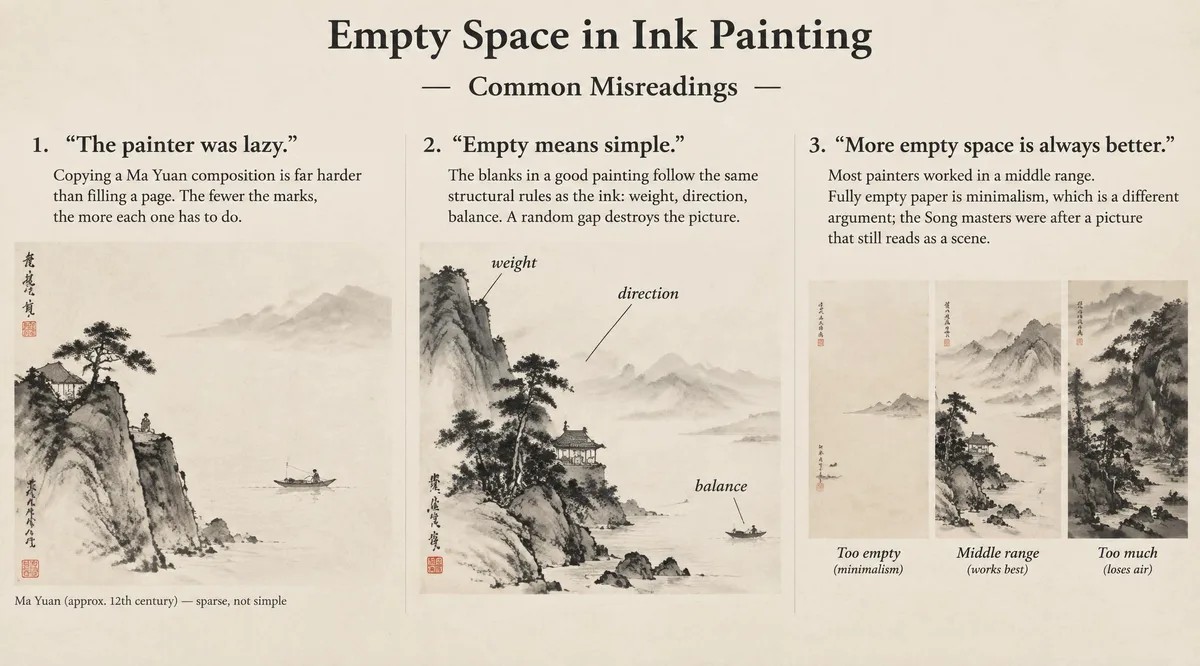
Three assumptions are worth clearing up.
“The painter was lazy.” Copying a Ma Yuan composition is far harder than filling a page. The fewer the marks, the more each one has to do.
“Empty means simple.” The blanks in a good painting follow the same structural rules as the ink: weight, direction, balance. A random gap destroys the picture.
“More empty space is always better.” Most painters worked in a middle range. Fully empty paper is minimalism, which is a different argument; the Song masters were after a picture that still reads as a scene.
The Skill Behind the Blank
The blank is finished work, not absence of work. What a painter actually controls is the boundary: the edge where ink stops has to suggest whatever the viewer is meant to see.
That is why copies often fail. Reproduce the boat and the line of wash, and the result looks thin, because the copyist treated the empty area as leftover space rather than as the subject’s setting.
Two habits help if you are learning:
- Sketch the blank first — decide its shape before you add ink
- Judge the painting from two paces back; if the empty part holds its shape, the structure is sound
If you draw or photograph, you already use a version of this. Negative space in Western design describes the same territory: the part of the frame that carries the subject by not being the subject.
Common Questions
Is liu bai only about landscape painting?
No. It shows up in bird-and-flower painting, in figure painting, and in calligraphy, where the spacing between characters carries as much rhythm as the strokes themselves.
How is a blank different from an unpainted margin?
Margins frame a picture. A blank sits inside the composition and does a job — it is water, air, distance or pause.
Did painters leave blanks to save silk?
Silk was expensive, which is one reason pictures are small. Saving material was not the motive; the blank is where the mist is.
Can I see this in a museum in the West?
Yes. Song and Yuan scrolls are held in the Met, the Boston MFA, the Cleveland Museum of Art and the British Museum, among others. Look for the works with the least ink in them.
Does this connect to Japanese painting?
Directly. The ink traditions of Japan grew from Song and Yuan models, and the Zen-influenced painters took the empty-space habit further, sometimes to a single figure on bare paper.
Nothing, Held in Place
Chinese ink painting treats emptiness as a material. It has weight, direction and proportion, and the painter is responsible for all three.
The next time a picture looks almost empty, count the marks and notice where they sit. What the artist left out is not missing. It is the part they trusted you to finish.
More of this tradition is in brush practice and in Chinese colour names; the arts and culture section collects the rest of the site.