Arts5 min read
Why a Good Teapot Is Raised, Not Just Bought
Why a small unglazed Yixing pot costs more than porcelain, and why owners pour tea over the outside. The clay, the names, and the habit of raising a pot.
By Ming Chen — Editor & Researcher
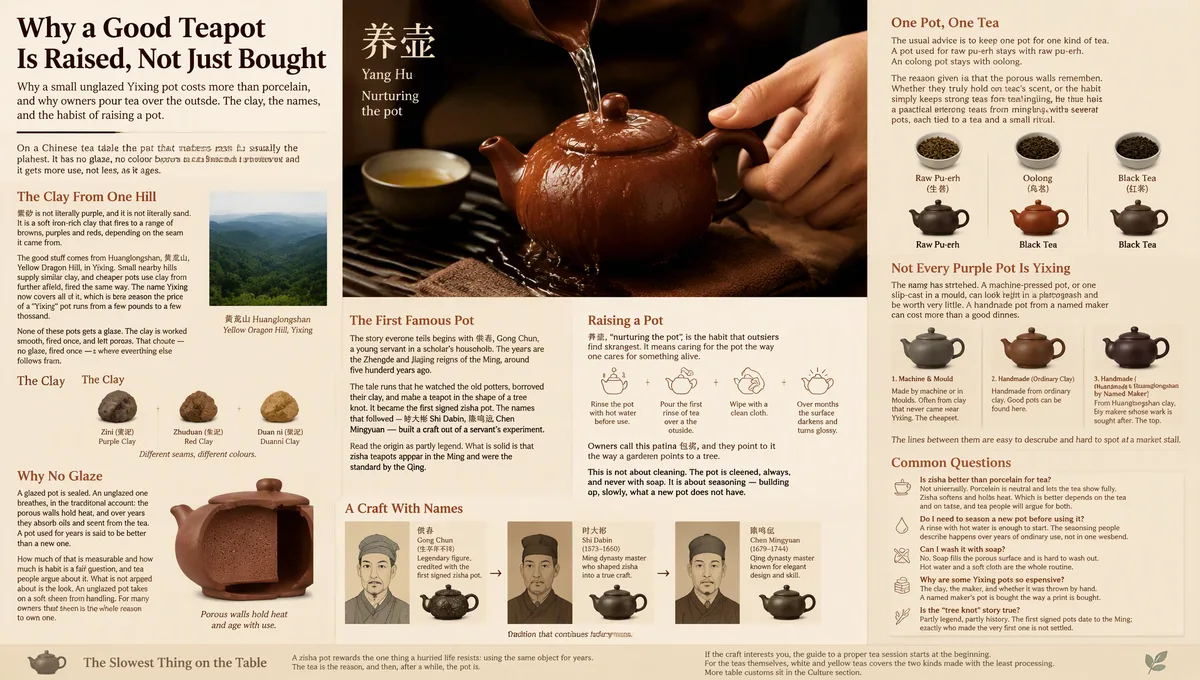
On a Chinese tea table the pot that matters most is usually the plainest. It has no glaze, no colour beyond a dull red-brown, and it gets more use, not less, as it ages.
The pot is zisha — “purple sand” — made from clay that comes, in the version people mean, from one place: the hills around Yixing in Jiangsu.
The Clay From One Hill
Zisha is not literally purple, and it is not literally sand. It is a soft, iron-rich clay that fires to a range of browns, purples and reds, depending on the seam it came from.
The good stuff comes from Huanglongshan, Yellow Dragon Hill, in Yixing. Small nearby hills supply similar clay, and cheaper pots use clay from further afield, fired the same way. The name Yixing now covers all of it, which is one reason the price of a “Yixing” pot runs from a few pounds to a few thousand.
None of these pots gets a glaze. The clay is worked smooth, fired once, and left porous. That choice — no glaze, fired once — is where everything else follows from.
Why No Glaze
A glazed pot is sealed. An unglazed one breathes, in the traditional account: the porous walls hold heat, and over years they absorb oils and scent from the tea. A pot used for years is said to be better than a new one.
How much of that is measurable and how much is habit is a fair question, and tea people argue about it. What is not argued about is the look. An unglazed pot takes on a soft sheen from handling. For many owners that sheen is the whole reason to own one.
The First Famous Pot
The story everyone tells begins with Gong Chun, a young servant in a scholar’s household. The years are the Zhengde and Jiajing reigns of the Ming, around five hundred years ago.
The tale runs that he watched the old potters, borrowed their clay, and made a teapot in the shape of a tree knot. It became the first signed zisha pot. The names that followed — Shi Dabin, Chen Mingyuan — built a craft out of a servant’s experiment.
Read the origin as partly legend. What is solid is that zisha teapots appear in the Ming and were the standard by the Qing.
Raising a Pot
Yang hu, “nurturing the pot”, is the habit that outsiders find strangest. It means caring for the pot the way one cares for something alive.
The routine is small and repetitive. Rinse the pot with hot water before and after use. Pour the first rinse of tea over the outside of the pot, and wipe it with a clean cloth. Over months the surface darkens and turns glossy. Owners call this patina bao jiang, and they point to it the way a gardener points to a tree.
This is not about cleaning. The pot is cleaned, always, and never with soap. It is about seasoning — building up, slowly, what a new pot does not have.
One Pot, One Tea
The usual advice is to keep one pot for one kind of tea. A pot used for raw pu-erh stays with raw pu-erh. An oolong pot stays with oolong.
The reason given is that the porous walls remember. Whether they truly hold one tea’s scent, or the habit simply keeps strong teas from mingling, the rule has a practical effect. A tea drinker ends up with several pots, each tied to a tea and a small ritual.
Not Every Purple Pot Is Yixing
The name has stretched. A machine-pressed pot, or one slip-cast in a mould, can look right in a photograph and be worth very little. A handmade pot from a named maker can cost more than a good dinner.
Three rough divisions help. The cheapest are machine and mould pots, some of them made from clay that never came near Yixing. The middle are handmade pots from ordinary clay. The top are handmade pots from Huanglongshan clay, by makers whose work is sought after. The lines between them are easy to describe and hard to spot at a market stall.
Common Questions
Is zisha better than porcelain for tea? Not universally. Porcelain is neutral and lets the tea show fully. Zisha softens and holds heat. Which is better depends on the tea and on taste, and tea people will argue for both.
Do I need to season a new pot before using it? A rinse with hot water is enough to start. The seasoning people describe happens over years of ordinary use, not in one weekend.
Can I wash it with soap? No. Soap fills the porous surface and is hard to wash out. Hot water and a soft cloth are the whole routine.
Why are some Yixing pots so expensive? The clay, the maker, and whether it was thrown by hand. A named maker’s pot is bought the way a print is bought.
Is the “tree knot” story true? Partly legend, partly history. The first signed pots date to the Ming; exactly who made the very first one is not settled.
The Slowest Thing on the Table
A zisha pot rewards the one thing a hurried life resists: using the same object for years. The tea is the reason, and then, after a while, the pot is.
If the craft interests you, the guide to a proper tea session starts at the beginning. For the teas themselves, white and yellow teas covers the two kinds made with the least processing. More table customs sit in the Culture section.