Arts6 min read
White Tea and Yellow Tea: Two Crafts That Skip the Hot Pan
White tea and yellow tea both skip the hot pan. How withering, piling and patience make two quiet crafts, and how to brew both at home.
By Wen Su — Writer & Editor
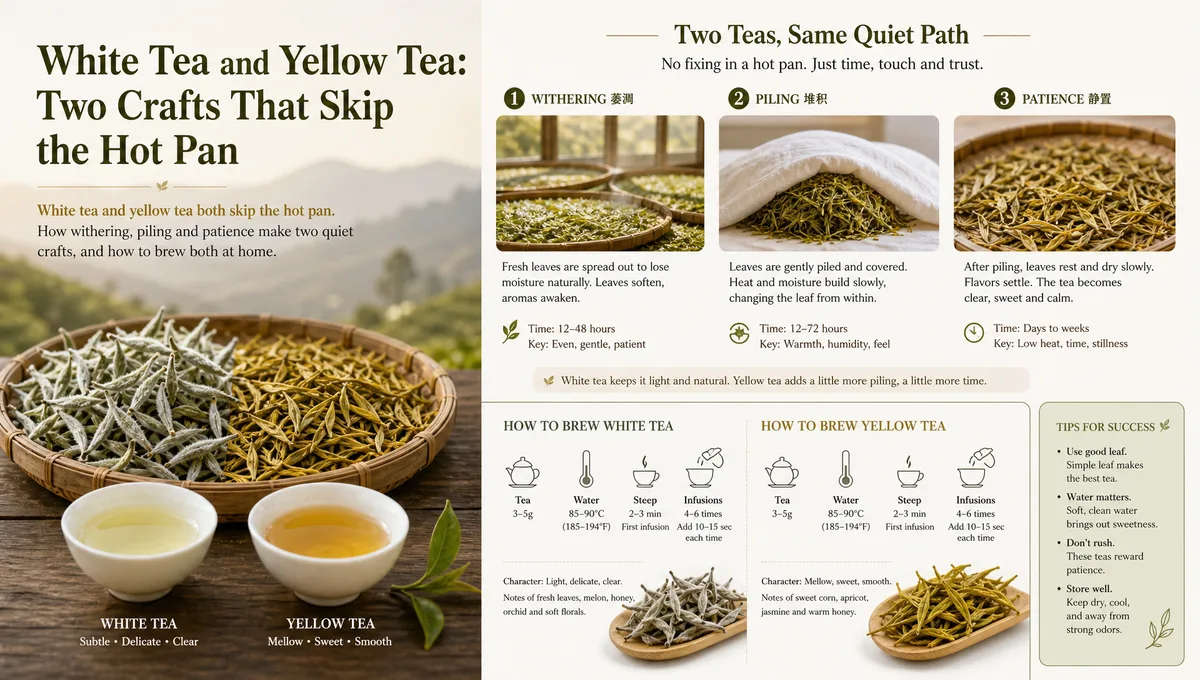
Most tea in China passes through a hot pan or a hot wok at some point. The heat stops the leaf from changing further, and it fixes the green.
White tea and yellow tea are the two families that mostly skip that step. Both let the leaf do more of the work on its own.
That single decision explains almost everything about them. It shapes how they look and taste, how long they keep, and why one is easy to find while the other is not.
A Quick Map of the Six Families
Chinese tea is usually sorted into six families, and the sorting is about process rather than about the plant.
- Green — heated early, stays green
- Yellow — heated early, then piled to mellow
- White — withered and dried, no pan, no rolling
- Oolong — bruised and partly oxidised
- Red (what English calls black) — fully oxidised
- Dark — fermented with microbes, pressed or loose
The same bushes can produce several of these. A leaf picked in April can become green tea in one village and white tea in the next. Our guide to a gongfu tea session covers what happens after the tea is made, at the table.
White Tea: Withering, Then Patience
White tea is the simplest process in the whole list.
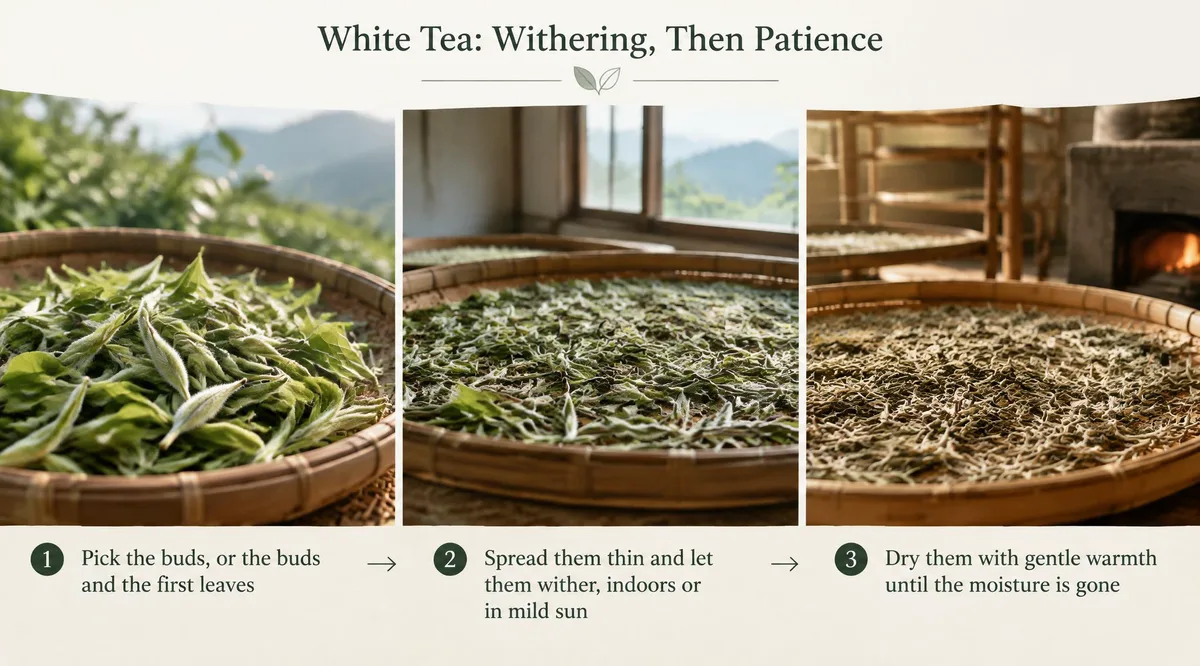
- Pick the buds, or the buds and the first leaves
- Spread them thin and let them wither, indoors or in mild sun
- Dry them with gentle warmth until the moisture is gone
No rolling, no pan, no shaping. The leaf keeps its white down, which is where the name comes from.
The grades follow what was picked:
- Silver needle (bai hao yin zhen) — buds only, straight and covered in fine white hair
- White peony (bai mu dan) — one bud with two leaves, more body in the cup
- Longevity eyebrow (shou mei) — larger, later leaves, darker and sweeter
Because there is no kill-green step, white tea keeps changing after it is made. Fresh it tastes of hay and melon rind. After three or four years it turns to dried apricot, honey and wood. In Fujian, older white tea is treated as a small household asset rather than as a quick purchase.
Yellow Tea: The Pile in the Middle
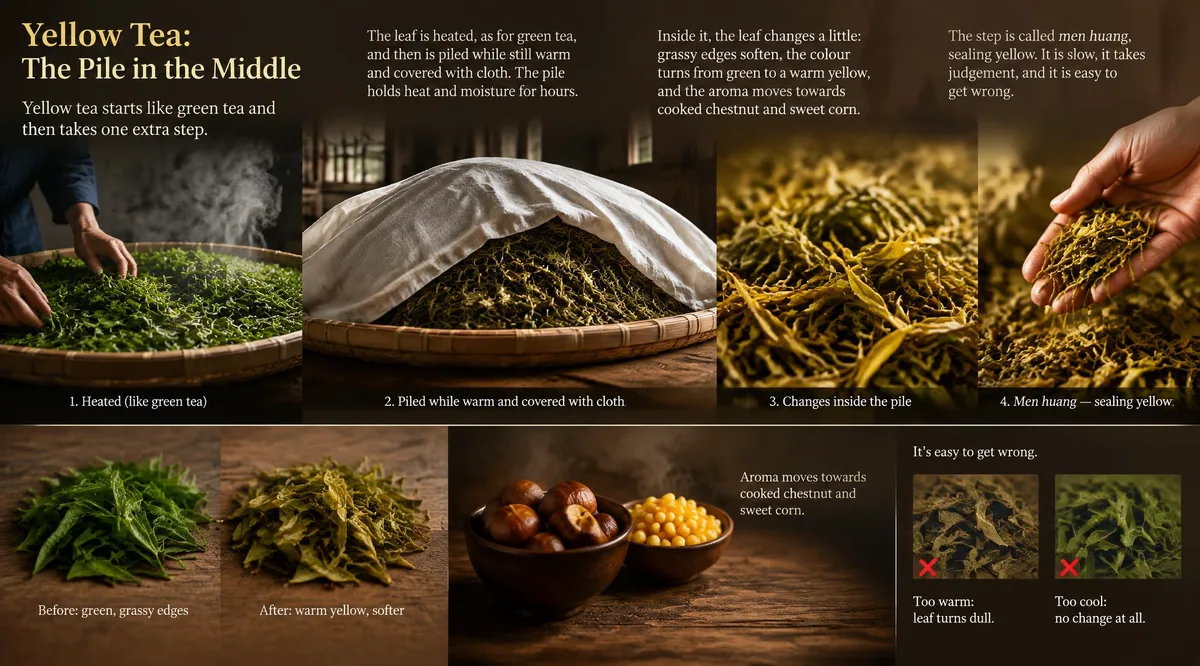
Yellow tea starts like green tea and then takes one extra step.
The leaf is heated, as for green tea, and then it is piled while still warm and covered with cloth. The pile holds heat and moisture for hours. Inside it, the leaf changes a little: grassy edges soften, the colour turns from green to a warm yellow, and the aroma moves towards cooked chestnut and sweet corn.
The step is called men huang, sealing yellow. It is slow, it takes judgement, and it is easy to get wrong. A pile that is too warm turns the leaf dull; a pile too cool does nothing at all.
That is the practical reason yellow tea is scarce. It costs nearly as much work as a fine green tea and sells for less, because most drinkers do not know the name. Two historic examples are Junshan silver needle from Hunan and Mengding yellow bud from Sichuan. Both are worth trying once, if you find them fresh.
Brewing Both Without Fuss
Neither tea wants boiling water, and neither wants to be rushed.
- Water — around 80–85 °C for silver needle; 85–90 °C for white peony, longevity eyebrow and yellow tea
- Leaf — about 3 g to 150 ml, or one generous spoon in a small pot
- Time — 45 seconds for the first pour, then add 15 seconds each round; five or six rounds is normal
- Vessel — a gaiwan or a small porcelain pot; glass shows the buds best
White tea is forgiving about time and unforgiving about temperature. Pour boiling water on silver needle and the first cup turns bitter while the second tastes of nothing. Yellow tea is the reverse: it can take a little more heat, but it fades faster after the third round.
A note on the old habit of adding things. Aged white tea is sometimes simmered in a clay pot with a piece of dried peel or a date. That is a winter drink in Fujian and Guangdong, and it is closer to a soup than to a brew. Our piece on the slow kitchen shows the same pot doing other work.
Storing What You Buy
Both families reward a little care, though for different reasons.
White tea improves for a while if it is kept dry, dark and sealed. Yellow tea does not: it is finished when it is made, and it goes flat within a year or two. If you buy yellow tea, drink it.
For both, air and light are the enemies. A sealed tin in a cupboard is enough. The refrigerator is a common mistake, because the leaf takes on whatever else is in there.
Common Questions
Is white tea just unprocessed green tea?
Not quite. Green tea is deliberately heated to stop change. White tea is not heated at the start, so it dries slowly and continues to change afterwards. The difference shows up in the cup and in the shelf life.
Does white tea have less caffeine?
Usually a little less than a green tea made from the same leaf, and less again if the leaf is old. The main difference you will notice is the taste rather than the lift.
Why is yellow tea so hard to find?
The men huang step adds days of careful work for a small change in flavour, and the market for it is small. Many shops label a light green tea as yellow instead.
Can I age white tea like pu’er?
You can age it, and it does improve, but it is not the same process as dark tea fermentation. Keep it dry and out of the light, and taste it once a year.
What if my white tea tastes bitter?
Two usual causes: water too hot, or too much leaf. Drop the temperature to 80 °C, use less leaf, and pour the first round off faster.
Two Quiet Crafts
White and yellow tea are what happens when a maker decides to intervene less. One lets the leaf wither and dry on its own; the other adds a single warm pause and then stops.
If you would like the wider context, our guide to eating with the seasons explains why autumn and early winter suit these cups best. The arts and culture section collects the rest of this corner of the site.