Arts4 min read
Suzhou Embroidery: How Many Strands in One Silk Thread?
Suzhou embroidery splits one silk thread into a thirty-second of itself. The double-sided trick, the colours, and why the craft stays slow.
By Wen Su — Writer & Editor
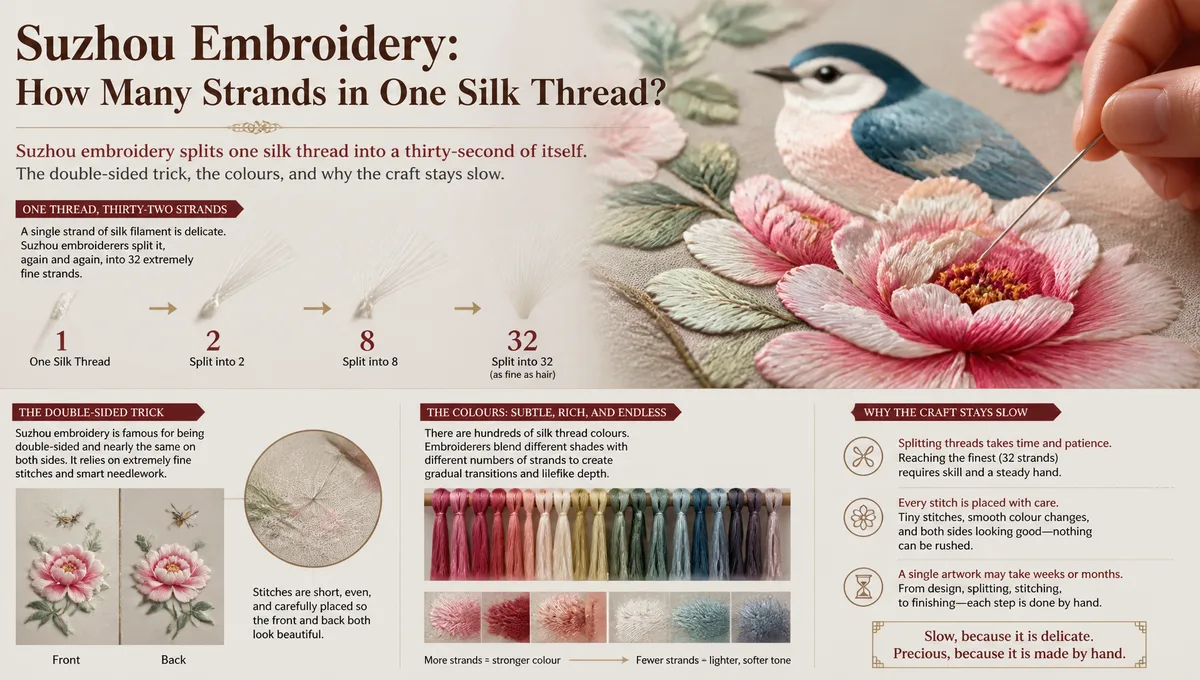
A single silk thread can be split into thirty-two strands. The best Suzhou embroiderers go finer.
That one fact is the whole doorway into the craft. Everything else about Suzhou embroidery follows from it: the double-sided images, the colours that look painted, and the reason a small piece can take a year.
The Thread Comes Apart First
The craft’s signature move has a plain name: pi si, “splitting the thread.”
A silk thread is already fine. The embroiderer takes it apart anyway — first into halves, then quarters, then eighths. A skilled hand reaches a sixteenth or a thirty-second, and a master can go to a sixty-fourth, thinner than a human hair.
Why split it? Because the finest lines — a bird’s feather, a strand of hair, the edge of a petal — cannot be made with a whole thread. They need a strand so thin it almost disappears.
One City, One Craft
Suzhou embroidery (Su xiu) takes its name from Suzhou, the canal city in Jiangsu province known for silk, gardens, and patience.
It is the most famous of the four regional embroideries of China, the others coming from Hunan, Guangdong and Sichuan. What sets Suzhou apart is less the material than the discipline: the split thread, the tiny stitches, and an almost obsessive neatness.
The craft has been practised there for over a thousand years. Silk, after all, was the city’s trade long before embroidery became its art.
The Double-Sided Trick
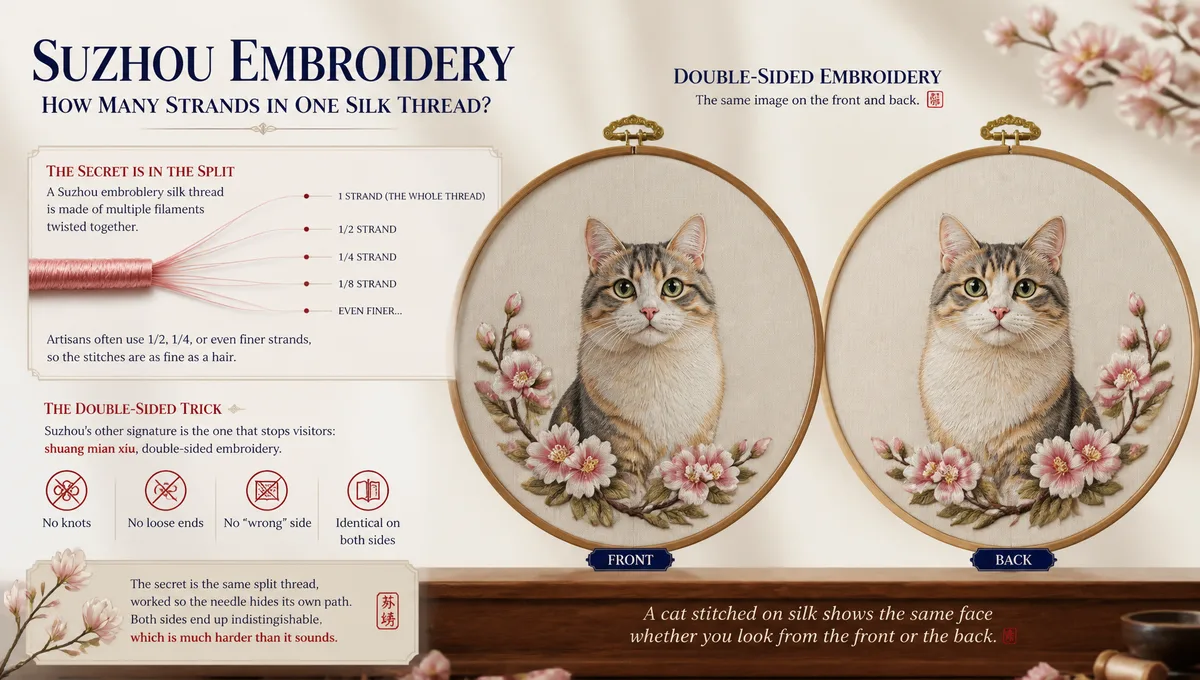
Suzhou’s other signature is the one that stops visitors: shuang mian xiu, double-sided embroidery.
The image appears on both sides of the fabric, with no knots, no loose ends, and no “wrong” side. A cat stitched on silk shows the same face whether you look from the front or the back.
The secret is the same split thread, worked so the needle hides its own path. Both sides end up indistinguishable, which is much harder than it sounds.
Why the Colours Look Painted
Silk takes dye the way paper takes ink, which is why Suzhou work looks more like painting than stitching.
A single embroidered face might use dozens of shades, each a slightly different strand. The colours are not outlined; they merge, the way they do in a watercolour. The palette connects directly to the named colours that Chinese artists have kept for centuries.
The Slowness Is Part of It
No machine does this. Suzhou embroidery is still done by hand, at a frame, under good light, for hours at a time.
A palm-sized piece might take a month. A large double-sided screen can take a year or more. The work is not rushed because it cannot be rushed; the split thread and the hidden needle only behave at a certain speed.
For the person doing it, the repetition is the reward. Splitting a thread, filling a shape, one stitch at a time — it is close to meditation, and the craft has survived partly because people find that useful.
A Day at the Frame
A day at the frame goes like this.
The silk is stretched tight on a wooden frame. The embroiderer holds a needle no bigger than a sewing needle. A card of silk floss sits to one side, and the first task of the morning is always the same: split thread.
Then the filling begins. A leaf, a sleeve, a face — each built from thousands of tiny stitches that only show themselves when you step back.
Most of the time, the picture looks like nothing. Then, after days of this, it resolves into something.
Common Questions
Is Suzhou embroidery still made by hand?
Yes. The fine pieces are entirely by hand. Machine embroidery exists, but it cannot split a thread or hide a needle the way the traditional craft does.
How long does a piece take?
A small flower can take weeks. A serious double-sided work can take months or years, which is why good pieces are priced the way they are.
Do you need special silk?
The thread is silk floss, dyed in the colours needed. The splitting is done by hand, strand by strand, before any stitching begins.
Can a beginner try it?
The basics are approachable, but the thread splitting and the double-sided work take years. It is closer to learning an instrument than to knotting, where the first project comes in an afternoon.
Where can I see it?
The Suzhou Embroidery Museum and the city’s silk workshops show live work. Pieces also turn up in museum collections of Chinese textiles.
The Thread, Split, Then Sewn
Suzhou embroidery looks like magic until you learn its one trick: take the thread apart, then put it back together as an image.
It pairs naturally with the other slow hand work on this site — Chinese knotting with its one cord, or the named colours that the same silk once dyed.