Arts5 min read
Osmanthus: Why Autumn in China Smells of Apricot and Violet
A small flower on an evergreen tree, blooming two weeks a year. Why the osmanthus is the moon's tree, what the scent is, and how it gets into sugar.
By Lian Zhao — Copy Editor
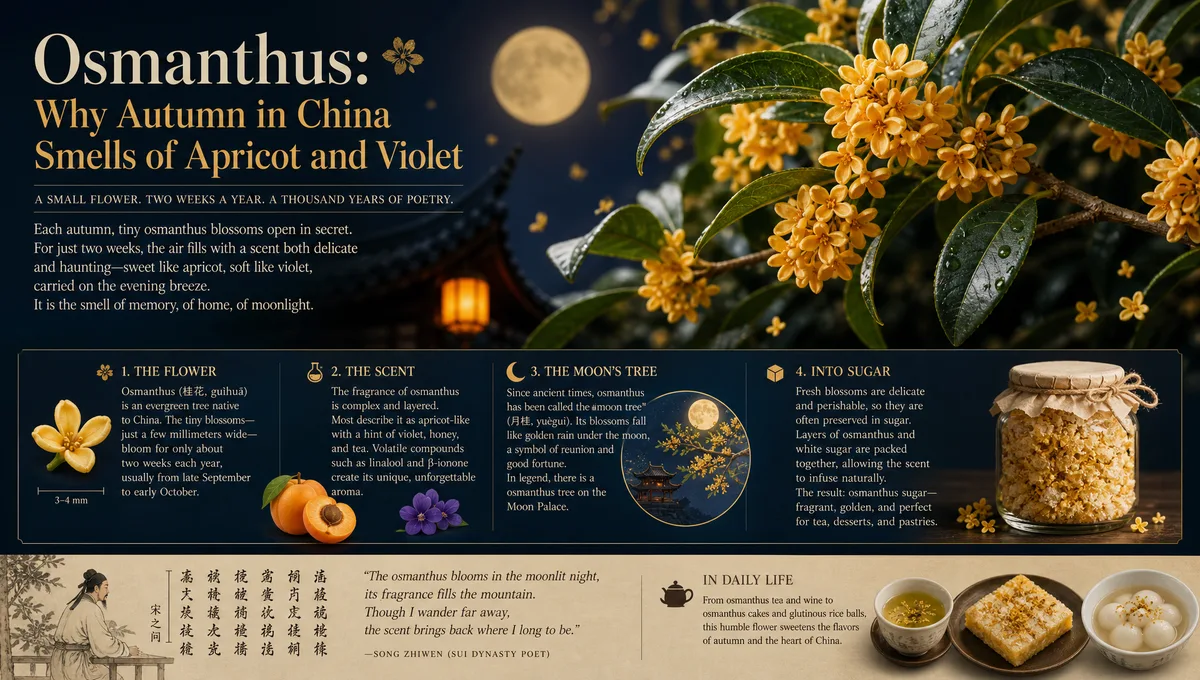
Most flowers in China are looked at. One is smelled from a street away.
In late September and October, the osmanthus opens in small clusters along the branches, four petals each, smaller than a fingernail. The tree itself is unremarkable: evergreen, dense, unexciting for fifty weeks of the year. Then for about two weeks the air around it turns sweet, and everyone in the neighbourhood knows where the tree is.
The Flower That Times Itself to the Moon
The osmanthus is gui, and its season is the eighth lunar month. That month has a second name: gui yue, the osmanthus month. The Mid-Autumn Festival falls inside it, which is one reason the flower is tied to the moon rather than to the garden.
The old stories make the connection literal. The moon is said to hold an osmanthus tree, and a man named Wu Gang is condemned to chop it down. The tree regrows as fast as he cuts, so the work never ends. It is a punishment story with a strangely pleasant image at the centre: a tree on the moon, dropping flowers.
There is a second layer, and it is social rather than celestial. Chan gong zhe gui, “plucking the osmanthus in the toad palace”, meant passing the imperial examinations. The moon’s tree became a metaphor for an achievement that a family could wait generations for.
Four Kinds, Four Colours
Gardeners sort osmanthus by colour and season, and the names are worth knowing if you plan to plant one.
Jin gui is golden yellow and the strongest scented. Yin gui is paler, almost cream, and milder. Dan gui is orange-red with a sharper, less sweet smell. Si ji gui is the odd one. Pale, sparse, and flowering on and off all year, it is useful in a small courtyard. It is a disappointment if you wanted a season.
The yellow ones carry the perfume. If a garden has one tree you can smell from the gate, it is almost certainly a jin gui.
What the Smell Actually Is
Osmanthus scent is unusual in that it reads as food rather than as flowers. People describe apricot, peach skin, honey, sometimes a powdery violet note.
The violet part is not imagination. One of the main aroma compounds in osmanthus is a type of ionone, the same family that gives violets their smell and that appears in some teas and wines. The apricot side comes from a group of fruity esters. Together they produce a scent that smells edible, which is convenient, because it is.
Picking, Preserving, and Sugar
The flowers are harvested in the two weeks they last. The method is simple and hasn’t changed: spread a cloth under the tree, shake the branches, collect what falls. Dry flowers are useless, and wet ones spoil quickly, so the work happens on a dry morning.
What comes home gets preserved, and sugar is the usual medium. Flowers are picked over, any green matter removed, then layered with sugar and left. The result is tang gui hua, osmanthus sugar: a jar of sticky golden preservative that keeps for a year and gets spooned into everything from porridge to rice cakes.
A salted version exists too, used in cooking rather than in sweets. And a syrup, made by steeping the flowers in hot sugar water, is what most commercial jars actually contain.
On the Table
The flavour turns up in more places than a foreigner expects.
Osmanthus cake is steamed rice flour with a layer of the sugar through it. Osmanthus wine is grain spirit infused with fresh flowers, traditionally opened at the Mid-Autumn Festival, when the tree is in flower. Stuffed lotus root is a Jiangnan dish: glutinous rice pressed into the holes of a lotus root, then simmered in osmanthus syrup. It turns up on autumn tables from Nanjing down to Hangzhou.
And in tea. Add a spoon of dried flowers to a plain green or oolong base and it is sold as osmanthus tea. That is less a variety of tea than an addition to one. Brewed in a gaiwan it is one of the simplest things in the whole tea repertoire.
Where to Smell It
Two places are famous for it, for different reasons.
Hangzhou has Manjuelong, a valley of osmanthus trees on the south side of West Lake. The combination of trees, slope and October air produces what the city calls man long gui yu, “the osmanthus rain of Manjuelong”. It is one of the ten scenes of the lake, and in season the path smells better than it photographs.
Guilin is named for the tree. The name means “forest of osmanthus”, and the city has planted accordingly. Whether the original forest was ever as dense as the name suggests is a question for local historians, but the planting today is deliberate and extensive.
Common Questions
Is osmanthus the same as “sweet olive”? Yes. Sweet olive and tea olive are both common English names for Osmanthus fragrans.
Can I grow one? In a mild climate, yes. It wants sun, decent drainage and a little patience; a young tree may take years before it flowers well. In cold winters it needs shelter, which is why it is grown in pots in northern China.
Why does my osmanthus tea taste bitter? Usually too much flower or too long a steep. A few flowers and a short infusion are enough; the aroma is strong and turns harsh when overdone.
Is the fruit edible? The flowers are what people use. The small purple fruit that follows is not a kitchen ingredient.
Do all of them smell? The yellow and orange ones do, strongly, for a short window. The four-season kind flowers often and smells faintly, which is exactly the trade-off its name suggests.
Two Weeks, Once a Year
The osmanthus is worth the trouble of learning because it does something most garden plants don’t: it changes the air of a whole street for a fortnight, then stops.
If autumn is your season to read about rather than garden, start with our piece on chrysanthemums in Chinese autumn. It covers the flower that shares the month. Then what the season does to a table covers the rest of it. More sits in the Culture section.