Wisdom8 min read
What Xiao Meant, and What It Means Now
The character for xiao puts an old person above a child. A short cultural history of filial piety in China, and why the modern reading keeps shifting.
By Ming Chen — Editor & Researcher
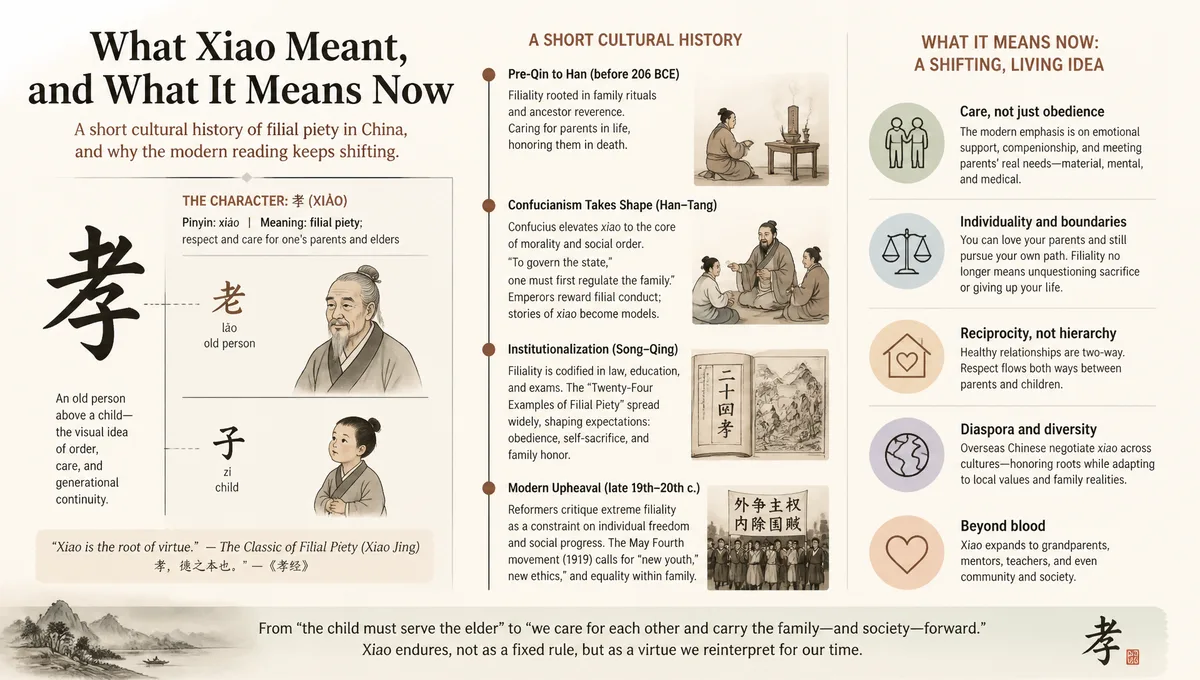
Xiao, filial piety, is one of the oldest and most argued-over words in Chinese life. It gets translated as filial piety, which is accurate and also useless, because English has no matching concept to hang it on.
The character itself is a picture. Look at it and you are already reading the idea.
One Character, Two Parts
The top of xiao is an abbreviated lao — old, or elder. The bottom is zi — child. One generation sits above the other, and the shape of the thing is the whole of the first lesson: this is a relationship, written as a fact.
What the relationship requires is where it gets interesting, and where almost every argument about the word has happened for two thousand years. The character does not contain the answer. It only contains the arrangement.
The Passages Everyone Quotes
The classic lines come mostly from the Analects, and they are worth having straight, because they are regularly misquoted in both directions.
Asked about xiao, Confucius answers with an objection rather than a rule: jin zhi xiao zhe, shi wei neng yang. zhi yu quan ma, jie neng you yang; bu jing, he yi bie hu. Today people call it xiao to feed their parents. But dogs and horses are fed too. Without respect, what is the difference?
That single line rules out the reading of xiao as material support with a receipt attached. Food and money are assumed. They are not the measure.
Another often-quoted line is fu mu zai, bu yuan you, you bi you fang — while your parents live, do not travel far; if you must go, go with a stated destination. The second half is usually dropped, which turns a request for information into a prohibition.
And on the harder question of disagreeing with a parent, the same book says: shi fu mu ji jian, jian zhi bu cong, you jing bu wei, lao er bu yuan. Remonstrate with them, gently; if they will not be persuaded, stay respectful, and do not resent the work. Note what is present in the sentence. Advice is expected. Obedience is not the price of it.
When the State Picked It Up
For about a thousand years, xiao was not only a family matter. It was a career path.
In the Han dynasty, officials were recruited through a system of recommendation, and one of the categories was literally xiao lian — the filial and the incorrupt. Being seen to care well for your parents could get you an office. It is the point at which a virtue becomes a performance, and Chinese writers have been noting the irony ever since.
Later dynasties legislated it differently. Under the Ming and Qing, an official whose parent died was expected to leave his post and go home to mourn, a period of roughly twenty-seven months. The state made room for grief, and it also made grief compulsory.
The most quoted anthology on the subject is the Twenty-Four Parables of Filial Piety, put together in the Yuan dynasty. Several of its stories are extreme. One son lies on ice to melt a hole for fish. Another proposes to bury his own child, on the grounds that there is not enough food for the grandmother. These were criticised as excessive even before modern times, and they were among the examples a young Lu Xun mocked sharply in the 1920s.
So the tradition contains its own critics. That is worth knowing before either defending it or dismissing it as a monolith.
Xiao Is Not the Same Word as Shun
The most useful distinction for a modern reader is between xiao and shun — obedience, or going along with.
In everyday use the two get welded together, and the phrase xiao shun now means something close to “dutiful and compliant”. But the classical texts separate them, and the separation is the interesting part. Respect, care, presence and honesty are xiao. Doing whatever you are told is not identical to it, and the tradition’s own stories contain characters who push back, refuse, and are praised for it.
Later Confucian literature tells of a disciple who accepted a beating from his father without resisting, and was criticised for it. A small rod you can take, the reasoning goes. A heavy one you should run from, because a father who injures his son has done wrong. The story is a story, not a rule. It still shows where the line was drawn.
What Changed in the Last Century
A practice built on proximity became difficult to keep when proximity stopped being normal.
Work moved to cities. Households got smaller. A generation grew up in one province and raised children in another, or on another continent. The practical arrangements xiao had always assumed — the same courtyard, the same town, the same daily presence — stopped being available to millions of people at once.
What replaced them is not simple neglect. It is remittances. It is the video call at a fixed hour. It is the train ticket booked eleven months ahead. It is an adult child who flies home twice a year and phones every Sunday, and who carries a low continuous guilt about the arithmetic.
Anyone who reads Chinese poetry from a thousand years ago will notice that this is not new. The complaint of the official posted far from home, watching the moon and thinking about his mother, is one of the oldest registers in the language. Our piece on poems about ageing covers some of it.
How It Looks in Ordinary Life
The customs that carry the idea are mostly small and mostly domestic, which is why they survive.
Spring Festival is the yearly attempt to be in the same room, and the transport system strains under it. Qingming sends families to sweep graves. Chongyang, on the ninth day of the ninth month, is the festival explicitly about elders, and the day when people take their parents up a hill. A washed foot, a basin of hot water and a towel remains a standard image of care, in advertising and school compositions alike. It is the reason our article on evening foot soaking mentions the gesture at all.
There is also a habit that runs alongside: bao xi bu bao you, reporting the good news and not the bad. Children who live far away give their parents a filtered version of their lives, on the theory that the worry costs more than the information is worth. Parents do the same thing back, for the same reason.
Reading It Without Keeping Score
This is where a site like this one has to be careful. Xiao sits close to questions people hold personally: how much time is owed, whose city a couple settles in, whether an ageing parent moves in. There is no version of those questions that a cultural essay should answer.
What can be described is the shape of the expectation, and where it came from. The Chinese model of care between generations is strongly reciprocal. A grandparent who raises a grandchild is not doing anybody a favour; the account runs in both directions and everyone involved treats it as such. If there is a difference from the Western norm, it is less about warmth than about accounting: the obligations are named, expected and mostly not discussed out loud.
What This Is Not
It is not a values lecture, and it takes no position on how anyone should organise their family. It is also not a claim that one culture cares for its elders more than another — the practical arithmetic of modern working life makes that comparison mostly meaningless.
It is a description of one word, what it used to require, and what it demands now.
Common Questions
Does xiao mean absolute obedience?
The classical texts do not read that way. They expect advice, respect and care, and they distinguish all three from simply complying.
Where does the phrase xiao shun come from?
From ordinary usage rather than the classics. It joins xiao, the care owed to parents, to shun, going along with them, and treats the pair as one obligation.
Is xiao still important in China today?
It is still the framework families reach for when they talk about elder care, even where the practice looks nothing like it did a century ago.
Why do the Twenty-Four Parables include such extreme stories?
They were moral teaching material, and teaching material exaggerates. Several of the stories were criticised for going too far, including by Lu Xun in the 1920s.
Did the state ever enforce it?
Yes, and unusually directly. The Han used recommendations of the filial as a route into office, and later dynasties required officials to leave their posts to mourn a parent.
An Old Word, Still Being Defined
Two thousand years of commentary have not fixed the meaning of the character. They have produced a long argument about what care between generations is worth, who owes it, and how it survives a train timetable.
That argument is still going, in kitchens and on video calls, and it is more interesting than the shorthand. Our piece on Spring Festival covers the yearly attempt to gather. The parable of the lost horse is the tradition’s best-known comment on not knowing yet whether something is good news. More in the wisdom section.