Wellness6 min read
Winter Foot Soaking: What Goes in the Water
Winter foot soaking is a household habit in China. What people put in the water, how hot, how long, and where the tradition stops and advice begins.
By Lian Zhao — Copy Editor
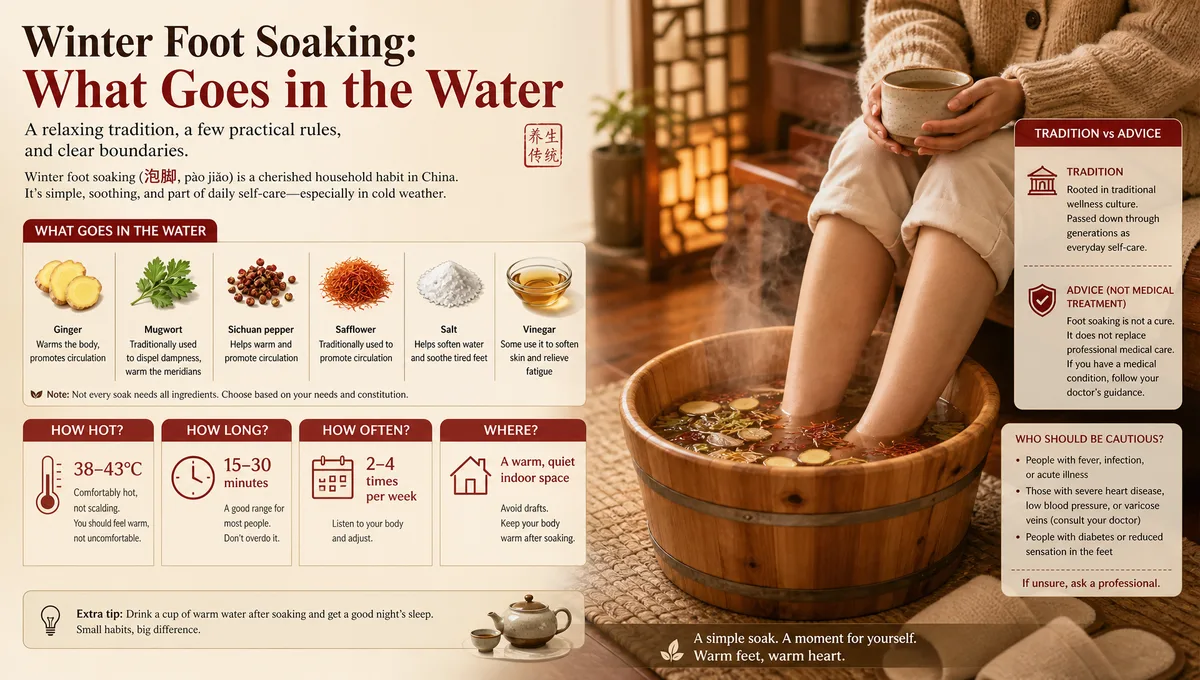
In a Chinese household, the first cold week of the year produces a basin.
Someone boils water, digs out a bag of dried herbs from the cupboard, and sets a stool in front of the sofa. Ten minutes later the room smells of ginger and mugwort, and the day is officially over.
This is a piece about the habit as a habit: what people use, what the numbers are, and where the tradition should hand over to your doctor. It is not a page about what soaking does inside a body, and this site does not make claims of that kind.
The Standard Version
The plain version needs three things: hot water, a basin deep enough to cover the ankles, and a towel.
That is the version most households actually use, and it is the one to start with. Everything else is a variation, and the variations carry a lot of regional character.
What People Add
The additions are chosen for smell, for colour, and for tradition rather than for any agreed effect. Listed roughly in order of how often they show up.
| Addition | Where it is common | Note |
|---|---|---|
| Mugwort (ai cao) | Nationwide, especially around the Dragon Boat Festival in summer and again in winter | Sold dried, tied in bundles; strong, herbal smell |
| Fresh ginger | Southern households | Sliced or crushed; warms the smell sharply |
| Sichuan pepper | Sichuan and the southwest | A handful, in a cloth bag to keep the seeds out of the water |
| Coarse salt | Coastal provinces | Cheap, easy, no scent |
| Dried orange peel | Guangdong and Fujian | Kept through the year from winter fruit |
| Rice wine or spirit | Northern households, older habit | A small cup; the smell is better than the result |
Two practical notes from anyone who has done this for years. A cloth bag keeps the water clear, and less is more: a fistful of dried herb is a strong soak, and a whole packet is usually a waste.
The Numbers People Use
These are the ranges that appear in household practice and in the older popular literature. They are conventions, not measurements to follow blindly.
- Water temperature — hand-hot, comfortable on the wrist. Around 40 °C is the usual figure quoted.
- Depth — above the ankle bone, below the calf.
- Time — 15 to 20 minutes, while the water is still hot.
- Timing — before bed, at least an hour after a large meal.
- Finish — dry the feet properly and put on socks; the older habit says do not walk on a cold floor afterwards.
The traditional stopping point is described as a light warmth across the back, sometimes translated as a faint sweat. Household practice treats that as the moment to stop rather than a state to hold.
The Basin Itself
Two options dominate, and the choice is mostly about heat.
The wooden barrel (mu tong) holds temperature better and looks the part; it is heavy, needs rinsing, and must not be left soaking. A plastic basin is cheap and light and loses heat within ten minutes, so most people add hot water halfway through.
Extras that show up in shops include a lid with two holes for the feet and a mat to protect the floor. An electric version keeps a set temperature.
Family Logistics
The habit is public in most homes, and that shapes it.
- One basin, several people — the usual fix is a plastic bag liner per person, or staggered times
- Children — usually a short, cooler soak with no additions, and an adult present
- Elderly family members — often the reason for a lid and a temperature check; if sensation in the feet is reduced, the water should be tested by hand or by someone else
- Guests — offering a basin is a hospitality gesture in winter, much like a second helping of soup
Where Tradition Should Stop
Two honest cautions, and this site would rather state them than leave them out.
Water that is too hot can scald. Foot skin is sensitive, and the common failure is topping up with kettle-hot water while the feet are already in. Pour into a spare bowl first, or take the feet out.
If you have a health condition, reduced sensation in your feet, or you are unsure, ask your doctor first. That is a reference to professional advice, not a claim about what soaking does; this page describes a household custom and offers no medical information.
The same restraint applies to the additions above. They are what people put in the basin. None of them is presented here as a way to change anything inside a body.
A Ritual, Not a Course
What the habit actually provides is a boundary: a fixed twenty minutes, a stool, a warm floor, and a signal that the working day has ended.
If that appeals, the practical way in is the plain version. Boil water, find a basin, sit for fifteen minutes and go to bed. Add the herbs later, once the sitting part has become routine.
Our first piece on the subject, foot soaking before sleep, covers the wind-down side of the same habit. The winter warmth guide covers the rest of the household’s cold-weather routines.
Common Questions
How hot should the water be?
Hand-hot, and comfortable on the wrist. Around 40 °C is the figure usually quoted in household practice, and it is a convention rather than a measurement.
How long is enough?
Fifteen to twenty minutes is the usual window. Longer soaks mostly mean water that has gone cool.
Do the herbs do anything?
They change the smell and the colour of the water, and they are part of the tradition. This page makes no claim beyond that.
Is it safe for everyone?
Not automatically. Reduced sensation in the feet, or an existing health condition, is a reason to check with a doctor before using hot water on your feet.
Can I use a normal plastic basin?
Yes. It loses heat quickly, so expect to add hot water once or twice. A wooden barrel holds temperature better and needs more care.
Twenty Minutes and a Towel
The habit survives because it is cheap, repeatable and pleasant, and because it gives a cold evening a shape.
That is the whole case for it, and it is enough. Anyone who wants more than that from a basin should be talking to a doctor rather than to a website.
More household routines are in the wellness section, including seasonal eating and the slow kitchen.