Wellness7 min read
A Hundred Steps After Dinner: Where the Saying Comes From
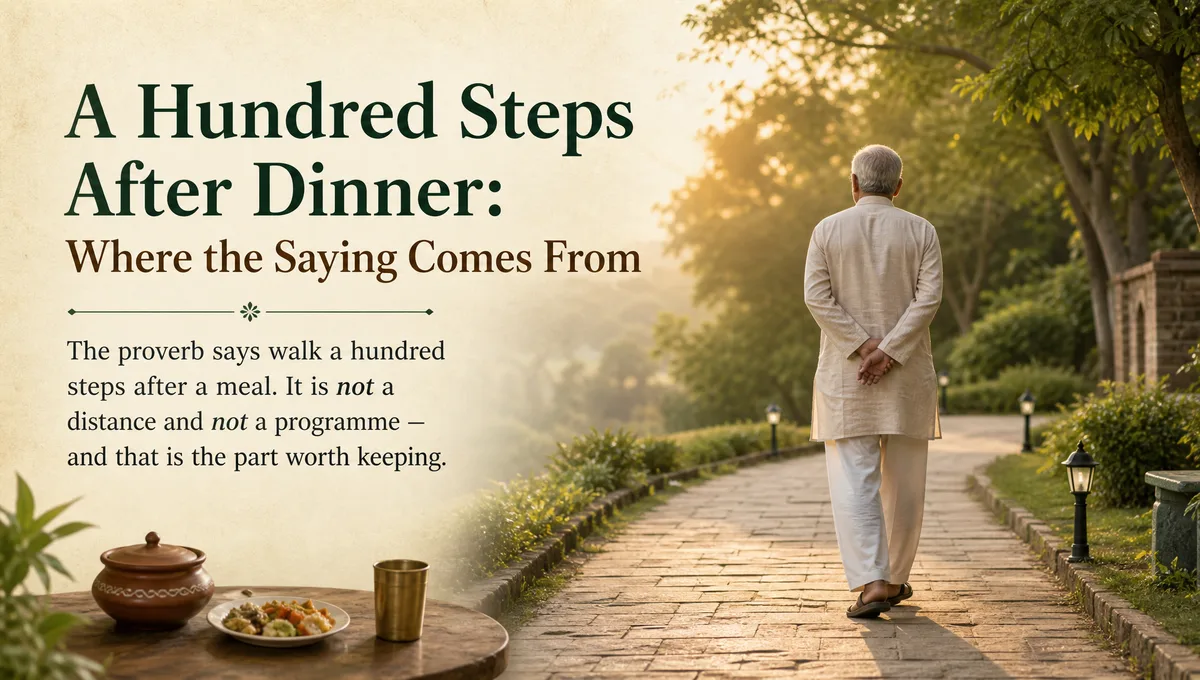
The proverb says walk a hundred steps after a meal. It is not a distance and not a programme — and that is the part worth keeping.
By Wen Su — Writer & Editor
Fan hou bai bu zou, huo dao jiu shi jiu. Eight characters, two numbers, and a claim. It is one of the most repeated lines in the Chinese language, and it is usually quoted as an instruction.
Read it straight and it describes a habit that already existed. The numbers are doing something other than counting.
Two Numbers That Are Not Measurements
Start with the count.
A hundred steps is not a distance. It is a short walk. In Chinese sayings, bai usually means “a good many” rather than one hundred exactly, and it turns up in that sense in dozens of ordinary expressions. The instruction is to walk briefly, soon after eating, without hurrying.
The second number is better. Jiu shi jiu — ninety-nine — stops just short of a hundred. Round numbers carry a certain formality, so a folk blessing says “very long” without naming the finish line. It is the same instinct that puts a traditional ceiling at ninety-nine.
The proverb is description rather than instruction, with a blessing folded into the arithmetic.
Small Units Were Always the Point
The steps half of the line belongs to a much older way of thinking about effort.
The Tao Te Ching ends its sixty-fourth chapter with qian li zhi xing, shi yu zu xia — a journey of a thousand miles begins beneath your feet. Xunzi put the same idea in harder words: bu ji kui bu, wu yi zhi qian li. A kui bu is half a pace.
Neither image is about distance. Both are about the smallest unit you can repeat. The dinner walk fits that family exactly, which is probably why it outlived the advice that produced it.
The Walk Is a Civic Institution
In most Chinese cities, the after-dinner walk is not a private habit.
It happens at the same hour on the same circuit, and everybody knows the route. A loop around the compound. A street with trees and a bench. A stretch of riverside path.
Between seven and nine in the evening it fills up. Couples walk without talking. Grandparents trail a child on a scooter. Dogs, teenagers on phones, and one man doing very slow arm circles on the corner.
Fitness equipment in public parks gets its second shift after dinner. So do the squares, where the dancing starts. What the hour produces is a low-grade, entirely unorganised carnival of people doing the same small thing in the same place.
Our piece on the three crowds in a morning park describes the daytime version of the same arrangement.
Three Words for One Walk
The vocabulary reflects how ordinary the habit is, and how regional.
Liu wan is the northern word, and it is almost untranslatable. It means to take a stroll with no destination, the way you might walk a dog. The character liu is the one used for walking animals. It tells you what the activity is: a leg-stretch, not a workout.
San bu is the formal term, the one in dictionaries. Literally, to scatter steps. It is the word you would read in a book or see on a hospital sign.
Zou yi zou is what people actually say when they are leaving the table. Just go for a little walk. The repetition softens it into an invitation rather than a plan, and you can hear the difference immediately.
Three words, one activity, and not one of them implies a target.
The Other Saying
The tradition is not unanimous, and it is worth knowing the counter-line.
Plenty of older advice warns against moving briskly straight after eating. The household version that survives both positions is fan hou xie yi xie zai zou — rest a little, then walk. Everybody seems to have grown up with some version of this, usually delivered by a grandmother, and it is closer to how the habit is actually practised.
Two pieces of folk advice, side by side, one qualifying the other. That is how most oral traditions work, and reading the proverb alone flattens it.
Xiaoshi: The Word That Sets the Pace
The reason usually given for the walk is xiao shi — literally, to dissolve the food. It is a household word, used without ceremony, and it is treated on this site as a custom rather than a claim about the body.
What matters is what the word does to the walking. Xiao shi describes a process, and a process cannot be rushed. It produces a stroll instead of a march, hands behind the back, no target and no pace.
That is the opposite of what most exercise advice asks for, and probably why it is easier to keep.
Then the Step Counter Arrived
The modern number is ten thousand, and it is a very different kind of number.
The figure is usually traced to a Japanese pedometer sold around the 1964 Tokyo Olympics, marketed as the ten-thousand-step meter. The name came first and the advice followed, which is the reverse of how these things are usually presented.
The contrast with the proverb is the interesting part. Bai bu is about rhythm: a small amount, repeated, attached to a moment in the day. Ten thousand is about volume: a target to hit, counted, and abandoned when it is missed. One fits into an evening. The other becomes a second job.
A Walk at Night, With a Friend
The best writing about walking in Chinese is not about distance either.
Su Shi wrote a short piece about a night in 1083 when he could not sleep. He went to find a friend, and the two of them walked in a temple courtyard. The moonlight made the ground look like water, he wrote, and the shadows of the bamboo and cypress moved through it like weeds.
Then came the line that has kept the piece alive: He ye wu yue? He chu wu zhu bai? Dan shao xian ren ru wu liang ren zhe er.
Which night has no moon? Which place has no bamboo? There is simply a shortage of unhurried people like the two of us.
The walk was never the scarce thing.
What This Is Not
It is not medical guidance, and the proverb is not an instruction promising a result. It is folklore, with a history, and this site describes it that way.
It is also not a claim about what a walk does after a meal. Chinese households carry their own beliefs on that point, and they are worth describing as beliefs. Anything more belongs with a doctor.
Three Ways to Take It Up
- Pick a circuit. The habit is easier to keep when the route is fixed and boring. Novelty is the enemy of a daily walk.
- Keep it short and attach it to a meal. Ten minutes, straight after dinner, is the version that survives. A long walk needs a decision. A short one does not.
- Find a person, not a target. The two-man night walk is the traditional version, and it works for the reason it always did. It is much harder to skip a walk that someone is expecting you on.
Common Questions
Is a hundred steps literal?
No. Bai in sayings usually means “a good many”. The instruction is a short walk, not a measured distance.
Why ninety-nine?
Because round numbers are for formal occasions. Ninety-nine is the folk way of saying “a very long time” without tempting fate.
Should I walk before or after resting?
The household version is to rest a little first, then walk. Both pieces of advice have been in circulation for a long time.
Is this about digestion?
Xiao shi is the traditional word for it, and a household term. This site treats it as custom rather than as a claim.
Where did ten thousand steps come from?
Usually traced to a Japanese pedometer named for the number, sold around the 1964 Olympics. The name came first.
More everyday practice sits in the wellness section, including the midday nap that occupies the other end of the day.