Wellness5 min read
Three Kinds of People Own a Chinese Park at Seven in the Morning
Three kinds of people own a Chinese park at seven in the morning. What the groups are, when each arrives, and the manners of watching without intruding.
By Wen Su — Writer & Editor
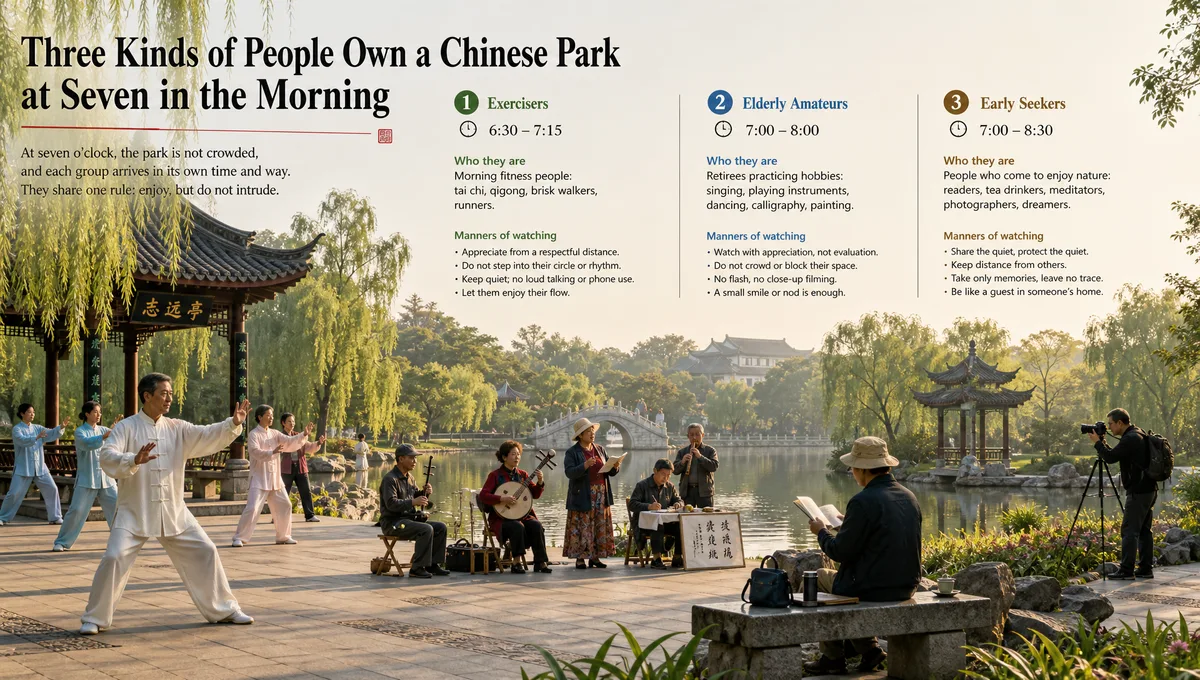
A Chinese city park has a timetable, and it is written by the people who use it.
By half past five the earliest group is in place. By six, music starts at the other end. By eight, a third shift has arrived, and the first two are mostly gone. Three crowds, one space, no organiser.
This is an observation piece rather than a routine to copy. The interest is in how a public space organises itself when nobody is in charge.
The First Group: The Quiet Corner
They arrive in the half-dark and take the same patch of ground they have used for years.
- Slow forms: Tai Chi, sword sequences, standing practice against a tree
- A radio at low volume, or none at all
- Little conversation before or after
- Small groups of two or three, sometimes alone
The movements are slow, and the tempo is deliberate. Our guide to standing practice covers one of the forms you see here, with a companion on the knees, and five gentle qigong movements covers another.
What marks this group is not the exercise. It is the regularity. Many of these people have stood in the same spot at the same hour for a decade, and the park bench beside them functions as a locker and a noticeboard.
The Second Group: The Music
By six, a different kind of sound arrives: a portable speaker, a queue of people, and a route.
Three formats are common.
Group dance — a dozen to fifty people, one speaker, a leader at the front facing the group. The music is loud, the steps are simple, and newcomers copy from behind. This is what English usually calls square dancing, though the Chinese term simply means plaza dance.
Marching and walking teams — a line that moves around the park perimeter, sometimes with a flag or a uniform shirt. Numbers matter to this format; a walk becomes a group activity with a fixed route and time.
Organised fitness routines — an instructor, a mat area, and a sequence borrowed from aerobics or broadcast exercise programmes. This is the format most likely to include men, and the most likely to have a fee of a few yuan per month for equipment.
The plaza dance phenomenon spread across cities in the 2000s and has produced a durable argument about public space. Residents near parks complain about volume and hours; participants point out that the alternative for many older people is a small flat and a television. Most cities have since pushed the activity earlier and quieter, which is why the music now starts at six rather than seven.
The Third Group: The Social Shift
The last group arrives after eight, when the air is warmer and the first two have left for breakfast.
- Bird cages hung in a row of trees, owners sitting on stools beneath them
- Chess and card games with spectators standing three deep
- Tea in a thermos, and conversations that last the morning
- Shopping trolleys on their way back from the market
This group is barely exercising and it is doing the most important work of the three. For a retired person whose social world was the workplace, a park bench at nine in the morning is infrastructure. It is a place to be expected, at an hour when someone will notice you are late.
If you want the dining side of the same morning, our piece on the Chinese breakfast table follows what these people eat on the way home.
Watching Without Intruding
Visitors are welcome and photographs often are not, and the distinction is easy to get wrong.
- Watch from a bench, not from a metre away. Standing behind a class with a camera reads as inspection.
- Do not photograph faces close up. Wide shots of a park are ordinary; a stranger’s portrait is not.
- Ask before joining. Most groups will wave a newcomer in, but the leader needs to know the count.
- Do not correct anyone’s form. The quiet corner has its own authorities, and they did not recruit you.
- Learn the hours. Arriving at nine expecting the dancers only reveals that you have not understood the place.
What the Timetable Says
The park is a free, unmanaged answer to three separate needs: a place to move, a place to be with others, and a place to be expected.
Most cities in the world have the first and second somewhere. Fewer have the third, and the third is the one that seems to keep people arriving at half past five for a decade.
Common Questions
Is this a bookable activity?
Almost never. Groups form informally, some collect a small fee for speakers or equipment, and there is no sign-up. Some parks now have designated areas where amplified music is permitted.
Why does it happen so early?
Two reasons: heat and habit. In summer the cool hours are before eight, and the early slot is also quieter and less likely to be refused by neighbours.
Can visitors join a group?
Often yes, especially walking teams and dance groups. Watch the first ten minutes, then ask the person with the speaker.
What is the best time to see it all?
Between six and seven, when the quiet corner and the music groups overlap. By nine, the park belongs to the conversation.
Is there advice here about exercise?
No, and this site does not offer it. This is a description of how a public space is used, not a programme to follow.
A Park With a Clock
Stand in one spot for an hour and the whole structure becomes visible. The slow group arrives first, the loud group takes the middle, and the social group inherits the rest of the morning.
None of it is organised, and all of it is orderly. If you ever want to see how a public space can run itself with no committee and no budget, this is the demonstration, and it starts at half past five.
More on daily practice sits in the wellness section, including the slow kitchen and foot soaking in winter.