Wellness7 min read
Zhan Zhuang and the Knees: Foot Position and How Deep to Stand
Knees, feet and depth are what beginners ask about most in zhan zhuang. What the traditional cues aim at, and how to tell stiffness from a stop signal.
By Lian Zhao — Copy Editor
By the second week of zhan zhuang, almost nobody is still thinking about standing still. They are thinking about their knees.
How low should I be? Do my feet stay parallel? Why does the weight keep settling into my heels? And is the shaking at minute three normal, or have I got it wrong?
The old instructions answer most of this, but they usually assume there is a teacher in the room. This piece spells out the lower-body questions one at a time. If you have not seen the practice itself, start with standing still for ten minutes.
How Deep Is “Slightly Bent”?
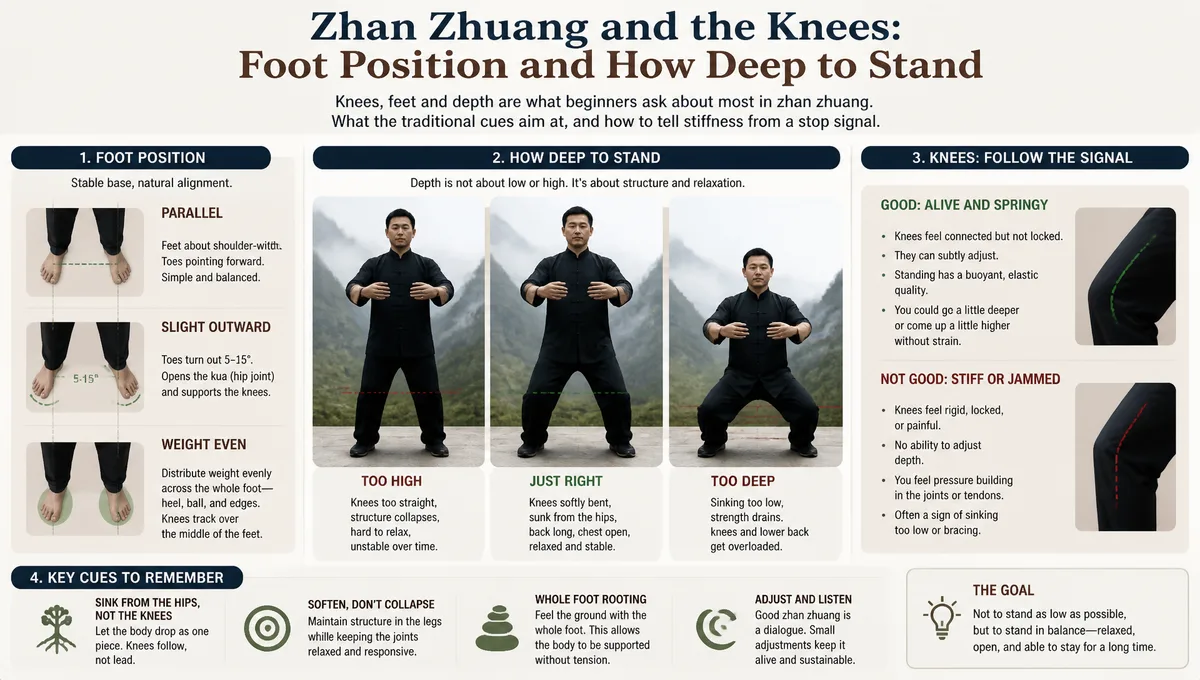
Every book says “bend the knees slightly”, which is where the trouble begins. Slight is not a measurement, and beginners read any instruction to bend as permission to sink.
Two tests get past that.
The first is just looking. If someone across the room can tell at a glance that your knees are bent, you have gone deeper than the practice wants. The bend belongs in the posture, not in the outline of your legs.
The second is your voice. You should be able to say a full sentence at normal volume, and breathe underneath it, without working at it. A stance you cannot talk in is a stance you will quit after forty seconds.
The old image is neither a squat nor a martial arts stance. Think of standing on a moving boat: the legs stay long, and the knees just stop being locked. That last part is what most people miss. Knees jammed back into a straight line are not stable, and they make you hold the whole position with muscle. “Bend the knees” is really another way of saying “stop locking them”.
Where the Knees Point
Once the knees are soft they need a direction, and the traditional answer is the second toe.
The knee should track over the middle of the foot. If it drifts inward, the weight piles onto the inner edge; if it drifts out, the outer edge takes it. Watching the middle of the foot keeps both edges honest.
This is why beginners are told to keep the feet parallel — it is the version you learn before you change anything. Turning the toes out a little is a reasonable later adjustment, especially with stiff hips. What matters is that the knee keeps following the foot instead of fighting it.
Two older cues belong here. Song kua means letting the hips hang instead of gripping. Yuan dang describes a rounded space between the legs, an arch rather than a clamp. Both are getting at the same thing: the pelvis stays loose, and the legs hold the shape instead of the pelvis holding it.
Feet: Width, Angle, Weight
Width. Shoulder-width is the starting point because it measures itself. Stand too narrow and you wobble. Stand too wide and the work moves into the outer hips, which makes the shallow bend hard to keep.
Angle. Toes forward. Feet parallel to each other — not turned out like a duck, not squeezed into a pigeon stance.
Weight. The whole foot should carry it: heel, ball and outer edge, roughly equal. This is the one most beginners get wrong, because dropping into the heels feels safe at first. It is not. Weight that lives only on the heels takes the front of the foot out of the job and tips the pelvis back.
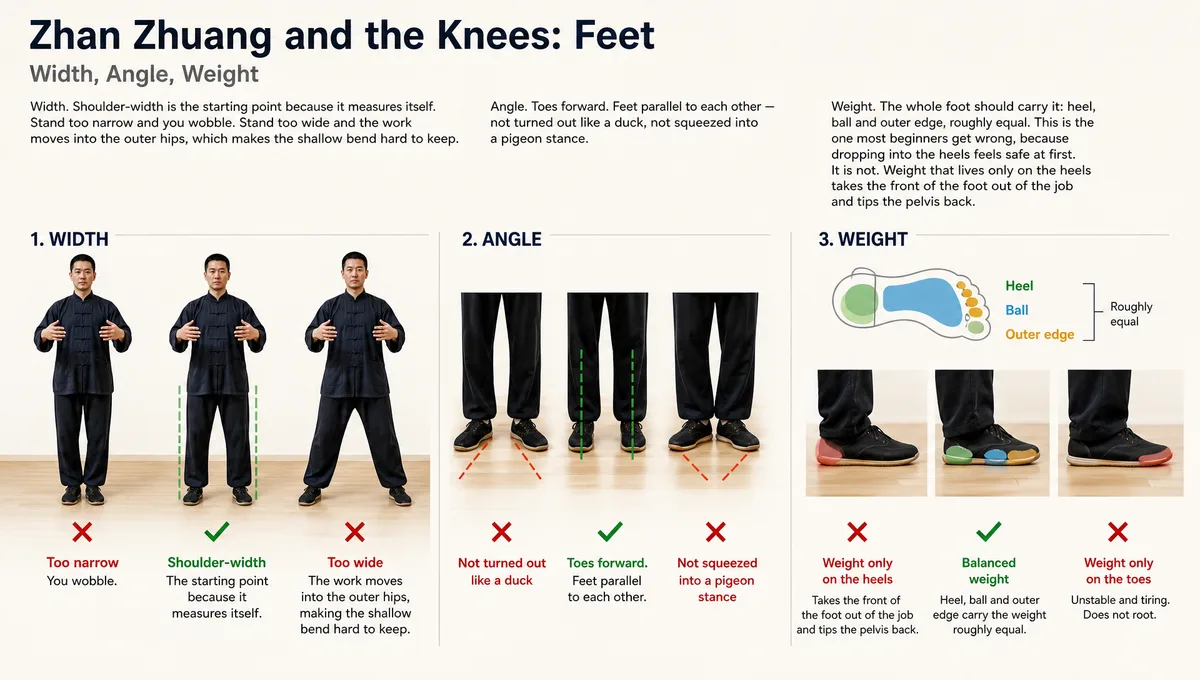
For the first month, check the foot once a minute the way you would check a table for a wobble. Four corners, even load.
The Floor, Socks and Shoes
The practice needs a flat surface and a way to feel the floor. Everything else follows from those two.
Floor. Wood is ideal indoors, tile is fine. Thick carpet is the hardest to work on: the whole foot sinks and the feedback disappears.
Feet. Barefoot or in socks on a non-slip floor reads clearest. If the floor is cold, a thin sole beats a thick one.
Shoes. Skip thick, cushioned trainers indoors. They exist to soak up exactly the information the practice is trying to collect.
The tradition was practised outdoors on packed earth. A flat stone path or a solid balcony floor works the same way. The five gentle qigong movements can be done in almost any shoes; standing still cannot.
How Long, How Often
Three minutes twice a day does more than twenty minutes once, and it has nothing to do with fitness. The practice is training your attention to stay put, which is a habit rather than a workout.
Add one minute a week and you will not overshoot. Most people who comfortably reach ten minutes took about two months to get there.
One thing to know before you start: somewhere between minute two and minute four, the legs often start to tremble lightly and the mind gets unusually loud. Nearly everyone reports both, and neither is a fault in the stance. Standing still leaves the mind nowhere to hide, and that is exactly the exercise.
If balance is a worry, use a wall. Standing a hand’s width in front of one is the traditional starting point, not a compromise.
When to Stop
Two different feelings show up, and they want different responses.
Stiffness that eases. The legs and lower back complain in the first minute, then settle. That is ordinary, and it usually passes while you hold the position.
Anything sharp, hot, or on one side only. That is a stop sign. Come out, walk around, and shorten the next session. Pushing through a signal like that does this practice no favours.
This is a description of a traditional practice, not medical guidance. Persistent or one-sided discomfort around the knees belongs with a professional, and no standing posture replaces that conversation.
The Six Usual Corrections
- Too deep. Visible from across the room means too low. Raise the hips until the bend is barely there.
- Locked knees. The opposite fault, and it shows up most in people who were told to stand up straight for fifty years.
- Feet too close. A narrow base sways, and no amount of concentration fixes a sway.
- Weight in the heels. Even load, four corners, checked once a minute at first.
- Lifted shoulders. Let them drop before you start counting. If they climb back at minute three, drop them again.
- Too long, too soon. Ten minutes in week one is how most beginners stop by week three.
Common Questions
How deep should zhan zhuang be?
The bend should be there when you look for it, but not obvious from across the room. You should also be able to talk and breathe normally the whole time.
Parallel feet or turned out?
Parallel is the standard start, knees tracking over the middle of the foot. A slight outward turn is a fine later adjustment for stiff hips.
Why do my knees shake after a few minutes?
Light trembling is common and usually means the legs are working, not that you are doing it wrong. If the trembling starts earlier each session, shorten the standing time.
Barefoot or shoes?
Barefoot or socks on a non-slip floor gives the clearest sense of the ground, which is the whole point. A thin sole is a reasonable stand-in on cold floors.
Can I use a wall?
Yes. For anyone with balance concerns, a wall a hand’s width behind you is the recommended starting position, not a step down.
Less Depth, More Years
The knees are where beginners over-correct, and you can see why. A deeper stance looks more like practice. But the tradition’s own measure is whether the posture can be held, then forgotten.
Keep the order: soften the knees first, then set the feet, then let the depth find its own level. Of the three, depth is the one to underdo.
What the practice changes over months is a different question, and it has its own piece: zhan zhuang benefits.
If you are still settling into the habit, the five gentle qigong movements are a good companion on days when standing still feels like too much. The eight-section brocade covers the moving set people often alternate with standing. More gentle practice is in the wellness section.