Wellness6 min read
Zhan Zhuang Benefits: What Standing Practice Does and Does Not Change
What zhan zhuang benefits hold up, and what gets overstated: balance, leg endurance, posture and calm, plus how long each change usually takes.
By Wen Su — Writer & Editor
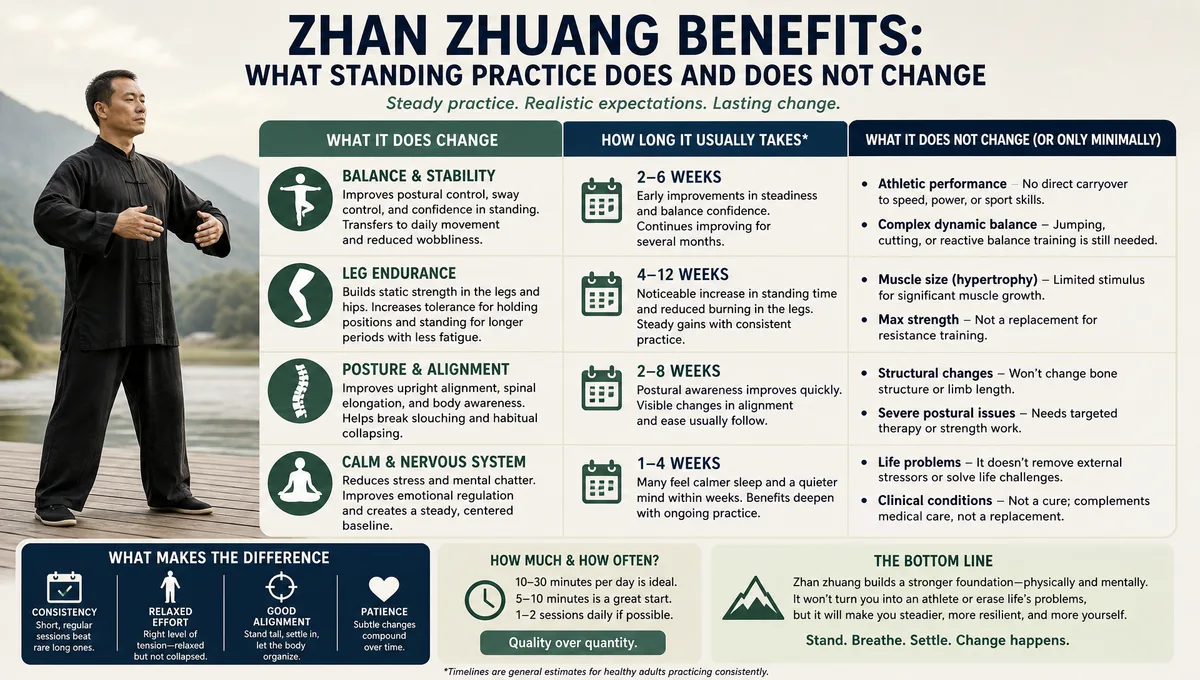
Most people arrive at zhan zhuang through a question exactly like the one in the title. They have read that standing still is good for something, and they want to know what.
The honest answer is narrower than the internet suggests. Standing practice does a few things well. It is not a general-purpose fix, and the tradition’s own claims are larger than anything a study has shown.
This piece keeps those two things apart. Below is what the practice is traditionally said to do, what the research can actually support, and roughly how long the changes people describe tend to take.
What the Tradition Claims
Classical writing on standing practice is not modest. It describes the posture as building jing (essence), qi and shen (spirit) at once, and as a foundation for both health and martial power.
The martial side is the easier half to check. Wang Xiangzhai (1885–1963) built an entire art, yi quan, around standing postures. His students stood for long stretches before they were taught to move. Whatever else that was, it was training.
The health side is where caution belongs. Traditional texts describe better circulation, steadier nerves and a stronger constitution. Those are descriptions of an experience, not measurements. Read them as the tradition’s own account rather than as findings.
What the Research Can Support
Zhan zhuang sits inside a well-studied family: tai chi, qigong and other slow, low-intensity practices. Research on that family is mildly encouraging and consistently modest.
Three findings keep appearing in reviews of older adults:
- Balance and confidence. Slow standing and weight-shifting practice is associated with better balance scores and less fear of falling.
- Lower-limb endurance. Holding a posture for minutes at a time is leg work, and legs adapt to work.
- Calm and attention. People in slow-movement programmes often describe a steadier mood, though self-report is a soft measure.
Two limits apply to all of it. Samples are usually small, and the studies rarely separate zhan zhuang from the rest of a programme. Anyone quoting a precise percentage is quoting more than the evidence carries.
Four Changes People Notice First
These are the reports that come up most often from people who keep the practice for a month or two. They are descriptions, not promises.
The legs get quieter. The trembling in the thighs during week one fades. Standing for five minutes stops being an event.
The feet wake up. Most beginners carry their weight in the heels. Learning to spread it across the whole foot changes how standing feels for the rest of the day.
The shoulders drop. Rounded arms are light work, but holding them shows how much tension the shoulders carry by default. People notice it at their desk afterwards.
The mind stops looking for a task. This one is slower. At some point the urge to check the phone during a session simply does not arrive.
What It Does Not Do
The other side deserves plain speech, because search results rarely give it.
It does not fix a named condition. No standing posture addresses a specific health problem. Any page that says otherwise is worth closing.
It is not cardio. Heart and lung fitness comes from work that raises your breathing rate. Standing still does not do that.
It is not strength training. Your legs get better at holding a position. They do not get meaningfully stronger in the sense a weight programme means.
It will not correct your posture on its own. Standing well for ten minutes helps you notice how you stand for the other twenty-three hours. The noticing is the benefit. The correction is still your job.
How Long the Changes Take
Nobody can give you a schedule, but the usual order is fairly consistent.
- Week one to two. The posture stops feeling strange. Three minutes becomes ordinary, and the knees complain less early in the session.
- Week three to six. Five to ten minutes is comfortable. Trembling turns occasional instead of routine.
- Month two to three. Standing gets boring in a good way. The mind settles faster, and you stop checking the clock.
- Beyond that. Balance and standing tolerance keep improving slowly. Most people lose count somewhere in here, which is the point.
If you are waiting for a dramatic turning point, you will wait a long time. The changes are small and cumulative, like most things that last.
How to Tell It Is Working
Chasing sensations is the most common way to derail this practice. Warmth in the hands is reported often, and it is not a score.
Better markers are duller and more reliable:
- The talk test. You can say a full sentence at normal volume without gasping. If you cannot, the stance is too deep.
- The clock test. The same three minutes feels shorter this month than last month.
- The setup test. You arrange the posture in fewer steps than you did in week one.
- The rest-of-the-day test. You catch yourself standing on one hip and shift your weight. That is the practice leaking into ordinary life, which is where it does its work.
Who Should Be Careful
Standing still is gentle, but it is not nothing.
If balance is a worry, a wall behind you is the standard starting position. If five minutes on your feet is uncomfortable, the same posture works in a chair with the feet flat and the arms rounded.
If you have a heart condition, uncontrolled blood pressure, dizziness, or a recent knee or hip problem, ask your doctor before you begin. That is not a formality. Standing still for minutes at a time loads the legs and holds your body in one position, and a professional knows your case better than any article does.
Common Questions
Is zhan zhuang good for seniors? It suits people who want gentle, low-impact practice, and it needs no equipment. Balance work is worth doing at any age. Start with three minutes against a wall and add a minute a week.
Does it burn calories? Very few. Standing still is not a weight-management tool. Think of it as attention and posture practice, not exercise.
Can I do it every day? Yes, and short daily sessions beat long weekly ones. Three to ten minutes of standing does not need rest days.
Will it help me sleep? Some people describe feeling calmer in the evening after a session. That is a report rather than a finding. If sleep is why you are here, an evening wind-down routine matters more.
Do I need a teacher? Not to begin. A teacher helps once the basics are familiar and you want corrections on details you cannot see in yourself.
Where This Leaves You
Zhan zhuang offers less than its reputation and more than its appearance. Ten quiet minutes will not rebuild your health. It will teach your legs to hold a position and your attention to stay in the room, and both carry into everything else.
If you want the practice itself, start with standing still for ten minutes. The lower-body questions, depth and foot position, are answered in zhan zhuang and the knees. If you would rather move than stand, the five gentle qigong movements and the eight-section brocade are the other half of the same tradition. More gentle practice lives in the wellness section.