Wellness5 min read
Indoor Shoes: Why the Shoes Come Off at the Door, and What Goes On
The shoe rack by the door, the pair of cotton slippers waiting on it, and why the floor matters more than the air when the weather turns.
By Wen Su — Writer & Editor
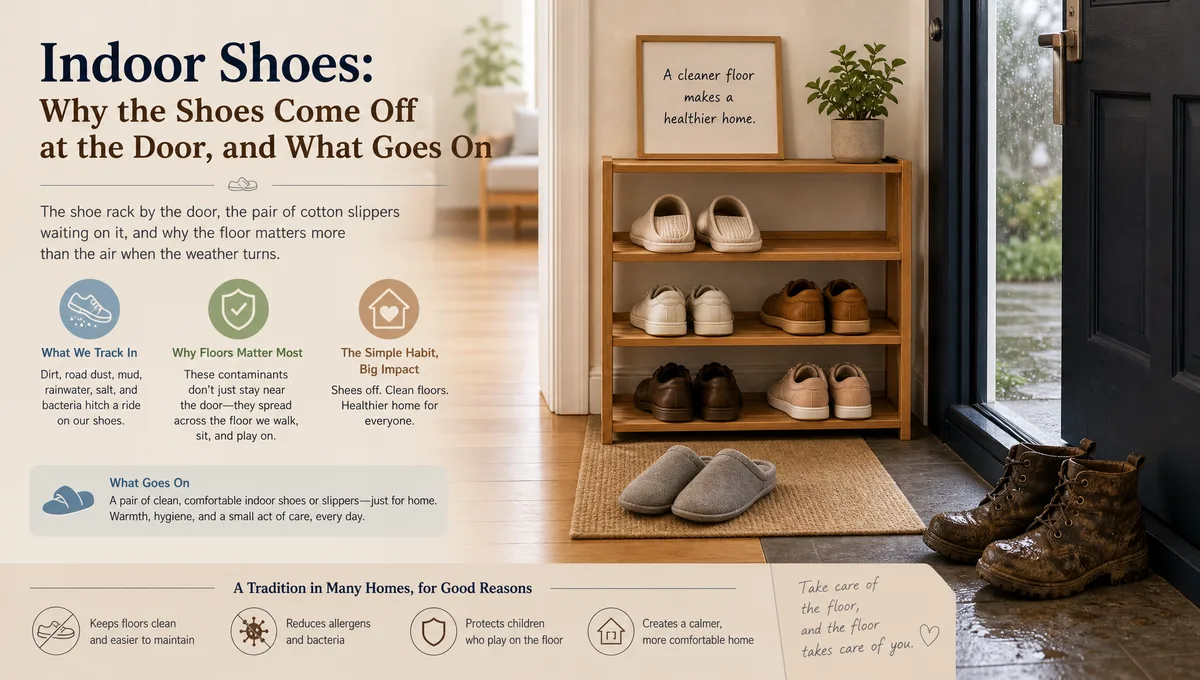
Walk into a Chinese home in January and you meet the shoe rack first: low, wooden, and holding more pairs than there are people in the flat.
Then comes the question of what to put on. In winter it stops being a formality. The floor in an unheated flat is the coldest surface in the building, and the answer people settled on, long before anyone measured floor temperatures, was a padded slipper.
The Shoe Rack at the Door
Taking shoes off indoors is not a rule anyone explains. It is just what happens at the door, in the same way that coats go on hooks.
The practice is partly practical. Streets are wet for months at a time, and indoor floors are cleaned by hand. It is partly social: a household that keeps its floors clean expects guests to help, and a guest who walks in without removing their shoes is noticed.
So the doorway holds a small kit. A pair of slippers for each resident, a pair or two for guests, and a bench or a stool because balancing on one leg while untying laces is undignified.
What Counts as an Indoor Shoe
Three kinds turn up in most homes, and they are not interchangeable.
The cotton slipper is the winter default: a padded upper, often corduroy or fleece, on a flat foam or stitched sole. Cheap, warm, replaced every year or two because the padding flattens.
The closed-back slipper adds a heel. It costs more and lasts longer, and it stays on when you walk quickly, which matters in a household with stairs.
The cloth shoe is the old version: a hand-stitched sole of layered fabric, breathable and quiet on wood. These are still made and still worn, mostly by people who grew up with them.
What all three share is a thin, flat sole. Nobody wears anything with a heel indoors, and nobody wears outdoor shoes past the mat.
Why the Floor Matters More Than the Air
The old saying is that cold enters through the feet: han cong jiao xia qi. Treat it as a household proverb rather than a piece of physiology, and it still points at something real.
Air in a room mixes. A floor does not. In a flat without heating, tiles in January can sit several degrees below the air temperature, and they stay there all evening. Feet in thin socks lose heat to that surface continuously, and the rest of the body notices long before anyone thinks to check a thermometer.
This is what the padded slipper is for: a layer of insulation against the one surface you cannot avoid.
North, South, and the Temperature of the Floor
The habit looks different depending on where the heating is.
In the north, radiators and underfloor heating keep the floor warm through the winter. Indoor shoes there are light, and plenty of people wear socks or nothing at all. The complaint in a northern flat is dry air, not cold tiles.
Along the Yangtze, there is no central heating and the winter is damp. Tiles and stone floors hold the cold, the air is only a few degrees warmer, and the indoor shoe becomes the most important piece of winter clothing in the house. The thick-soled cotton slipper was built for exactly this weather.
In the far south, winter is short and mild. Slippers exist, but they are thin, and the season for them is measured in weeks. Our piece on winter warmth in Chinese households covers the regional picture in more detail.
Choosing a Pair
Four things matter, in this order.
- Thickness under the foot. A sole of a centimetre or more does more than a thick upper. This is the part that separates a floor from your skin.
- A closed back. Slip-on mules are cooler in every sense; they fall off, and the heel stays exposed.
- Grip. Bathroom tiles and kitchen floors get wet. A smooth foam sole on a wet tile is how people fall.
- Quiet. If you live above someone, a soft sole on a hard floor is a courtesy, not just a preference.
Fit matters less than people expect, because the shoe does not have to hold a foot in place. It only has to keep the foot off the floor.
Guests, Children, and the Awkward Moments
A few situations come up in every household, and the customs are not strict.
Guests are offered slippers, usually with the option to decline. A visitor who keeps their socks on is not being rude. A host who has a spare pair ready is being thoughtful.
Children go barefoot more than adults do, indoors and out, and most families stop arguing about it. If the floor is genuinely cold, socks are the compromise.
The awkward moment is the tradesman or the delivery at the door, who cannot reasonably take shoes off mid-job. Most households keep a pair of washable covers or simply wipe the floor afterwards. It is a practical problem with a practical answer, not a ritual one.
Common Questions
Can thick socks do the same job? Partly. Socks insulate, but they compress under body weight, and the thin part under the heel is where the cold comes through. A padded sole holds its shape.
Do people wear indoor shoes in summer? Thin ones, often just fabric slides. The habit of not walking on the floor barefoot lasts all year; the padding does not.
Is this a Chinese thing? The no-outdoor-shoes rule is common across East Asia and in much of northern Europe too. The padded cotton slipper is the local version.
What if the flat has underfloor heating? Then the floor is the warmest surface in the room and the slippers come off. Many northern households switch to thin socks or bare feet for exactly this reason.
Does any of this matter for health? Comfort and warmth are reason enough. Feet that stay cold all evening make a room feel colder than it is. Nothing beyond that needs to be true.
The Smallest Piece of Winter Kit
A pair of padded slippers costs very little and has one job: keeping a cold floor away from the person standing on it.
If you want the rest of the seasonal picture, start with winter warmth in Chinese households. For the evening version of the same idea, there is what people add to a winter foot soak and the routine itself. The rest of our gentle habits sit in the Wellness section.