Wellness5 min read
Qigong for Seniors: Where to Start After Fifty
Qigong is slow movement, standing up, and attention to the breath. What it is, the three routines most often taught to older beginners, and a ten-minute start.
By Lian Zhao — Copy Editor
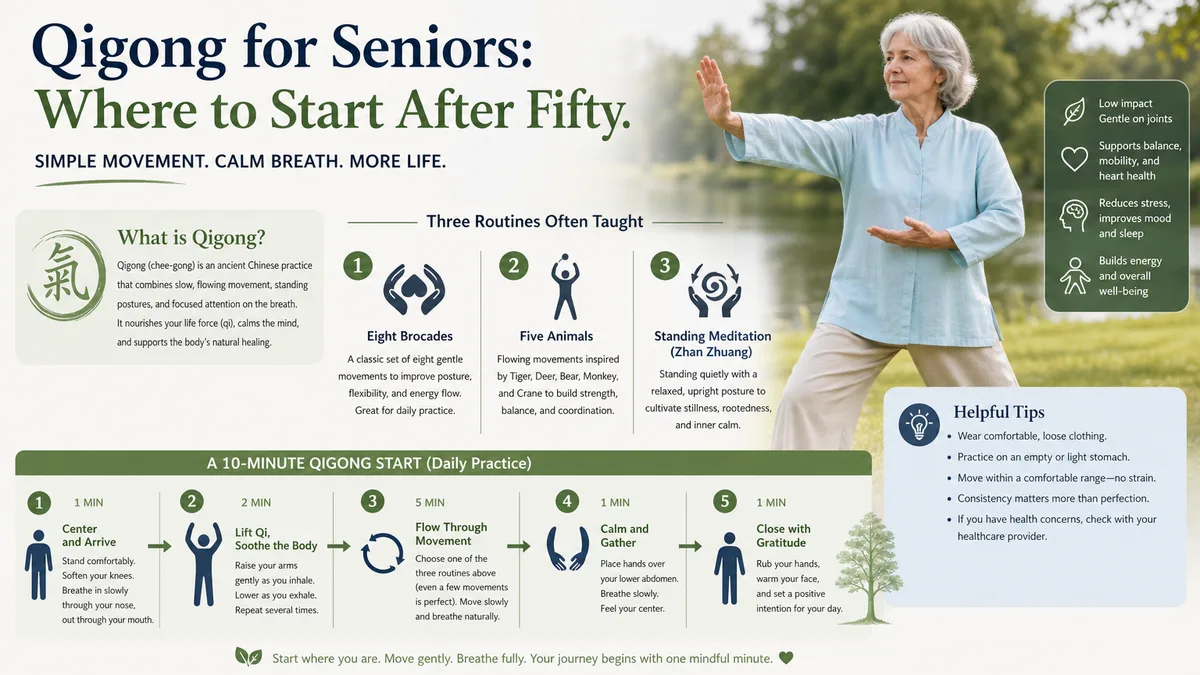
Qigong is the part of Chinese daily practice that looks like nothing much is happening. Someone stands on a patch of concrete at seven in the morning, moves one arm, breathes, and stops. Then moves the other.
That is not a beginner’s version of something harder. It is the thing itself.
What Qigong Is
The word is two characters: qi, breath or energy, and gong, work or skill. The compound is modern. What it names is old: a set of slow, repeated movement patterns done with attention, usually standing.
Three ingredients, and all three are required. The movement is slow enough to feel. The breath is not forced, and it does not need to match anything. The attention is on what the body is doing, which is what separates qigong from a stretch.
Remove the attention and you have gentle exercise. That is fine, but it is a different thing.
Why It Suits Older Bodies
Most exercise advice assumes you are willing to get on the floor. Qigong does not.
Everything happens standing, in a small space, wearing ordinary clothes. There is no pace to keep, no repetitions to complete, and no finish line. Ten minutes on a kitchen floor is a normal session, and stopping in the middle is not a failure.
The other advantage is that it is boring. A practice with no music, no target and no partner is easy to keep for years, which is the only property that matters in a daily habit.
The Three Routines Most Often Taught
If you have watched a group in a park, you have probably seen one of these three.
Baduanjin, the eight pieces of brocade. Eight fixed movements, done in order, from stretching overhead to bending and reaching the feet. It is the most common starting routine in China and the easiest to learn from a video. Our walk-through of the eight movements of baduanjin covers each one.
Wuqinxi, the five animals. Crane, bear, monkey, deer and tiger, each with its own posture and temperament. The animal names make it memorable and slightly comic, which is useful when you are learning.
Liuzijue, the six sounds. This one is mostly breath and voice: six syllables, each paired with a slow movement. It has the smallest movements of the three and the strongest internal focus.
A teacher will usually pick one and repeat it for months rather than mix them. Sequences are not interchangeable, and the gains come from repetition.
A Ten-Minute Start
Three movements, done slowly, once in the morning.
Stand with the feet about shoulder-width apart, knees soft, arms hanging. Stay there for a minute and let the breath settle. Most beginners skip this and it is the most useful part.
Then raise both arms slowly in front of you to shoulder height, palms down, and lower them. Ten times, matching the breath: up as you breathe in, down as you breathe out. Keep the shoulders down.
Then turn the waist gently left and right, arms following loosely, ten times each side. The feet stay planted and the knees stay soft.
Finish by standing still again for a minute.
That is a complete session. There is a shorter set of five movements on this site if you want more variety.
Standing Still Is Also Qigong
The most minimal version is not a movement at all.
In zhan zhuang, standing post, you hold one posture with the arms rounded as if around a barrel. Nothing moves except the breath. Beginners are told to start with two minutes, and two minutes is longer than it sounds.
This is the practice that most often surprises people over fifty, because it asks for nothing except staying. Our introduction is here.
The Group at Seven in the Morning
In China qigong is mostly a public activity, and the group does the teaching.
The same people arrive at the same hour in the same corner of the same park. One of them knows the sequence. Newcomers stand at the back and copy, badly, and nobody corrects them for the first month.
If you are learning alone, this is worth copying in one respect: fix the time and the place, and let the sequence be imperfect. The habit is the practice.
What to Skip
Two pieces of advice that circulate online are worth ignoring.
The first is that the breath must be deep, long and coordinated with every movement. Beginners who try this end up tense and dizzy. The instruction in the old manuals is closer to leaving the breath alone and letting it settle.
The second is a promise. Qigong is presented here as a daily practice with a long tradition, not as a way to fix a specific condition. If something hurts, that belongs with a doctor, not a routine.
Common Questions
Do I need a teacher?
Not to start. Baduanjin and the five animals are learnable from a clear video. A teacher matters later, for correction and for the sequence order.
Can it be done sitting?
Yes. There are seated forms, and they are the usual adaptation for anyone who cannot stand for long. The attention part does not change.
How often?
Daily, briefly. Ten minutes every morning beats an hour on Sunday, and the tradition is built around frequency rather than duration.
Is qigong the same as tai chi?
No. Tai chi is a martial art with a fixed long form and a fighting application. Qigong is a set of short, repeated patterns with none. They overlap in feel and are taught by the same people.
What about the energy claims?
The tradition describes qi as something that moves through the body. This site describes the practice and leaves the claims where they belong: with the practitioner’s own experience.
A Practice With No Score
The reason qigong survives is the same reason it looks unimpressive. There is nothing to measure, so there is nothing to fail.
Ten minutes of standing and moving slowly, at the same hour, in the same place. That is the whole instruction, and it has been the whole instruction for a long time.
If you want the daytime version of the same scene, read the three kinds of people in a morning park. More everyday practice sits in the wellness section.