Wellness6 min read
The After-Dinner Walk: How Fast, How Long
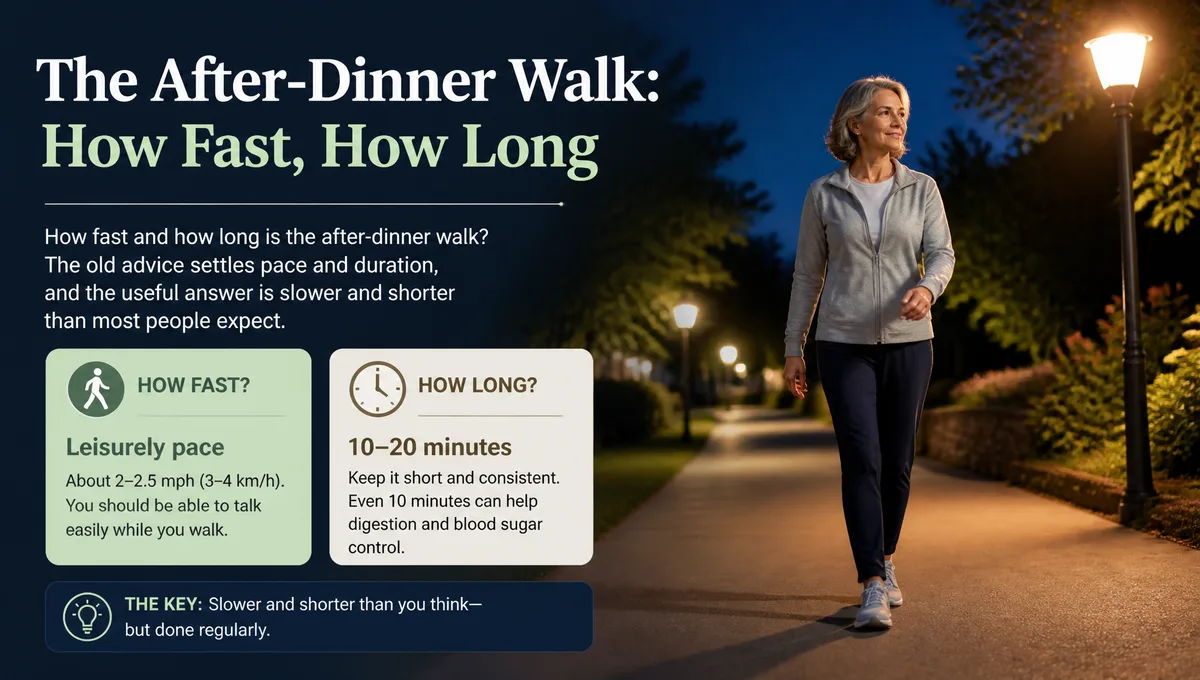
How fast and how long is the after-dinner walk? The old advice settles pace and duration, and the useful answer is slower and shorter than most people expect.
By Lian Zhao — Copy Editor
Two questions come up whenever the after-dinner walk is discussed, and they are both about numbers. How fast, and for how long.
The traditional answer is annoying: slower than you think, and shorter than you think. It is also the version that people actually keep doing, which is worth something.
What the Old Advice Says
The saying that starts all of this is about a hundred steps, and a hundred steps is a few minutes. Not a session. A turn around the yard.
The household manuals are more explicit. The best known is a Qing dynasty guide to the daily life of an older person, written by Cao Tingdong. Its section on walking defines the activity before it says anything else. Walking, the text says, is scattered and unconstrained: going a while and standing a while, standing a while and going a while, in a relaxed manner.
That definition rules out most of what a modern reader would call a walk. There is no distance in it, no pace, and no route. There is a state of the body being described, and the state is unhurried.
Order Before Speed
Before pace comes sequence, and the tradition is not unanimous here either.
One line says walk a hundred steps after a meal. The counter-line, which most households also know, says rest a little first, then walk. Both are old. Both are quoted by grandmothers. The practical version that survives is the second one: clear the table, sit for a bit, then go out.
The reason is not subtle. A walk that starts immediately feels like a chore attached to dinner, and a walk that starts ten or fifteen minutes later feels like the evening beginning. The habit survives on the second feeling.
A Working Pace
Slow enough to talk is the whole instruction.
Concretely: the pace of a person carrying a cup of tea across a room. Not a stroll in the park on a Sunday, and certainly not the arm-swinging march that fitness advice describes.
Two details from Chinese street practice are worth copying. The first is the hands. They are often clasped behind the back, which slows the stride without any decision to slow it. The second is the pause. People stop. They look at something, exchange a sentence with a neighbour, then continue. A walk with pauses in it cannot be timed, and that seems to be the point.
If you want a stop rule, use conversation. The moment the walk becomes too fast to talk comfortably, it has stopped being this kind of walk.
A Working Length
Ten to twenty minutes covers almost every traditional description.
The hundred-step formula lands at the short end. The household manuals describe something open-ended, bounded by daylight or by the cold rather than by a clock. Some families timed it by a stick of incense, which is roughly half an hour, but that was the upper bound for a slow evening, not a target.
Half an hour is a fine walk. The problem with half an hour is that it needs a decision each time, and decisions are what a daily habit cannot afford. Ten minutes needs no decision. It fits between dinner and whatever the evening holds.
The Nearest Loop
The route matters more than the duration, because a fixed route removes the second decision.
The pattern in most Chinese cities is a loop: around the compound, along one stretch of riverside, once around the small park with the fitness equipment. Everybody on it knows the route and nobody is navigating.
The loop has a second function. It is where you meet people. The same neighbours appear at the same hour, and a walk with three greetings in it lasts longer than a walk without, and costs nothing.
The Winter Version
Tomorrow is the start of the first winter period in the traditional calendar, and the evening walk changes with it.
It gets earlier, because the light goes. It gets shorter, because the cold cuts the pauses out. Hats and gloves come out, and the hands-behind-the-back posture disappears for a few months.
Where the climate is harsh, the loop moves indoors. In northern cities the winter version of the evening walk happens in shopping centres. It is a genuinely Chinese adaptation: a warm, flat, well-lit circuit with benches, open late and free to enter. Nobody pretends it is a park. It keeps the hour intact, which is the thing being protected.
For the clothing side of the same problem, see how winter warmth is handled indoors.
What Counting Does to It
The step counter changes the walk, and not only by adding a number.
A counted walk has a finish line. Once the line is set, the walk is something to complete, and a completed walk can be skipped tomorrow without guilt if the number is made up elsewhere. The uncounted walk has no such accounting, so it has to be repeated for its own sake.
There is nothing wrong with a pedometer. But the after-dinner walk is one of the few daily activities that works better unmeasured, and it is worth protecting from the number for that reason alone.
Common Questions
How fast should it be?
Slow enough to hold a conversation without effort. If you are breathing hard, it is a different activity.
How long is enough?
Ten to twenty minutes. The short version is the one that survives a bad week.
Before or after resting?
Rest a little first. Both sayings are old, and the rest-first version is the one people actually keep.
Does it have to be after dinner?
The hour matters more than the meal. The point is a fixed slot in the evening, attached to something that happens every day.
What about rainy or freezing evenings?
Move the loop indoors. The hour is the habit; the route is replaceable.
Is this about digestion?
The household word for the walk is dissolving the food, and this site treats that as a custom rather than a claim about the body. What the walk reliably does is end the working day, which is enough.
The Same Walk, Slower
The interesting thing about the traditional answer is that it is worse at everything a modern plan values. It has no target, no measurement, and no progression. It is also the version that has been kept for centuries by people with no interest in fitness.
That is not an argument against exercise. It is an argument for keeping one small, unmeasured walk in the day, at the hour when nothing else is being counted.
The proverb behind all of this is unpacked in a hundred steps after dinner. The other end of the daily rhythm is the midday nap, and more everyday practice sits in the wellness section.