Arts6 min read
Woodblock New Year Prints: Two Ways of Painting a Door God
The door god was the cheapest art in China: a printed pair pasted on the door for one year. Two kinds of guard, and two ways of printing them.
By Wen Su — Writer & Editor
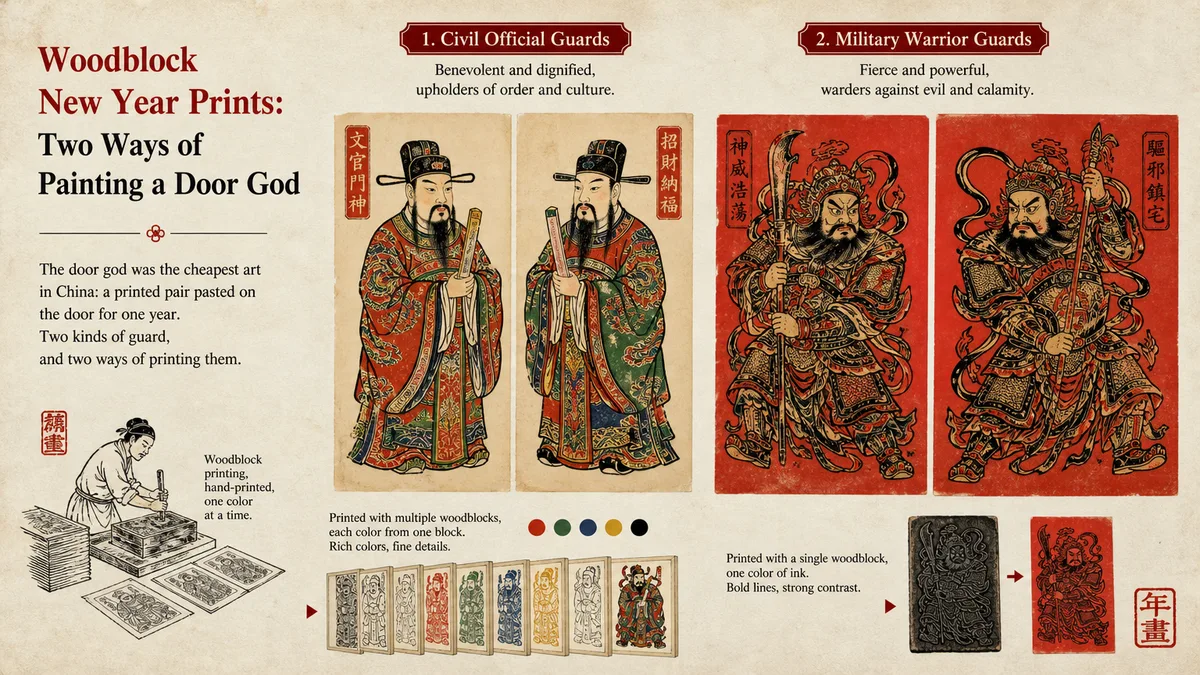
A printed door god is never sold as one sheet. It is sold as a pair, and the pair is the point: two guards, one door, one on each leaf.
That pairing, plus the way the sheets were made, splits the tradition cleanly in two. There are two kinds of door god, and there are two ways of printing one.
One Door, Two Guards
The martial pair is the one most people picture.
Qin Qiong and Yuchi Gong were generals under the first Tang emperor. The story has the emperor unable to sleep because of noises at his gate, and the two men standing watch outside it all night. Later their portraits took over the duty. Later still the portraits were printed by the thousand, so that every household could have them.
On a printed pair they are easy to tell apart. One holds a halberd, the other a mace or a sword. Both wear armour, both have a beard, both look furious. They face inward, toward each other and toward the seam between the doors, because a guard facing out is looking at the street while the door stands unwatched.
The Other Pair
Inner doors and hall doors got the civil version.
These are officials rather than soldiers: a heavenly official in a robe, holding the flat tablet of office, sometimes with a child beside him. The mood changes completely. The martial pair protects the threshold. The civil pair recommends the household, and the wish printed into it is promotion rather than safety.
The five-sons motif belongs to this family too. Five boys in one picture, one for each examination the household hopes a son will pass.
So the first division is content: soldier or official, protection or advancement. Households pasted soldiers on the street door and officials on the doors further in.
The Season
Prints were made in the weeks before New Year and bought in the same weeks.
The trade had a phrase for it, chasing the New Year pictures. Sellers laid sheets on the ground or hung them on strings in the cold, and families replaced last year’s set, which by then had faded and torn.
Size tells you where a sheet went. The big pairs were for the outer door leaves. Smaller sheets covered the kitchen god, single figures, and the odd story panel. Cheap paper, cheap ink, no expectation that anything would last past the year.
That is why the surviving examples are scarce. It was decoration with an expiry date.
Two Ways of Making One
Here is where the craft splits.
The printed outline, coloured by hand. In Yangliuqing, near Tianjin, the line block printed the drawing and the colour went on afterwards with a brush. A workshop could turn out modelled faces and soft washes this way, because a hand can shade where a block cannot. The output is half print and half painting.
The printed outline, coloured by block. In Yangjiabu, in Shandong, and in Taohuawu in Suzhou, each colour got its own block. Printing one sheet meant running it through the press once per colour, and getting the registration right every time. Fewer colours, bolder fields of red and green, and a look that reads from across a courtyard.
The two methods produce recognisably different objects. A Yangliuqing face is shaded. A Yangjiabu face is a flat peach-coloured shape with two black lines for eyes.
Neither is the degenerate version of the other. They are two answers to the same problem: how do you colour a thousand sheets before the New Year arrives, with the tools you have?
What the Blocks Do
All of them begin with a drawing, and the drawing is cut in reverse.
The carver works on a pear or jujube wood block, cutting away everything that should stay white. What is left takes the ink. A four-colour print needs five blocks: one for the black line, one for each colour.
Registration is the whole craft. Every sheet is laid on the first block, then the second, and any slip shows as a colour sitting a millimetre off its outline. On a well-made old sheet you can see the printer’s tolerance along one edge, and you can see that it is small.
Then the Calendars Arrived
The tradition did not die of neglect. It was replaced.
From the late nineteenth century, Shanghai printing houses produced calendar posters for tobacco and soap companies. They were brighter, cheaper and more modern, and they hung in the same rooms. Photography and offset printing finished the job. By the middle of the twentieth century the workshops that survived were making souvenirs.
What to Look For Now
Three things are worth checking on any sheet offered as old.
The paper. New Year prints were run off on thin, cheap stock and pasted on doors, so real examples often show paste marks or a torn edge.
The colour. Mineral and vegetable dyes age into duller, warmer tones. Aniline dyes, which came in later, stay harsh.
The registration. Slight misalignment is a sign of hand printing, not a fault. A perfect sheet is more likely to be a modern reprint.
Common Questions
How many door gods are there?
Hundreds of named figures across the regional traditions. Two pairs dominate: the Tang generals on the outer door, and civil officials further in.
Why do the pair face each other?
Because they are guarding a door, not a road. The two sheets were designed to be read together, and a single one looks wrong on its own.
Was every print coloured by hand?
No. Hand colouring was one regional method among several. Multi-block colour printing was faster and far more common by the nineteenth century.
Were they only for New Year?
Mostly. Workshops also printed images for weddings, birthdays and the kitchen, but the door pair was the New Year purchase.
Are they still made?
Yes, in small numbers, and largely for collectors. A few workshops still print the old designs from the original blocks.
A Door That Was Read
The print on a door was the cheapest art in China and the most looked at. Nobody framed it. It was pasted up in the cold, looked at for a year by everyone who walked past, and then scraped off.
That is a strange place for a craft to survive, and it is the reason the surviving sheets feel used rather than exhibited. For the season they belonged to, read how New Year was kept. The red paper cut for the window came from the same winter market, and both sit in the Culture & Arts section.