Arts6 min read
Shadow Puppets: A Whole Play Cut From One Hide
A shadow puppet is a piece of donkey hide scraped thin enough to glow, cut with a thousand strokes, and worked by three rods behind a lit screen.
By Lian Zhao — Copy Editor
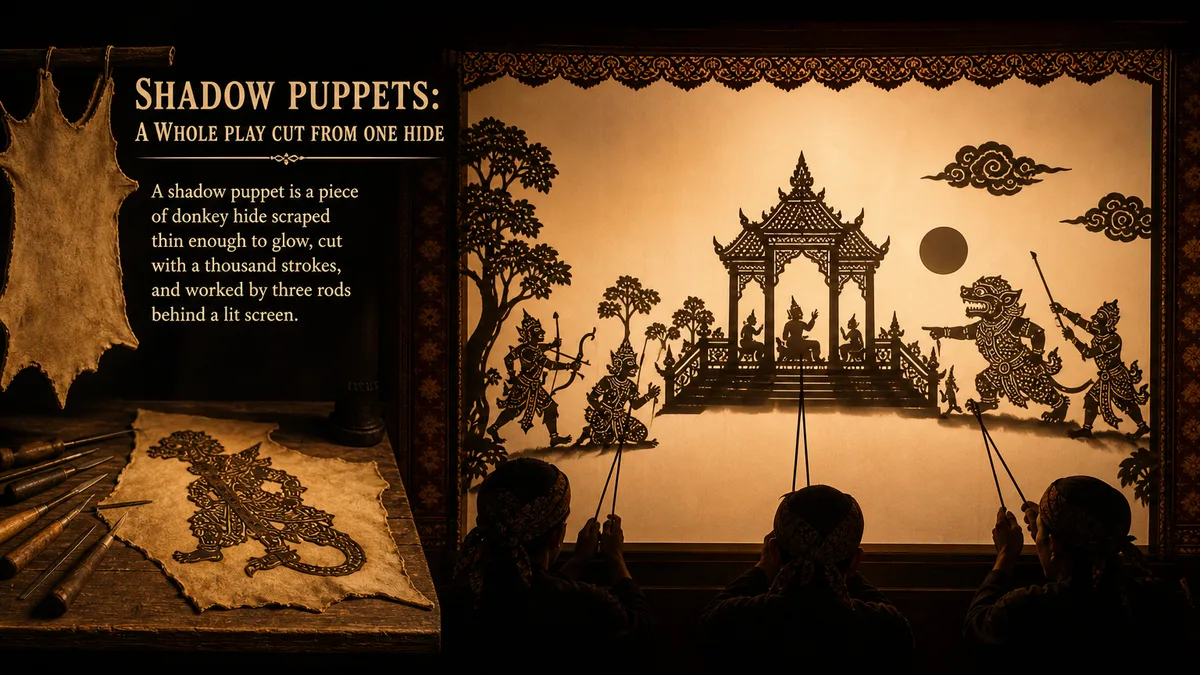
The theatre is a cloth screen about two metres wide, a lamp behind it, and a bench.
That is the whole arrangement. The audience sits in the dark on one side. On the other side, behind the screen, four or five people work the puppets, sing every part, and play the instruments. Nobody in the audience ever sees the face of the person doing the singing.
What the Audience Sees
What you see are flat figures, roughly a foot high, coloured and translucent, moving against a lit cloth.
They enter from the side, turn, sit, fight, bow. A general rides in on a horse that is a separate cut-out attached at the waist. A fight is two figures closing on each other, blades crossing, and then one of them tilting slowly backward and exiting sideways, which is how a death is staged.
Because the figures are flat, everything is played in profile. A character who turns to face the audience is doing something unusual, and the puppeteers use that sparingly.
The Hide
The material decides the whole look.
Most puppets are made from donkey hide, which is why the northern trade name is simply hide shadow. Ox hide and sheepskin are also used, and the choice shows in the object: donkey gives a fine, slightly honey-coloured sheet, sheepskin gives a softer and cheaper one.
Getting there takes days. The hide is soaked, then scraped to remove hair and the inner membrane, then scraped again until it is thin enough to pass light. A good sheet is almost transparent. It will still hold a cut edge, which is the point.
The Cutting
This is the part that reads as impossible.
The dried sheet is laid on a block of wax or wood and cut with small knives, held upright. The outline is cut first, then the interior. Faces are left mostly solid, with a few lines for the eye and mouth. Armour, sleeves and skirts are cut away into patterns, so light comes through them as texture.
A single figure can take thousands of cuts. The cut areas are then dyed, one colour at a time, using mineral and vegetable pigments, and the sheet is pressed flat to dry. Finally it is treated with oil, which makes it more translucent and keeps the hide from curling.
Joints and Rods
A finished puppet is not one piece. It is a set of pieces riveted together.
The head, the torso, the two arms at the shoulder and elbow, the two legs at hip and knee, and often the waist, so that the figure can bend. The rivets are small loops of thread or wire, and they have to be loose enough to swing and tight enough not to flop.
Three rods do the work. One runs up into the torso or the collar, and it holds the figure. The other two go to the hands. A skilled performer can make a figure walk, sit, drink, and fight a duel, with those three sticks and no visible hands.
Five People, One Bench
A travelling troupe was small, and everyone did two jobs.
One person worked the rods, one sang the main role, one handled the secondary figures, and two played instruments. The instruments are the local ones: a two-stringed fiddle, a lute, clappers, a small drum and a gong. A single singer voiced every character, changing register and accent between them, which is why the singing style is so distinctive.
The music and the voice are not accompaniment. They carry the plot. The puppet supplies the body, and the singer supplies the person.
Regional Styles
The tradition is not one style, and the differences are audible before they are visible.
In the Tangshan and Laoting area of Hebei, the figures are small and finely cut. The singing there is high and nasal, with a wailing quality that carries a long way.
In Shaanxi, around Huaxian, the figures are larger and the accompaniment is built around a set of small bowls struck with chopsticks, which gives the style its name.
In Sichuan, the puppets are bigger again, the faces are painted rather than cut, and the comic roles are broad.
Each region had its own repertoire, its own tunes, and its own way of cutting a sleeve.
The Repertoire
The stories were the ones everyone already knew.
Journey to the West, the tale of the White Snake, the Investiture of the Gods, the Three Kingdoms. Because the audience knew the plot, the pleasure was in the playing: a famous aria, a fight, a comic servant’s monologue.
Longer pieces ran as serials across many nights, and a village might book a troupe for a week of them. The last night of a run was the crowd-puller, and the troupe saved its best figures for it.
Where It Went
Cinema arrived, then television, and both were cheaper than a troupe.
The craft nearly went with them. What kept it alive was partly official support, partly collectors who wanted the old carved figures as objects, and partly tourism. Chinese shadow puppetry was added to the UNESCO list of intangible cultural heritage in 2011, which brought funding and, more importantly, students.
Modern performances are shorter and often aimed at children. Purists complain about the abbreviated repertoire. The cutting, at least, is still taught properly.
Common Questions
Is the hide really donkey?
Usually, in the north. Ox hide and sheepskin appear too, and the choice is regional rather than fixed.
How long does one puppet take?
Days to weeks, depending on the number of figures and the amount of carving. A set for one play can take a season.
Can you see the puppeteer?
No, and that is deliberate. The screen is the whole world of the play; the bench behind it is workshop space.
Why is everything in profile?
Because a flat figure seen from the front would be a silhouette with no expression. Turned sideways, the cut lines read as features.
Is it still performed?
Yes, in regional troupes and in tourist venues, with a smaller repertoire than a century ago.
A Play the Size of a Hand
The strange economy of shadow theatre is that everything is disposable except the puppets. The screen is cloth. The lamp is a lamp. The stage is a bench. What the troupe actually owns fits in two wooden boxes, and inside them is a whole cast, cut by hand, that will outlast the performers.
Its nearest relative on this site is the other art of the spoken evening, the storyteller in the teahouse, where one voice also carries a dozen people. For the sound underneath both, start with the seven strings of the qin. More crafts sit in the Culture & Arts section.