Arts9 min read
Why the Guqin Has Only Seven Strings
Seven strings, no frets, and a notation older than print. What a guqin is, why it lived in every scholar's study, and whether an adult beginner should try.
By Lian Zhao — Copy Editor
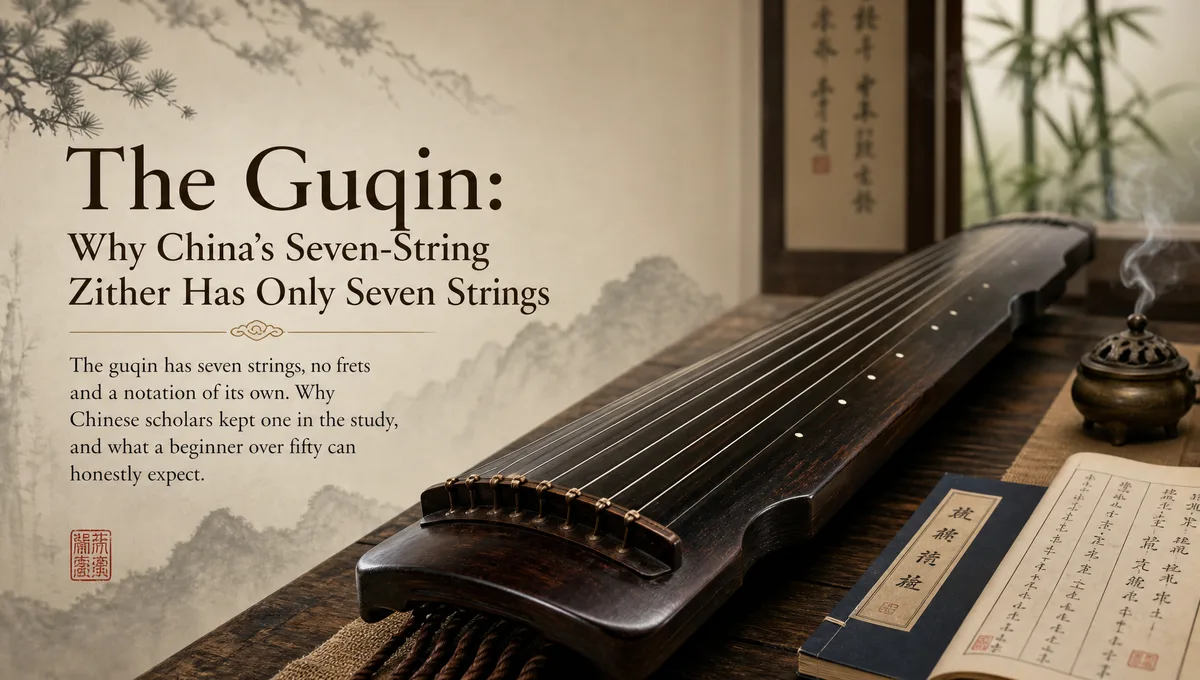
Most instruments are built to be heard. The guqin was built for a room.
It has seven strings, no frets, and a sound that fades before it can travel far. For two thousand years it was the instrument a Chinese scholar kept within reach. It comes first in the phrase qin qi shu hua, the four arts a civilised person was expected to attempt. Those four are the qin, the board game Go, calligraphy and painting.
The question people ask first is the simplest one. Why seven? Why not five, or twenty?
Seven Strings, and the Story of the Other Two
The earliest qin described in Chinese texts had five strings, and tradition attributes it to legendary rulers rather than to any inventor with a name. The instrument that survives has seven.
The usual explanation is a story about two kings of the Zhou dynasty. King Wen added a sixth string; his son King Wu added a seventh. Textbooks repeat this so often that it sounds like engineering. More likely it is a way of saying that the instrument reached its final form early in the Zhou dynasty. That was roughly three thousand years ago, and later hands were certainly involved.
Seven strings, tuned to a five-note scale, give a range of about four octaves once you include the harmonics. That turns out to be enough. Almost nothing written for the instrument needs more.
A second set of numbers is pure symbolism, and worth knowing because Chinese guides mention it constantly. The body is conventionally about 3 chi 6 cun 5 fen long — a little over a metre — and the figure is read as the days of the year. Thirteen small studs of mother-of-pearl run along the outer edge, marking where the strings divide into clean fractions. The instrument is a small calendar you can hold on your knees.
A Quiet Instrument for a Small Room
The guqin is fretless. Nothing stops the string except your own left hand, which is why the instrument can slide, bend and settle onto a note instead of striking it. Three kinds of sound come out of the same string:
- Open. The string is plucked with nothing touching it.
- Stopped. The left hand presses the string down onto the surface to shorten it.
- Harmonic. The left hand touches the string lightly above one of the thirteen studs, and the string rings an octave or more above its own pitch.
That third sound is the one people remember. It is bell-like, thin, and very quiet. It is also the reason the instrument never needed volume: a guqin plays to the person in the room, and occasionally to one guest.
Here the confusion with the guzheng begins. English calls both of them “Chinese zither,” which is like calling a lute and a guitar by one name. The guzheng has around twenty-one strings stretched over movable bridges, and it is loud, bright and public. The guqin has seven strings, no bridges, a much softer voice, and a completely different repertoire. You can put a guqin in a small apartment. You cannot quietly ignore a guzheng.
A Notation That Is Not Music
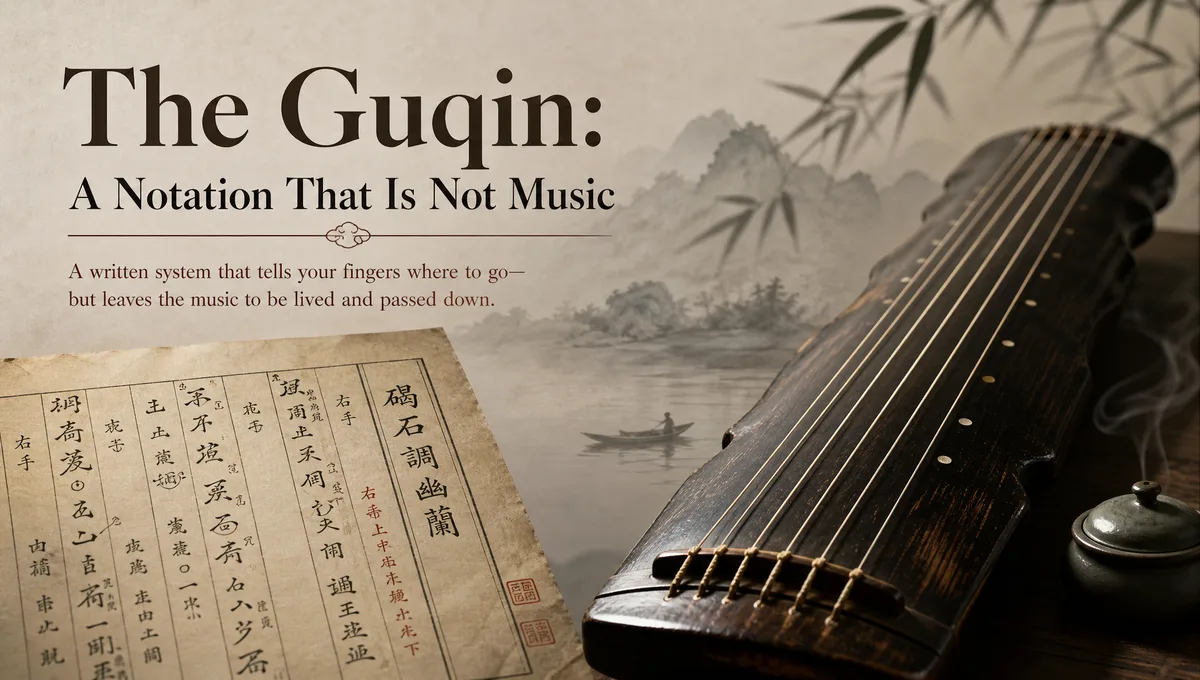
The guqin has one of the strangest written systems in the world, and it explains the playing better than any description of the sound.
It is called jianzipu, or “reduced-character notation.” Each sign is built from pieces of ordinary Chinese characters. It names the right-hand finger, the string to pluck, and where the left hand should press. A single small block of ink tells you everything about the physical action.
What it does not tell you is rhythm.
The score says where your fingers go. It says nothing about how fast, and almost nothing about how the phrase should breathe. Those came from a teacher, by ear, over years. The tradition calls that transmission “mouth to ear, heart to heart.” Two players reading the same page in two centuries produced two different performances, and both were considered correct.
The oldest surviving notation is a piece called Jieshi Diao Youlan. Its manuscript is written in an earlier and even wordier system, and was copied in the Tang dynasty from a version several centuries older. Most of the music you can hear today, though, is far more recent than the instrument itself, because the tradition has always been a spoken one with a written skeleton.
Written for One Listener
The most famous guqin story is about two men who never performed for anyone.
Boya played the qin. Zhong Ziqi listened. When Boya played about high mountains, Ziqi saw the mountains. When he played about flowing water, Ziqi saw the water. When Ziqi died, Boya broke his instrument and never played again, on the grounds that there was no longer anyone who would understand it.
That story gave Chinese the word zhiyin, meaning one who knows the sound. It is still how the language says true friend: the one person who understands what you are doing. It also gave the instrument its two best-known pieces, High Mountains and Flowing Water.
Flowing Water has since travelled further than any of them could have imagined. In 1977 it was recorded by the player Guan Pinghu and placed on the Voyager Golden Record, a copper disc now somewhere past the edge of the solar system. A piece about a river, sent into space, chosen by people who could not read the notation that preserves it.
The First of the Four Arts
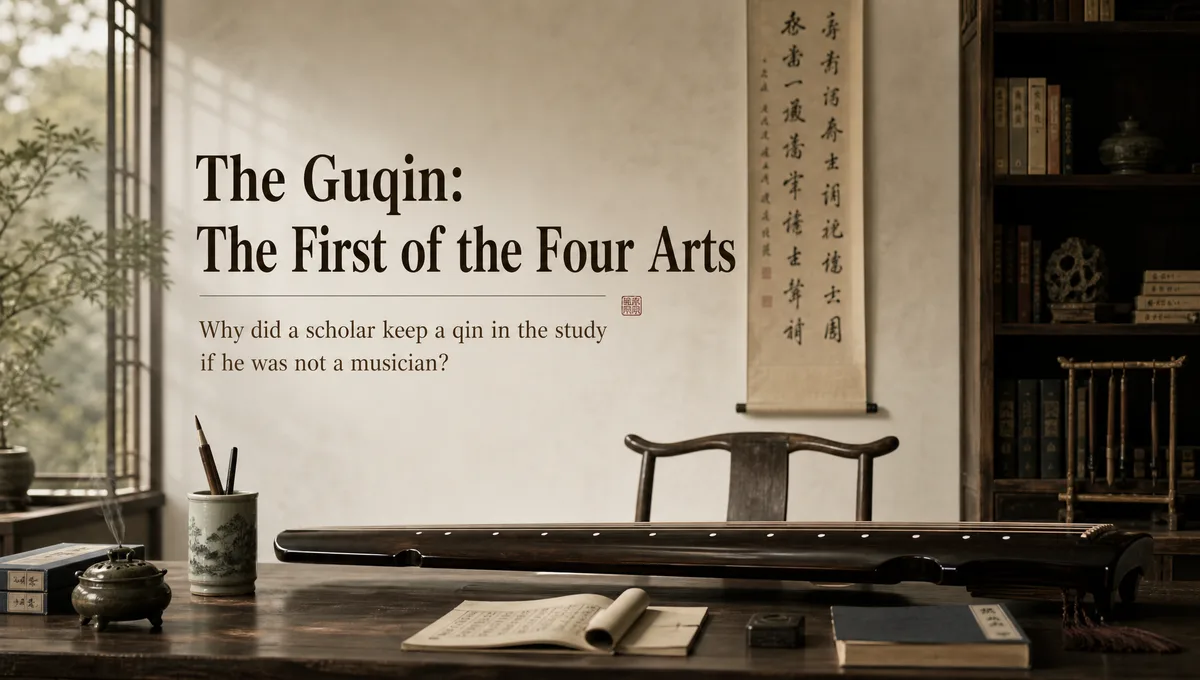
Why did a scholar keep a qin in the study if he was not a musician?
Because the instrument was not treated as a performance. The Book of Rites has the line that a gentleman does not remove his qin and se without good reason. In practice that meant the qin lived where the person lived: in the room where he read, wrote, and received a friend. It was played alone, briefly, between other things.
A few of the stories around it make the point better than any description.
Xi Kang, one of the Seven Sages of the Bamboo Grove, wrote a long and technical rhapsody about the qin. He was executed at forty, still in the middle of his argument with the world. Tao Yuanming, the poet who gave the chrysanthemum its place in Chinese culture, kept a qin with no strings at all. When the wine had done its work, he would set his hands on it and move them as if playing. He said he understood the idea; the sound was not the point.
That is the tradition in one image: an instrument with no strings, held by a man who knew exactly what it was for. Our piece on the chrysanthemum and Tao Yuanming’s late garden covers the same man from the other end of his life.
In 2003, UNESCO named guqin music a masterpiece of the oral and intangible heritage of humanity. It was inscribed on the representative list in 2008, under the full name guqin art.
Learning It After Fifty
The practical questions are honest ones, and the answers are more encouraging than the romance suggests.
Start with one short piece, not with theory. Beginners usually learn a small tune such as Xianweng Cao or Autumn Wind Song within the first few weeks, played slowly. The first month is mostly single notes, and that is not a warm-up — it is the music.
Finger pressure matters more than finger strength. The left hand presses the string down onto the wood, and the fingertips need time to get used to it. Short daily sessions work far better than one long weekly one, and there is no reason to push through discomfort. Stop for the day and pick it up again tomorrow.
You do not need to read Chinese, though it helps. The tabs are instructions for fingers, and teachers in the West teach them aloud. You do need to tune by ear eventually; a phone app is fine to start, and standard tuning spreads the seven strings across a five-note scale.
What you should not expect is a performance. There is no exam, no recital, no audience, and the repertoire is short pieces that reward repetition rather than size. The guqin asks for a chair, a table, twenty minutes, and a room where nobody is waiting for you.
Common Questions
Is the guqin the same as the guzheng?
No. The guqin has seven strings and no bridges; the guzheng has about twenty-one strings on movable bridges. The guqin is quiet and played with both hands directly on the strings. The guzheng is louder, brighter, and often played with picks. English blurs them by calling both “Chinese zither.”
Do I need to read Chinese to learn the guqin?
It helps and it is not required. The notation gives finger positions rather than notes, so a beginner can follow it as a diagram. Most Western students learn pieces by hearing them first and reading the tab afterwards as a memory aid.
Why does the notation leave out rhythm?
Because the music was carried by people, not by paper. The score preserved the physical action, which was the hard part to remember; the phrasing was taught in person. This is why recordings from different teachers sound so different from one another.
How long before I can play something recognisable?
A simple tune usually arrives in a few weeks. Playing it well is a matter of years, which is not a warning — it is the reason the instrument suits people who are no longer in a hurry.
Where does the name come from?
Gu means ancient and qin is the instrument family name. Chinese says guqin to distinguish it from other instruments of the same family, in the same way English says “grand piano.”
The Quietest Room in the House
There is a reason the guqin never became a concert instrument, and it is not a limitation. Volume is what you need when there is an audience. Precision of touch is what you need when there is not.
The instrument sits at the quiet end of two traditions this site writes about. If you like the idea of a daily practice measured in minutes, read our guide to calligraphy for focus. It describes the same kind of attention, with a brush instead of a string. Our piece on the afternoon tea ceremony does it with water and a small pot.
For the poetry that the instrument spent two thousand years accompanying, start with Chinese poems about growing older. And the rest of this corner of the site is in our Culture & Arts section.