Arts5 min read
The Teahouse Told the Story: One Table, One Block, One Voice
Before television, the teahouse told the story: one performer, one table, one wooden block. How Chinese storytelling worked, and where it still runs today.
By Ming Chen — Editor & Researcher
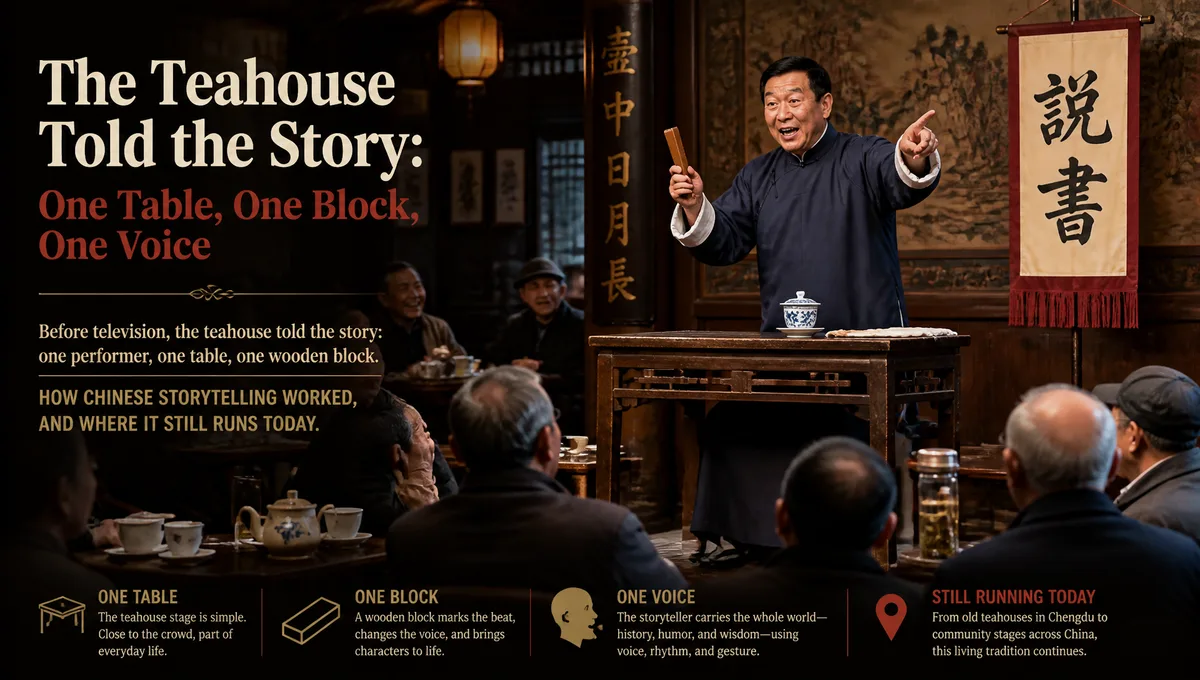
A teahouse performance needs almost nothing: a table, a fan, a wooden block, and one person who can hold a room for two hours without a script.
The form is called pingshu in the north and pinghua in the south, and it was the main narrative entertainment of Chinese cities for centuries before radio. It is still running, in a smaller number of rooms.
Where It Came From
Professional storytelling in cities is documented from the Song dynasty, when urban entertainment quarters supported performers who worked in serials rather than single evenings.
The craft hardened over the following centuries into a set format:
- A single performer standing or seated behind a small table
- Minimal props — a folded fan, a wooden block (xingmu), sometimes a handkerchief
- A divided performance: an opening aside, the main episode, and a hook to the next instalment
- No script on the table, but a memorised framework that can run for months
The material came from history, from the classic novels, from court cases and from ghost stories. Our guide to the four classical novels covers the books that supplied a large share of it.
The Hook at the End
The commercial logic shaped the art. A performer who wanted the same audience back tomorrow needed a reason.
Hence the formula that everyone in China can quote: and if you want to know what happened next, listen to the next instalment. The sentence is not a weakness of the form. It is the form’s engine, and it is the reason these stories could run for six months in one room.
Three features follow from it.
- Episodes end at a turn, not a resolution. The audience leaves with a question, not an answer.
- Recaps are built in. Each session repeats the last minute of the previous one, which also served listeners who arrived late.
- The performer can stretch or compress. Anecdotes, proverbs and local references fill an evening when the plot does not need to move.
The Voices
The technical core of pingshu is vocal. One performer plays every character, and listeners identify who is speaking from the voice alone.
- A gruff register and clipped rhythm for a general
- A higher, faster delivery for a servant or a comic figure
- A flat, slow register for narration
- Silence and the wooden block for emphasis
The block is the loudest sound in the room, and performers use it sparingly. One strike can end a scene; two can dismiss a character.
The Room
The setting mattered as much as the performance. A traditional teahouse provided low tables, benches, tea that was refilled for the price of the seat, and a stage the size of a carpet.
The audience talked, drank, smoked, came and went. A storyteller had to hold attention against a room that was not silent, which is one reason the delivery is so rhythmic.
The teahouse was also a news exchange and a job market. Lao She’s play Teahouse uses one Beijing establishment across fifty years precisely because the room could stand in for the city’s changes.
Radio, Then Television, Then a Revival
The twentieth century moved the form twice.
Broadcast era. From the 1950s, radio carried storytellers to households that never went to a teahouse. Performers such as Shan Tianfang became national voices, and the daily episode became a fixture of lunchtime.
Television era. From the 1980s, televised storytelling reached a wider audience still. It also broke the format: a camera rewards close-ups that a teahouse cannot give, and it removes the room’s noise.
Small-room revival. Since the 2000s, teahouse performance has returned in a modest way, sometimes with younger performers and experimenters working in dialect comedy. The audience is smaller, and the format is closer to the original.
If you would like the drink that goes with it, our guide to a gongfu tea session covers what is in the cups.
Watching One
A few practical notes for a first visit.
- Format. A ticketed sesession lasts one to two hours, often with a break.
- Language. Most performances are in dialect or heavily accented Mandarin. Comprehension is not required to follow the shape, but subtitles do not exist.
- Seating. Arrive early; the good seats are the ones nearest the performer and away from the door.
- Tea is part of the price. Expect a covered cup and a thermos, refilled without asking.
- Recording. Ask first. It is a working performance, not a tourist show.
Common Questions
What is the difference between pingshu and pingtan?
Pingshu is solo storytelling. Pingtan is the Suzhou tradition, usually pairing spoken narration (pinghua) with sung ballad (tanci), sometimes two performers with a lute and a pipa.
Do the stories still get new instalments?
Traditional repertoire dominates, and performers also commission or write new material. The format is flexible enough that contemporary subjects appear in older frameworks.
Was it ever considered low culture?
It was popular culture, and like popular culture everywhere it was sometimes looked down on and sometimes studied. Several of the great performers are now treated as artists of the first rank.
Where can I see it now?
Teahouses in Chengdu, Beijing, Tianjin, Suzhou and Yangzhou run regular sessions, as do a few venues overseas. Search for the local shuchang, or book hall.
Does it need the Chinese language to be interesting?
Not entirely. Watching a performance is educational even without comprehension: the rhythm, the block, the audience, the refills. For the stories themselves, translated collections of the classic novels are the usual route in.
The Loudest Quiet Thing
Storytelling in a teahouse is a reminder that narrative does not need production. It needs a voice, a room and a reason to come back tomorrow.
The wooden block still lands in the middle of a sentence, the tea is still refilled, and the episode still ends before the question is answered. The technology has changed around it, and the trick has not.
More of this world is in the arts and culture section, along with seals and signatures for the visual version of a signature.