Arts7 min read
Seals and Signatures: The Last Stroke of a Chinese Painting
In China a painting is signed with an artist's seal, not a pen: how the signature is carved in stone and pressed in vermilion paste.
By Lian Zhao — Copy Editor
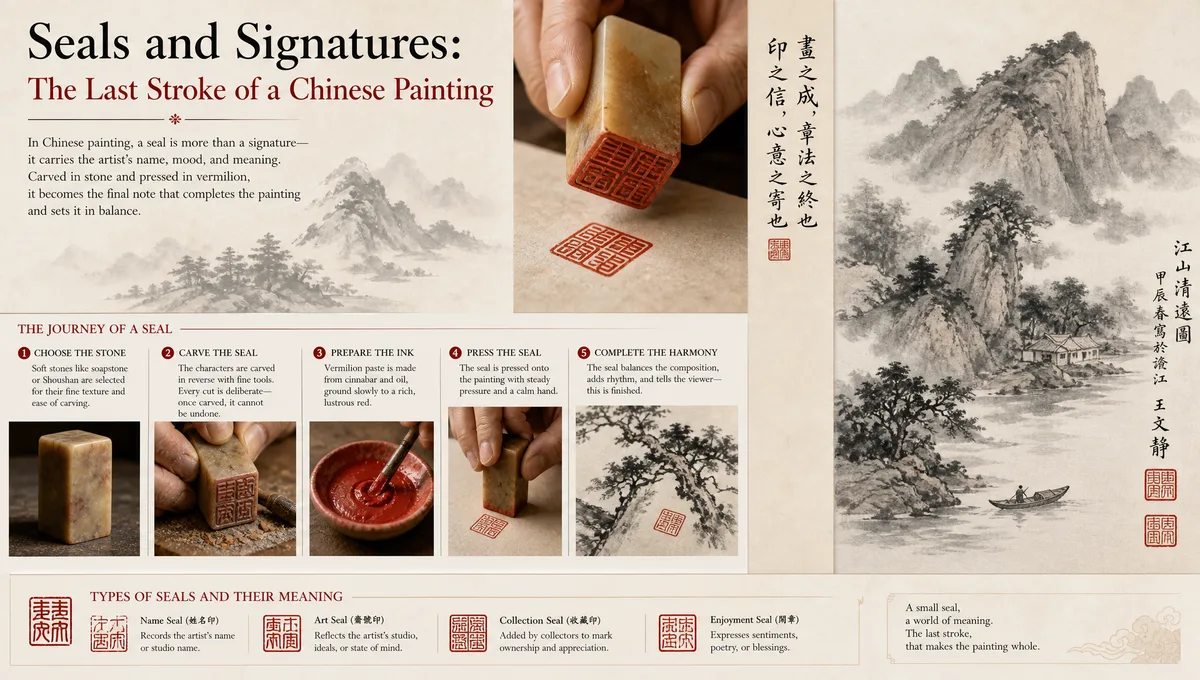
A Chinese painting does not end with the artist’s hand. It ends with a small red mark.
The mark is a seal, pressed into vermilion paste and set down beside the signature. It carries a name, sometimes a mood, sometimes the record of everyone who has owned the picture since.
Most viewers in the West read the seal as decoration. It is closer to a signature, a title and a chain of custody in one gesture.
A Short History of the Seal
Seals are older than painting as we use the word now.
- Warring States and Qin — official seals in bronze, jade and clay, used to authorise documents
- Han dynasty — the classical style: square faces, carved characters, a settled visual grammar that later carvers still imitate
- Tang and Song — collectors begin stamping their own seals on paintings, creating a record of ownership
- Yuan and Ming — scholars start carving their own seals in soft stone, and the personal seal becomes an art form
- Ming and Qing — schools of seal carving appear, with regional styles and named masters
The turning point is the soft stone. Bronze and jade need grinding tools; a piece of soapstone can be cut with a knife at a desk. Once that became possible, artists could make their own seals instead of commissioning them, and the seal joined calligraphy and painting as a personal skill.
Cutting a Seal
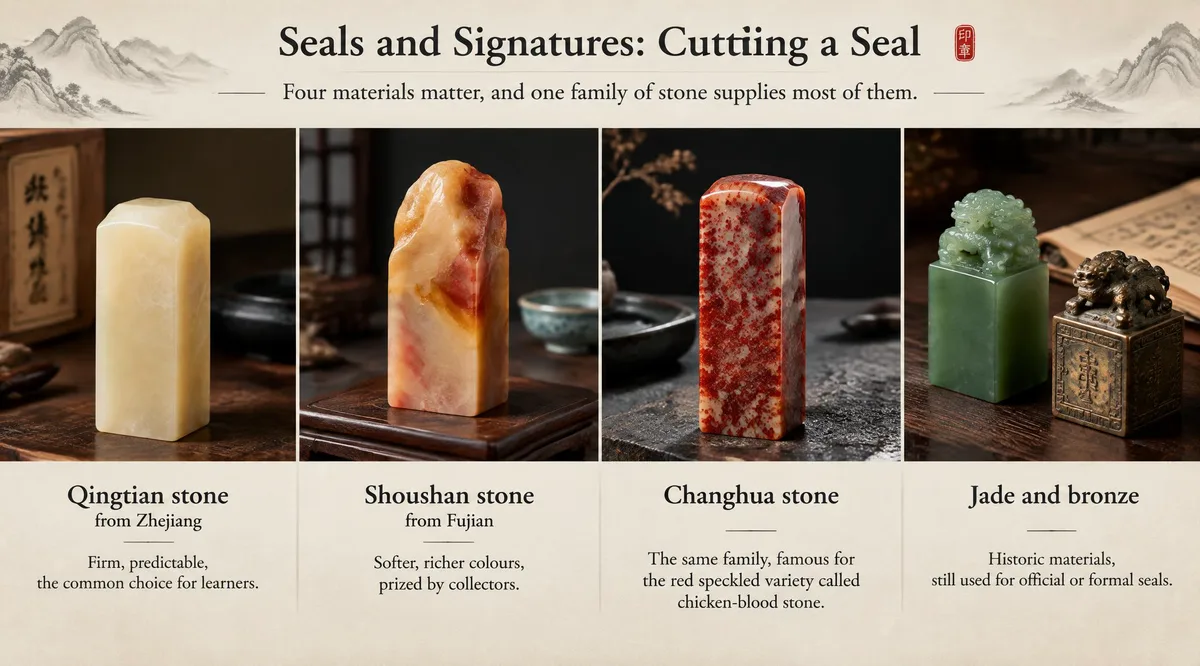
Four materials matter, and one family of stone supplies most of them.
- Qingtian stone from Zhejiang — firm, predictable, the common choice for learners
- Shoushan stone from Fujian — softer, richer colours, prized by collectors
- Changhua stone — the same family, famous for the red speckled variety called chicken-blood stone
- Jade and bronze — historic materials, still used for official or formal seals
The carving itself is done in seal script (zhuan shu), an older and more angular form of writing than the standard characters used today. Using seal script is practical as well as traditional: it fills a square face evenly, and its strokes bend without breaking.
Two basic techniques produce the two visual results:
- Bai wen (intaglio) — the characters are cut away, so the print is white on red
- Zhu wen (relief) — the characters are left standing, so the print is red on white
A carver thinks about three things at once: the shape of each character (zhuan fa), the balance of the whole square (zhang fa), and the quality of the cut (dao fa). A seal can be perfectly legible and still feel dead, usually because the spacing was decided after the carving rather than before.
The Paste, Not the Ink
Seals are not used with ink. They are pressed into a paste that has three ingredients.
- Cinnabar (zhu sha) — the pigment, ground finely
- Castor oil — the binder, aged for months or years
- Mulled moxa fibre (ai rong) — the carrier that holds the mixture together
The fibre is what makes the difference between a stamp and a good impression. It releases the paste evenly and produces the soft edge that collectors look at first. Good paste is also slow: it takes years to mature, and a well-kept dish can last decades.
The colour is the same cinnabar red that appears in old painting and on lacquer. Our piece on Chinese colour names follows that pigment back to the mineral it comes from.
Where the Seal Goes
On a painting or a piece of calligraphy, position carries meaning.
| Seal | Where it goes | What it does |
|---|---|---|
| Name seal | Under the signature | Identifies the artist |
| Courtesy or studio seal | Beside the name | Adds a second name or a studio reference |
| Opening seal (yin shou zhang) | Top right of the inscription | Balances the composition, starts the eye |
| Corner seal (ya jiao zhang) | Lower corner | Anchors the empty space |
| Collector’s seal | Anywhere the owner chose | Records ownership, often several per painting |
The rules are visual as much as social. A large red square in the wrong corner can pull a whole picture sideways. Painters often decide seal placement last, and some leave the space deliberately, knowing what will go there.
Collectors were less restrained. The Qianlong emperor is the standard cautionary example. His seals appear on hundreds of paintings, sometimes four or five to a scroll. Modern viewers routinely complain that he stamped over the art. He was, in the language of the field, recording his attention.
How to Read One
Three questions get you most of the way.
What script? Seal script is the default, but carvers also use clerical or standard script, and the choice sets the mood. A stiff, even seal script reads formal; a looser cut reads personal.
Is it cut or cast? Hand-carved seals show slight irregularities in the strokes, which is usually a mark of quality. Mass-produced seals for tourists are often moulded, and the characters look identical and flat.
How is it placed? Notice whether the red mark sits in a gap or against a busy area. Seals are often the only saturated red in a monochrome painting, and they function as a counterweight.
Making or Buying One
If the idea appeals, the practical path is short.
- A plain soapstone blank costs very little; a named stone costs more
- A carving knife and a small vice are the only tools needed
- Practise on soft stone first; a mistake means the face is cut down and started again
- A shop or a studio can carve a seal from your name or a two-character phrase in a week
Many people commission one as a gift. The most common choice is a name seal in white characters, with the surname in one column and the given name in the other. Our guide to brush practice covers the ink side of the same desk; the seal is what goes on at the end.
Common Questions
Are seals only for paintings?
No. They are used on letters, books, contracts, tea packaging and ceramics. The official seal (gong zhang) is still a legal instrument in China, Taiwan and Japan.
What is the difference between a seal and a stamp?
Materials and intent. A stamp is pressed with ink onto paper for office use; a seal is pressed with paste and carries a name or phrase that identifies a person or a moment.
Do I need to read seal script to enjoy a seal?
No, but it helps to recognise the two formats. White characters on red usually mean a formal name seal; red characters on white often signal a personal or studio seal.
Why do paintings have so many seals?
Because ownership history was written onto the work. Each collector added a mark, and a painting with many seals has usually passed through several important collections.
Can a seal be removed?
Not without damage. Seal impressions sink into the paper and cannot be washed out, which is one reason collectors valued them: they are a permanent, unforgeable history.
A Mark That Finishes the Work
The seal is small, red and easy to overlook. It does three jobs at once: it names the maker, it holds the composition together, and it records the years of people who cared enough to claim the picture.
That is why a painting without a seal can look unfinished, and why artists spend decades refining a surface no larger than a thumbnail. The last stroke of the work is not a brush stroke at all.
More of this desk is covered in calligraphy practice, and the arts and culture section collects the rest of the site.