Arts6 min read
Seal Stone Carving: Shoushan, Qingtian and Two Ways to Cut
A Chinese seal is cut into soft stone with a knife, not carved like sculpture. The stones that matter, the tools, and the difference between yin and yang cuts.
By Wen Su — Writer & Editor
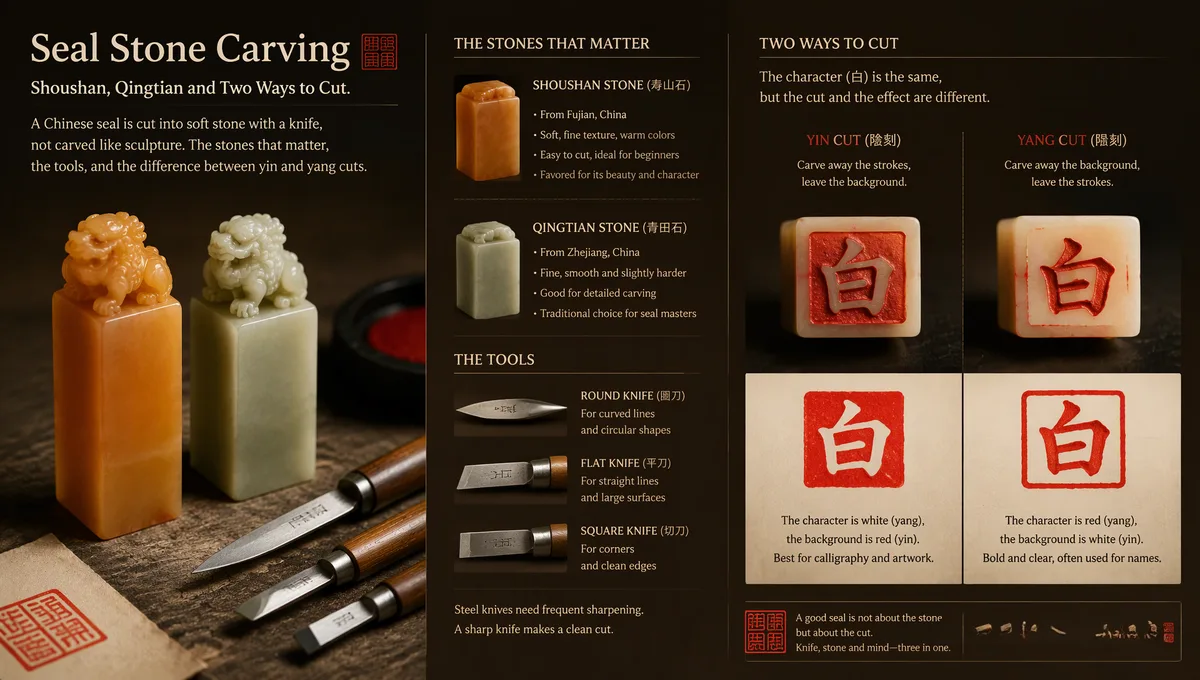
A Chinese seal looks like it must have been carved by a specialist with a workshop. Most of them were cut at a desk, by the person who was going to use them, in an afternoon.
The reason is the stone. It is soft enough to cut with a knife, and that single fact shaped the whole craft.
A Stone Soft Enough to Cut
Seal stones sit around two to three on the hardness scale. A fingernail will not mark them, but a steel graver goes through cleanly, and a beginner can cut a character on the first day.
Before soft stone became common, seals were cast in bronze or cut in harder materials, and you needed a foundry or a specialist. Once soft stone arrived, the seal moved from the workshop to the study. Calligraphers and painters began cutting their own, and the seal became a personal art rather than a service.
That is the same shift that made the four treasures of the study a single desk: brush, ink, paper, and a stone you could cut yourself.
The Stones That Matter
Three names come up constantly, and each is a place.
Shoushan stone, from Fujian, is the best known. It runs from a pale, almost soapy white to honey, and the finest pieces are semi-translucent. Tianhuang, the yellow variety, is the one collectors fight over.
Qingtian stone, from Zhejiang, is generally a little harder and a little more even. It is the practical choice for daily cutting, and the name is often used for pale greenish stones of a similar feel.
Changhua stone, also from Zhejiang, is known for chicken-blood stone: a red, mercury-sulphide colour spilling through a grey ground. The red is beautiful and the stone is brittle, which makes it a display piece as often as a working seal.
What matters in any of them is grain. A good stone cuts like firm soap, with no grit and no hidden crack. A cheap stone with a hard vein in it will ruin an otherwise fine character.
The Tools
Very few, and none of them expensive.
A graver, usually square-sectioned, with one flat and one angled face. A clamp to hold the stone, which matters more than beginners expect. A piece of fine abrasive paper and a flat surface for polishing the base. A brush and ink for the draft. And a box of cinnabar paste for printing, which is its own small craft.
Two Ways to Cut
There are two cuts, and their names trip people up.
In yin ke you cut the characters into the stone. The characters sit below the surface, so they take no paste, and the printed result is white characters on a red ground. This is called bai wen, white text.
In yang ke you cut everything around the characters and leave them standing. They take the paste, and the print is red characters on white. This is zhu wen, red text.
Neither is harder in principle, and both are harder in practice than they look. A deep yin cut has to be even at the bottom, or the print goes patchy. A yang cut has to clear the ground completely without nicking the strokes.
The seal on a painting is usually one of each: a white-text name seal and a red-text courtesy or studio seal, printed together.
Layout Before Cutting
The most common beginner mistake is a beautiful character in the wrong place.
A seal is a tiny composition, and the space between strokes carries as much weight as the strokes. Text is set in seal script, which is squared, symmetrical and radically unlike modern handwriting, so the layout has to be planned on paper first. Most teachers insist on a full draft before the knife touches stone.
There is an old principle from calligraphy that applies directly: leave space where space is needed, and let density be dense. A seal with four characters evenly spread and no air looks like a stamp. A seal with one character given more room looks composed.
The Process
Five steps, in order.
- Polish the base flat on abrasive paper, so the print will be even.
- Draft the characters on thin paper at seal size, then transfer them onto the stone face, usually by laying the paper on the stone and wetting it so the ink offsets.
- Cut. Characters first, then the ground between them.
- Print, look, and correct. A seal is cut in rounds, not in one pass.
- Cut the side inscription.
The fourth step is where the craft lives. Almost nobody gets the print right first time, and the correction is done by looking at the print, not the stone.
The Side Inscription
On the side of a seal, often on a face you never see when it is used, there is a small carved note.
The inscription usually carries a name, a date by the reign period, sometimes a line about the occasion, and occasionally a short comment on the cutting. Cut thin and shallow, in a running script rather than seal script, it is the closest thing Chinese craft has to a maker’s signature and diary entry in one.
What Makes a Seal Good
Three things, and only the third is about skill.
The characters have to be right, which is a calligraphy problem before it is a carving problem. The layout has to breathe. And the cut has to have bone: edges that are crisp and slightly angular, not soft and rounded. A seal cut with a dull blade looks furry when printed, and no amount of paste fixes it.
Beginners over-cut. The instinct is to go deeper and clean up the edges, and the result loses the cut quality that makes the print alive.
Common Questions
Do I need to know seal script?
You need to be able to copy it accurately. Few beginners can compose it, and copying from a dictionary of seal forms is the normal way to start.
Can I use any soft stone?
Any stone in the two-to-three hardness range will cut. The cheap ones crumble, which is why practice stones exist.
How long does one seal take?
An afternoon for a first attempt, and considerably longer for a good one. The cutting is fast; the drafting is not.
Is the red paste just ink?
No. Cinnabar paste is made from pigment, oil and a fibre binder, and it is worked into the seal face with a specific dabbing motion. It is thick and slightly raised on the paper.
Can a seal be re-cut?
Yes, and many old seals were. The base can be polished flat and cut again, which is one reason original seal faces are rarer than original stones.
A Knife, a Stone, an Afternoon
Seal carving is unusual among Chinese crafts in being genuinely domestic. No furnace, no workshop, no rare materials, and a finished object small enough to lose in a drawer.
It is also the step that finishes a painting. How seals function as a signature covers that side: where the seal goes, what the inscription means, and why the last stroke of a scroll is often red.
More crafts sit in the Culture & Arts section.