Arts6 min read
The Four Treasures of the Study: Brush, Ink, Paper, Inkstone
What the four treasures actually are, how each one is made, and what a beginner can skip. A plain guide to brush, ink, paper and stone without the mystique.
By Ming Chen — Editor & Researcher
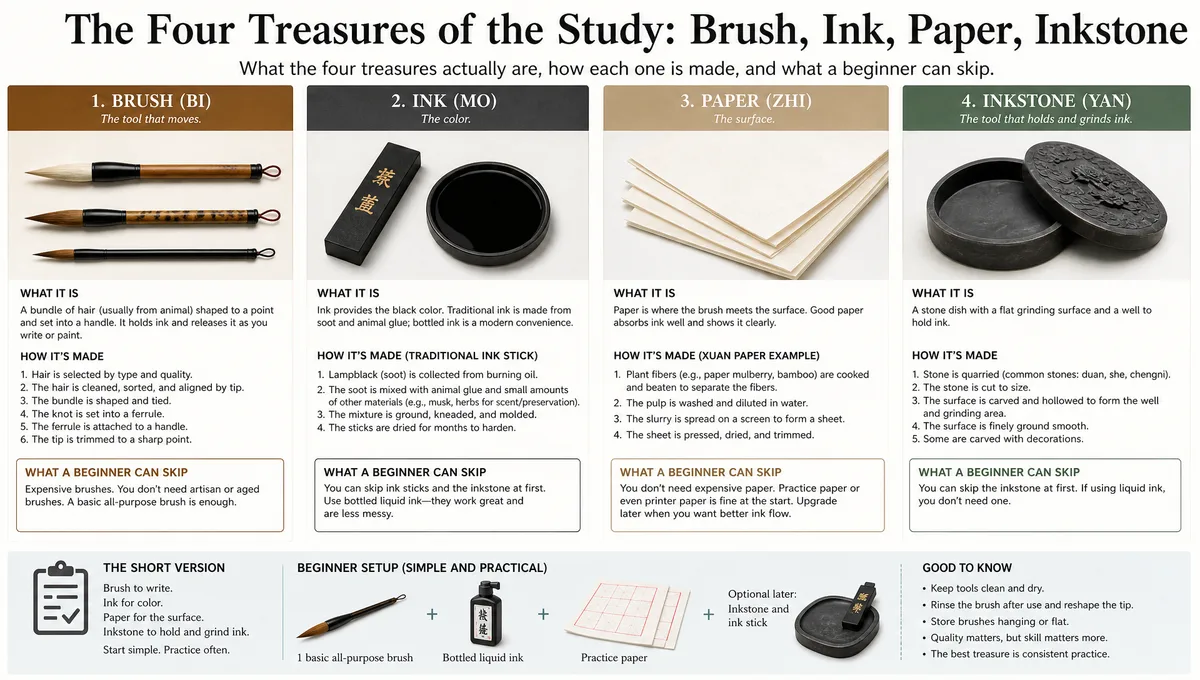
Wenfang sibao, the four treasures of the study, is one of those phrases that sounds like a museum label. It is really a shopping list, and a short one: a brush, ink, paper, and a stone to grind the ink on.
What makes the phrase interesting is that it groups them. Chinese writing does not need four objects. It needs a mark and something to carry it. The fact that the tradition counted them as a set says something about how the practice was taught, and about what a beginner should buy.
Why Four Objects and Not One
A brush by itself is a stick. Ink by itself is a block. Put them together and you still need a surface, and you need a way to turn the block into liquid.
The standard answer is the inkstone: water in the well, the stick ground against the stone until the water darkens. That sequence — grind, load, write, rinse — is the reason the four objects travel together. Each one sets the pace of the others.
You can work around all of it with bottled ink and a saucer. Plenty of people do. But it helps to know what the arrangement was designed for before you simplify it.
The Brush: Hair, Waist and Tip
A brush is a bundle of animal hair set in a bamboo or wooden handle. Three hairs matter.
Yanghao is goat hair. It is soft and absorbent, forgiving of a slow hand. It is also hard to control at first, because it holds a lot of water.
Langhao is weasel hair, not wolf, despite the character. Stiff and springy. It snaps back into shape, which makes it good for small regular script and for lines that need a crisp edge.
Jianhao mixes the two. Usually a stiff core with a softer outer layer, which is why almost every teacher hands a beginner a jianhao brush in medium size.
A good brush is judged on four things, together called jian, qi, yuan, jian (sharp, even, round, springy). The tip is sharp. The hairs are even in length when the brush is spread flat. The belly is round. And there is enough spring for the brush to return to a point. Cheap brushes fail the last test and shed within weeks.
The Ink: Stick, Stone and the Daily Grind
Ink comes as a stick of soot and glue, pressed in a mould. Pine soot (song yan) reads slightly cool and matte. Oil soot (you yan) reads glossier and darker.
Grinding takes ten to fifteen minutes for a usable pool. That sounds like a chore and is, at first. It is also the part people come to value. The hand moves in circles, nothing else happens, and by the time the ink is ready the mind has arrived.
Bottled ink is honest competition. It is cheap, consistent, and good enough for practice. What it lacks is the slight variation in density that a fresh grind gives you, which matters for shading and not much else.
The Paper: Xuan and Its Cousins
Xuan zhi comes from Jing county in Anhui, made from the bark of the blue sandalwood tree and rice straw. It is made in more than a hundred steps, which is why a sheet costs what it costs.
The distinction that matters is not the brand but the finish. Sheng xuan is unsized: water spreads into it and edges bloom. That is wonderful for ink painting and unforgiving for a beginner’s first characters. Shu xuan has been sized with alum, so the ink stays where you put it.
For daily practice, most people use maobian zhi or yuanshu zhi, both cheap and slightly absorbent. The name maobian is usually traced to a Ming publisher, Mao Jin, who sold books with untrimmed edges. Whatever the origin, the paper is forgiving. It lets you make the same mistake twice.
The Inkstone: A Stone That Holds Water
An inkstone is a flat stone with a shallow well. The best known are duan yan from the Duanxi creek in Guangdong and she yan from Longwei Mountain in Wuyuan, which took the name of the old prefecture.
What makes a good one is grain. A fine, even stone grinds the stick smoothly and does not wear it away in crumbs. A coarse stone does the opposite, and you feel the difference in your wrist before you see it in the ink.
If you are using bottled ink, you do not need a stone at all. A small porcelain dish does the job of holding a pool. The stone becomes worth its price when the grinding itself is the point.
What to Buy First
A beginner’s kit is cheaper than the gift boxes suggest.
One jianhao brush in medium size. One bottle of practice ink. One pack of maobian zhi. One small dish. That is the whole list, and it costs less than a nice dinner.
Skip the lacquered boxed set. The brushes in those boxes are usually the ones that shed, the ink is old, and the stone is decoration. Buy the four things separately and replace them one at a time as you learn what you like.
What the Four Things Are Not
They are not a personality. Owning good tools does not make anyone a calligrapher, and no teacher has ever been impressed by a brush collection.
They are not decoration either, though they photograph well. A brush left standing in its own ink for a week is a ruined brush.
And they are not expensive by necessity. The most useful thing about the set is that it limits decisions. Four objects, one practice, no further shopping required.
Common Questions
Why are they called treasures? The phrase is late and slightly promotional. Wenfang means the study, and the four objects were the minimum a literate household kept there. Calling them treasures was a compliment to the room, not a price tag.
Raw or sized paper for a beginner? Raw sheng xuan for painting and for anyone learning to control water. Sized shu xuan if you want crisp characters immediately. Cheap maobian zhi for the first months either way.
Can bottled ink replace grinding? For practice, yes. The grind adds control over density and subtracts ten minutes from your day. Most people grind on weekends and use bottled ink on weeknights.
How long does a brush last? Months with care, weeks without. Rinse it in cool water after use, shape the tip, and hang it bristles down. Never leave it standing in ink.
Do I need an inkstone? Only if you use sticks. With bottled ink, a saucer or a small dish is enough.
Four Objects, One Practice
The four treasures are a small technology, refined over centuries, for putting a thought on paper slowly enough to notice it. Buy the cheap version, use it badly for a few months, and the objects will explain themselves.
If you want the practice rather than the tools, start with calligraphy for focus. The unpainted space in a picture has its own piece, and the red mark that finishes a scroll is explained in seals and signatures.