Wellness5 min read
When the Light Leaves Early: Rearranging the Evening in Late October
By late October the dark arrives before dinner. Four small changes to the shape of the evening, borrowed from the old habit of living by the season.
By Lian Zhao — Copy Editor
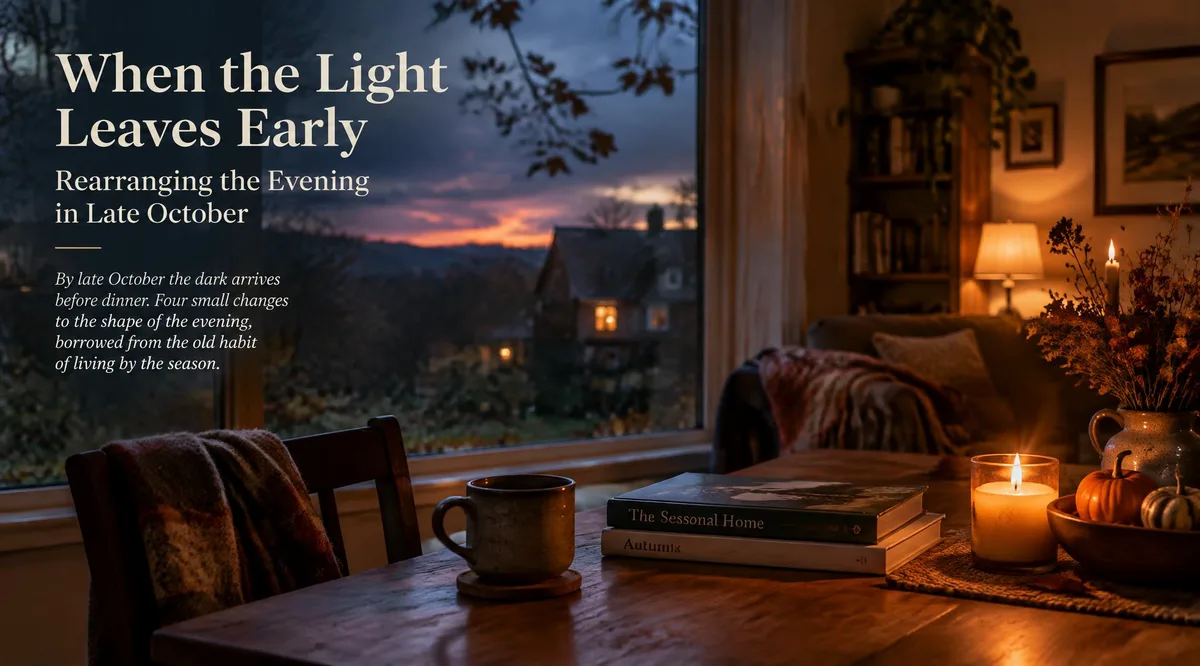
By the end of October the dark arrives before dinner across most of the northern hemisphere. That one change rearranges more of a day than the temperature does, and almost nobody plans for it.
The old Chinese calendar had a phrase for the right response, and it was not “push through”. It was adjust the schedule and let the season do what it does. The habit is easy to borrow even if the theory behind it does not interest you.
The Line in the Old Texts
The autumn passage of the Huangdi Neijing is short and oddly practical: zao wo zao qi, yu ji ju xing. Go to bed early, rise early, get up when the rooster does.
It reads like advice about sleep. It is closer to an observation about light. In a world without lamps, the usable hours in October shrink at both ends, and the text is telling people to match the day instead of arguing with it.
What has changed since is the lamp. What has not changed is the body’s habit of taking its cue from the sky.
Four Adjustments Worth Making
1. Move dinner half an hour earlier. By late October a meal at half past seven lands in full dark, and everything after it feels like borrowed time. Half an hour earlier puts dinner in the last of the light and leaves a longer stretch before bed. It is the single easiest change on this list.
2. Turn the lights down rather than off. One lamp in the room you actually sit in, at the warm end of the spectrum, is enough to read by. The overhead light is what makes an evening feel like an extension of the working day. Try the change for a week and notice whether the hour before bed feels different.
3. Warm the feet before you sit down. A basin of hot water for ten minutes, or thick socks and a blanket, does the same job at different speeds. We have a longer piece on foot soaking before bed, including the temperature that is actually comfortable and how long to stay in.
4. Fix the hour you stop working. Write it down, because in October it will arrive earlier than your inbox expects. The most useful version is a clock time, not a task count. Work expands into whatever hours you leave open, and the dark evenings are where it expands fastest.
The Long Evening Problem
Dark at six, bed at eleven. Those five hours are the ones people fill with a phone, and the reason is not laziness. An unstructured evening has no edges, and a screen is very good at giving it one.
The old answer was not entertainment but ritual. Tea brewed slowly. A few pages read aloud. A walk to the end of the lane and back. Gongfu tea works for this because it cannot be hurried: water, leaves, short pours, attention.
The rule of thumb worth keeping is that the thing should take twenty minutes and occupy your hands. Anything that fits both will hold an evening better than a list of resolutions.
What About the Nap?
Autumn is the season for shortening the midday nap rather than lengthening it. Longer daytime naps can push bedtime later, and the evenings are already getting long.
Two pieces cover the practical side: the midday nap in Chinese practice and where a nap stops helping. Both come down to the same three numbers. Twenty minutes, before three in the afternoon, sitting up rather than lying flat.
The Cold Comes Next
Late October also sits in the stretch that runs from Cold Dew towards the first frost. Nights cool faster than afternoons, which is why the same household can be overdressed at two and cold at nine.
The adjustment that matters here is layers rather than heating: something on the feet, something on the shoulders, and a blanket within reach of wherever you sit. Winter warmth in Chinese households goes through the same ground in more detail.
Common Questions
Is six o’clock dinner too early? It is early by modern habit and ordinary by historical standards. If it does not suit your household, move it half an hour from where it is now rather than to a number.
I work until nine. Does any of this apply? The order still works, compressed. Lights down on the way home, feet warm while you eat, and a fixed stopping point that is not midnight.
Will this help me fall asleep faster? Some people find that a dimmer, earlier evening makes the last hour easier to settle into. That is a routine effect rather than a promise, and it varies a great deal between households.
Do I need to change what I eat? Not for this. The seasonal eating question is separate, and it is mostly about what is in the market rather than about rules.
What if I like the long evenings? Then keep them, and take only the fourth adjustment. A fixed hour to stop is worth having in every season, and it is the one item on the list that has nothing to do with the sun.
Move the Evening, Not the Sunset
You cannot move the sunset. You can move dinner, the lamps, the basin of hot water and the hour you close the laptop. Four small decisions, and the evening stops feeling like something that happened to you.
Start with one of them this week. The half hour on dinner is easiest to test, and the difference shows up within a few days. More on living with the seasons sits in the Wellness section, and the October weather itself is covered in Cold Dew.