Arts8 min read
Cold Dew: The Chinese Solar Term When Dew Turns Cold
Cold Dew is the solar term when morning dew turns cold. Inside the name: geese, chrysanthemums, sesame, and the three signs old calendars watched for.
By Ming Chen — Editor & Researcher
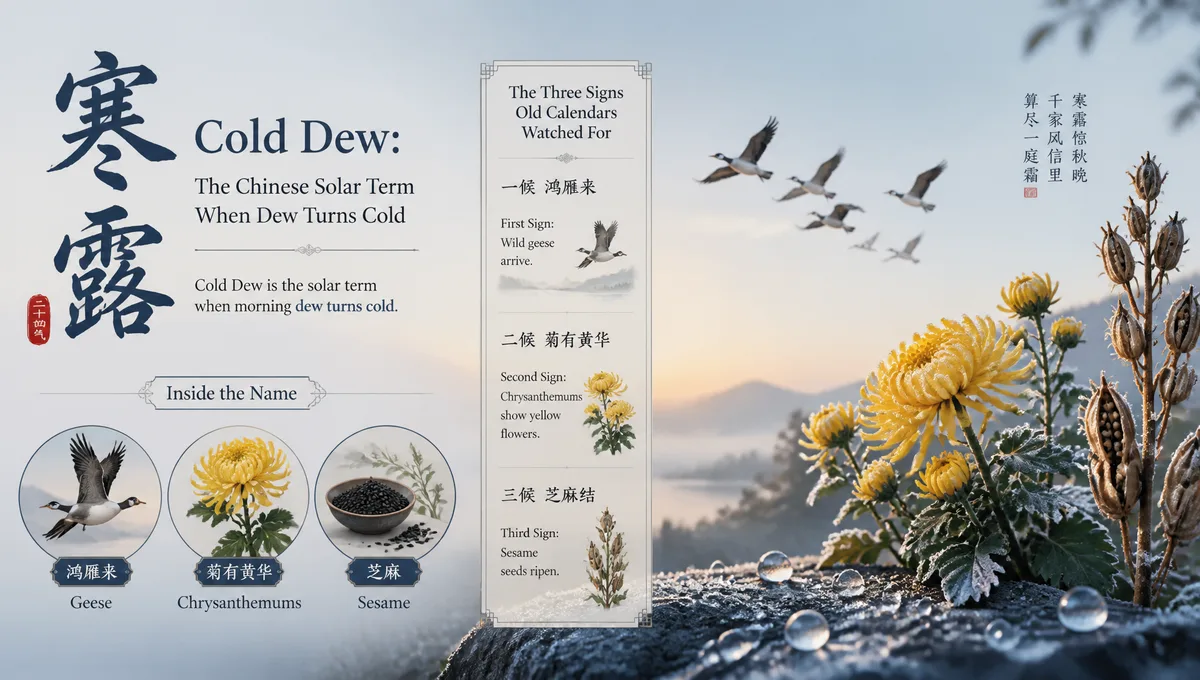
Two weeks after the autumn equinox, something small changes outdoors.
Dew that settles overnight stops feeling cool and starts feeling cold.
That shift is the whole meaning of the solar term called Cold Dew. In Chinese it is han lu, and it arrives around October 8 each year.
No festival marks the day. No dish is required. What the name records is one observation, made by people who went outside and looked.
A Calendar That Names What You Can See
The 24 solar terms divide the year into twenty-four stretches of about fifteen days. Each carries a name taken from weather or from the living world: rain water, awakening insects, white dew, frost descending.
Nothing on the list is abstract. Every name is something a person could walk out and check.
Cold Dew is the seventeenth term of the twenty-four. Its position matters, because it sits between two neighbours with almost the same name.
Three Steps: White Dew, Cold Dew, Frost
Autumn has a staircase, and its steps are fifteen days apart.
White Dew (bai lu) arrives in early September. Nights turn cool enough for moisture to gather into visible droplets.
Cold Dew (han lu) arrives in early October. The same droplets, now cold to the touch.
Frost Descending (shuang jiang) arrives in late October. The droplets stop being droplets.
Read as a set, the three names describe one process from three angles. The calendar does not say that temperatures are falling. It says: look at the grass in the morning, and notice what is on it.
That habit of naming is why the system lasted. Anyone with eyes could use it, in any region, without instruments.
The Three Signs of Cold Dew
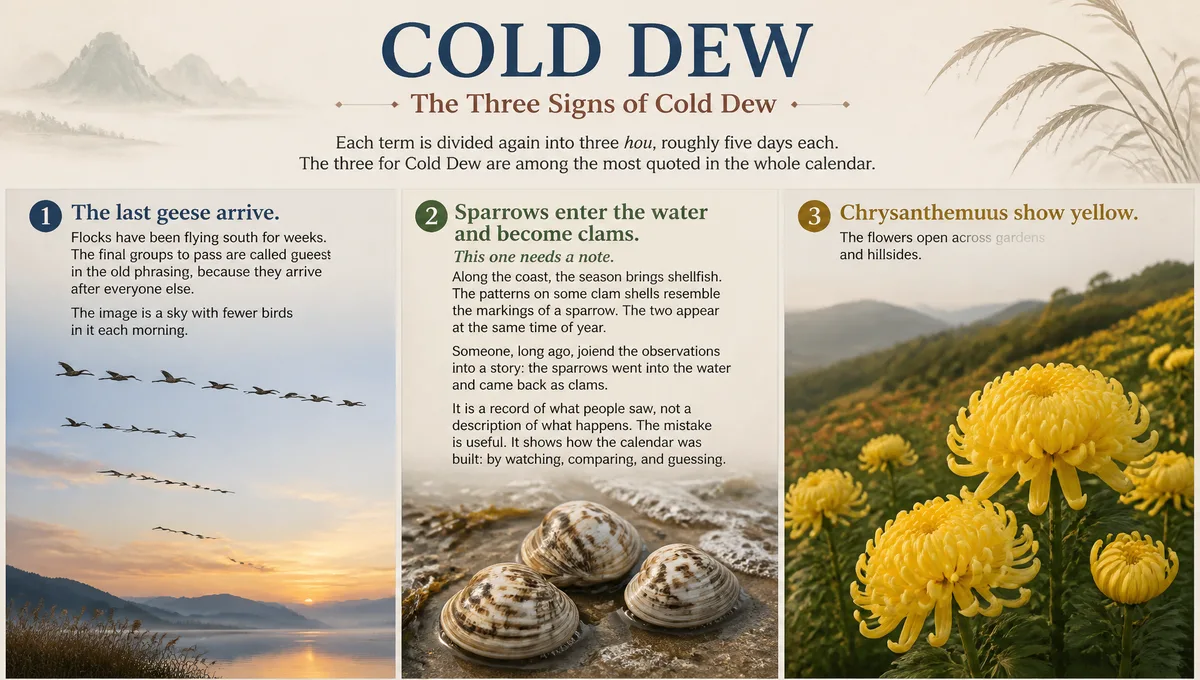
Each term is divided again into three hou, roughly five days each. The three for Cold Dew are among the most quoted in the whole calendar.
First, the last geese arrive. Flocks have been flying south for weeks. The final groups to pass are called guests in the old phrasing, because they arrive after everyone else. The image is a sky with fewer birds in it each morning.
Second, sparrows enter the water and become clams. This one needs a note.
Along the coast, the season brings shellfish. The patterns on some clam shells resemble the markings of a sparrow. The two appear at the same time of year. Someone, long ago, joined the observations into a story: the sparrows went into the water and came back as clams.
It is a record of what people saw, not a description of what happens. The mistake is useful. It shows how the calendar was built: by watching, comparing, and guessing.
Third, chrysanthemums show yellow. The flowers open across gardens and hillsides.
The three-part structure is usually credited to a Yuan dynasty scholar, Wu Cheng, who gathered the seasonal records into one book in the thirteenth century. The observations themselves are older.
“After White Dew, Cover Up. After Cold Dew, Do Not Bare Your Feet.”
That pair of sayings is the most quoted line about this season, and it is a clothing rule.
After White Dew, in September, people stopped going bare-armed. After Cold Dew, in October, they stopped wearing sandals and thin shoes. Feet went back into cloth and leather for the winter.
Read it as a description of an order of operations. The saying tracks what a farming household did with its clothes as the mornings cooled, step by step. It is a schedule, not a promise.
The same instinct shows up in homes today. Shoes change first. Then bedding is aired out and rotated. If you want the modern version of the ritual, our pieces on winter foot soaking and getting through winter cover the two habits that follow.
What the Table Holds in October
Seasonal eating in this tradition runs on what is ripe, not on what is recommended. Our guide to eating with the seasons explains the wider habit.
Late October brings the last of the fresh harvest, and a short list of foods is tied to the date.
Sesame. Ground sesame paste, sesame cakes and sesame candy are the foods most often mentioned with Cold Dew. The link is practical: the sesame harvest and the pressing of oil fall in these weeks. A bowl of black sesame paste is the standard example.
Chrysanthemum wine. Chrysanthemums are in flower, and the wine made from them belongs to this window. We cover the flower itself in our piece on chrysanthemums and autumn tea.
River crab. The old rule is nine female, ten male. Crabs caught in the ninth lunar month are kept for the roe, and those from the tenth for the paste. The rule is about timing, and it is still repeated in markets.
Persimmons, hawthorn and chestnuts. These arrive together, and they keep well, which is why they belong to the storage side of autumn rather than the table. The same logic sits behind our pear and snow fungus pot.
Climbing and Chrysanthemums: Two Names for One Week
Cold Dew and the Double Ninth Festival often fall within days of each other. The festival follows the lunar calendar, on the ninth day of the ninth month, so the two drift apart by a few weeks in some years.
When they overlap, the same three activities are claimed by both: climbing a hill, looking at chrysanthemums, and drinking chrysanthemum wine. Our guide to the Double Ninth Festival covers the festival side.
The difference is worth keeping clear. The festival is a date with people attached to it: visits, letters, a walk with family. The solar term is a weather note with no ceremony at all. One is a holiday. The other is a line on a farmer’s calendar.
The Busiest Fortnight in the Fields
For farming households, Cold Dew was less a name than a deadline.
In the north, the saying went: Cold Dew to Frost Descending, no need to hurry with the wheat. Winter wheat goes into the ground in this window. Miss it, and the seedlings go into the cold too small.
Along the Yangtze, late rice was filling out and cotton was being picked. In the south, another saying pushed the same point: if you do not pick cotton at Cold Dew, do not complain when the frost comes.
So the term carried two meanings at once. It told you what the mornings felt like. It also told you how many days were left.
What This Is Not
Three statements, because the wording matters on this site.
First, seasonal categories and the idea of eating with the calendar are traditional ways of sorting the year. They describe habits and harvests. They are not descriptions of effect, and this site does not make health claims.
Second, this is a piece about a name on a calendar, not guidance of any kind. Nothing here takes the place of advice from your own doctor. If something in your body is troubling you and does not settle, the answer is a doctor.
Third, if your doctor has given you a list to follow, that list wins.
Common Questions
Does Cold Dew always fall on October 8?
Usually, yes, give or take a day. The term begins when the sun reaches 195 degrees along its apparent path, so the date can be October 7, 8 or 9.
What is the difference between Cold Dew and the Double Ninth Festival?
One is a solar term and the other is a festival. Cold Dew is set by the sun and carries nothing but weather and farm work. The Double Ninth is set by the moon, on the ninth day of the ninth lunar month, and it carries visits, climbing and family custom. They land near each other most years because both sit in early-to-mid October.
Why is sesame associated with Cold Dew?
Because of the harvest. Sesame is gathered and pressed in these weeks, so the fresh paste and oil were on hand. It is a seasonal pairing, not a recommendation.
What did households actually do at Cold Dew?
Practical things, in a fixed order. Summer footwear was put away, winter clothing came out and was aired, bedding was washed and stored, and dried goods were checked before the damp set in. The list is about the house, not about the body.
Is Cold Dew observed anywhere else?
Yes. The solar terms travelled with the calendar, and the same term is read as kanro in Japan and hanro in Korea, on nearly the same date. The names sit on the same sun, and each language reads them in its own way.
A Name That Still Works
The charm of this term is that it asks for nothing. It is not a holiday, and it has no food you must eat. It is a note pinned to a fortnight, saying that the mornings have changed.
You can test it without a calendar. Leave something metal outside overnight, and touch it before sunrise. Or watch the grass at the edge of a path, and see whether the drops still look like water.
If the seasonal way of reading the year interests you, our piece on autumn and the three lessons of the season takes the same idea into a wider view. The rest of this corner of the site is in the culture & arts section.