Arts5 min read
The Chinese Knot Today: From Door Hanging to Keyring
The Chinese knot is older than its name. Where the knots came from, how the modern red version was standardised, and how to start tying one yourself.
By Wen Su — Writer & Editor
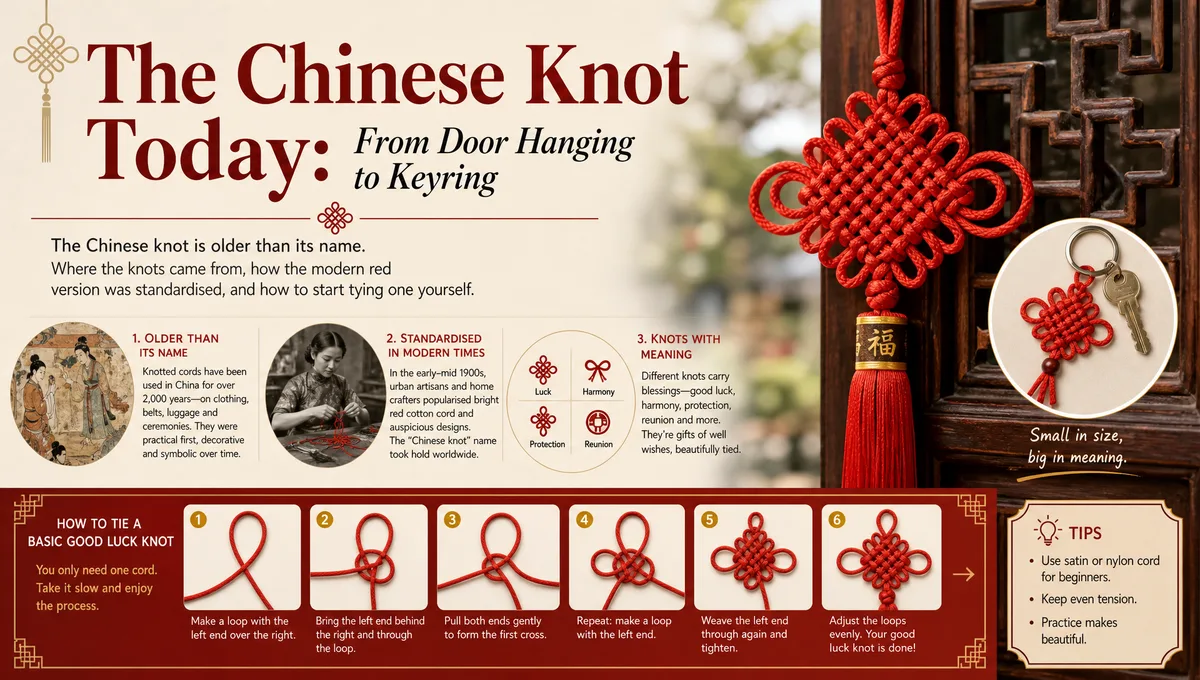
Walk through any Chinese market in January and you will see them by the hundred: red cord, symmetrical loops, a tassel at the bottom, a small price tag.
The object looks ancient. The name it goes by is not. The Chinese knot, as a category with a standard form and a standard colour, is largely a product of the last fifty years, built on techniques that are genuinely old.
Knots Before Names
Rope work is one of the oldest human technologies, and in early Chinese writing knots carry a memory function. A classical passage describes a time when people tied knots to keep records, before writing replaced them.
Specific knot types also travelled through daily life:
- Jade pendants hung on knotted cords, with the cord treated as part of the object
- Seal and tally cords for officials, where the knot indicated rank
- Bud and button knots on clothing, used as fastenings before buttons became common
- Sachet and fan knots, decorative and often perfumed
- The pan chang knot, an unbroken loop design associated with Buddhist imagery and long life
Until the twentieth century, this was craft vocabulary rather than a single named art form. A knot belonged to an object: a robe, a jade, a curtain.
How the Name Appeared
The phrase Chinese knot is modern. Craft promoters and designers in the 1970s and 1980s, first in Taiwan and then on the mainland, wanted a name for the body of techniques they were teaching.
Two decisions in that period shaped what we see now.
One visual language. Designers standardised the most legible shapes: the flat square knot, the double coin, the pan chang and the auspicious knot, usually worked in red cord with a tassel.
One symbolic reading. The forms were given meanings that a general audience could remember. Symmetry suggested balance, the unbroken loop suggested continuity, the coin shape suggested prosperity.
The result is a craft that is genuinely traditional in technique and quite modern in presentation. Our earlier guide to knotting for beginners goes through the first knots step by step; this piece is about where the object sits now.
Reading the Modern Knot
Once you know the vocabulary, the designs at a market stall stop looking identical.
| Element | What it does |
|---|---|
| Cord colour | Red for celebration; gold and jade green also common |
| Knot type | Simple loops read as everyday; dense symmetrical knots read as formal |
| Symmetry | Left-right balance is the default rule |
| Tassel | Carries the eye down; length sets the formality |
| Attachment | Door, car mirror, keyring, handbag — the intended use changes the size |
Size tells you the purpose. A knot the width of a hand is meant to hang. One the width of a thumb is meant to travel, which is why keyrings became the most common modern use.
Where You See Them Now
The object has spread well past the Lunar New Year.
- Door and window hangings in the fortnight before New Year, along with couplets and paper cuttings
- Car mirrors, often with a small gourd or coin attached
- Wedding and gift decoration, where red knots wrap gifts or appear on invitation cards
- Museum shops and overseas Chinatowns, where the knot functions as a portable emblem
- Jewellery, with designers using a single knot as a clasp or a pendant
The boom in handmade knotting is recent too. Craft shops sell cord by the metre, and evening classes run in most large cities. The appeal is the same as any small handwork: a tidy result emerges from an unhurried hour.
Starting It Yourself
The craft is friendly to beginners, and the equipment is minimal.
- Cord. Nylon or satin cord in 2–3 mm is easiest to learn with; silk looks better and slips more
- Board and pins. A foam board and T-pins hold the loops while both hands work
- One knot at a time. The flat square knot, then the double coin, then the pan chang
- Patience with tension. Loose loops look clumsy and tight loops distort the shape. The skill is evenness
Most learners spend a week on the first knot and a month before a pan chang looks round. After that the technique transfers: the same cord and the same movements produce a dozen different forms.
If you would like the season that surrounds the object, our piece on New Year traditions covers the decorations, food and household customs. Paper cutting is the other hand-craft that lives on the same windows and doors.
Common Questions
Is the Chinese knot a religious object?
Usually no. A few forms, such as the pan chang, carry Buddhist associations, and temple hangings are common. The ones sold as gifts are decorative.
Why is red the standard colour?
Red is the celebration colour across the culture, used for weddings, New Year and gifts. Knots in other colours exist and are chosen for interior design rather than meaning.
Was the Chinese knot invented in the 1980s?
No, and the claim appears in both directions. The techniques are old and the cord-and-tassel form is old; what the twentieth century added was a shared name, a standard palette and a market.
What is the easiest knot to learn first?
The flat square knot, sometimes called the basic knot. It is symmetrical, forgiving, and the base of many composite designs.
Can I use any cord?
Almost any braided cord works, but stiff cord holds shape and soft cord holds nothing. Nylon is the usual compromise for learning.
A Living Form
The Chinese knot is a good example of how traditions actually survive. The technique is inherited; the name, the colour and the purpose were chosen recently, by people who wanted the craft to be teachable.
That makes it neither fake nor ancient. It is a living form, still being standardised by whoever is tying it this winter. It is also still doing the job it always did: turning a piece of string into something worth hanging.
More of this kind is in the arts and culture section, including seals and signatures for the other craft that signs a work.