Wisdom5 min read
The Long Pavilion: How Chinese Poetry Says Goodbye
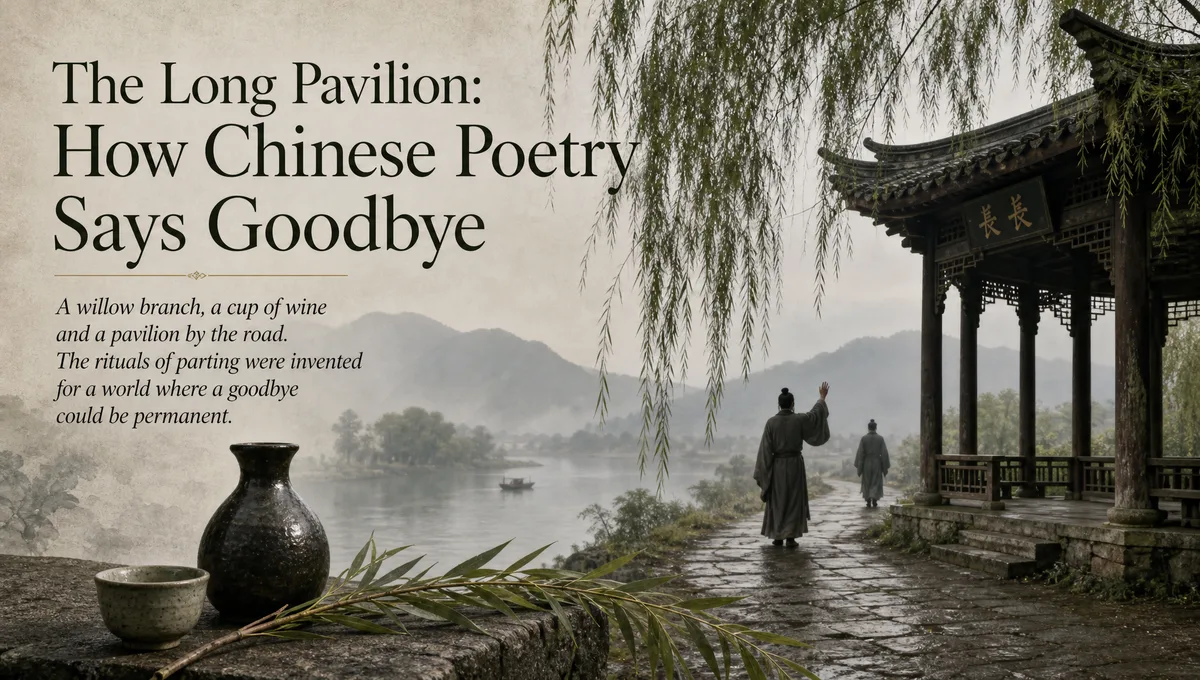
A willow branch, a cup of wine and a pavilion by the road. The rituals of parting were invented for a world where a goodbye could be permanent.
By Ming Chen — Editor & Researcher
Chinese classical poetry has a genre for almost everything, and one of the largest is the goodbye.
Poems of parting, songbie shi in Chinese, run into the thousands. The sentiment is obvious, so it is not what makes them interesting. The interesting part is the machinery: a set of places, objects and gestures that the tradition agreed on, and that a reader could recognise in the first two lines.
The Pavilions by the Road
Parting began with a journey, and journeys had a standard shape.
Travellers left a city on foot or by horse. The first stretch of road out of town was lined with pavilions. The custom was a long pavilion every ten li, a short one every five.
They were shelters, and they were also the places where people stopped to drink a last cup together. The changting, the long pavilion, became the shorthand for the whole genre. When a poem opens with a pavilion, the reader knows the subject before a single person appears. The building is not scenery. It is the stage.
The Willow Branch
The second piece of machinery is a tree.
Breaking off a willow branch and giving it to a departing friend was a real practice. It also worked as a pun. Liu, the willow, sounds like liu, to stay. Handing someone a willow was a way of saying stay without saying it.
Willows grow by water and along roads, which is where the pavilions were. In Chang’an, the place to do this was the bridge at Ba, where the road west began. After that, breaking a willow at Ba Bridge became a phrase any literate reader knew.
The Cup, and the Pass
The third element is drink.
Wang Wei wrote the most quoted farewell poem in the language. He wrote it to a friend being posted to the frontier, and the closing couplet is the reason it is remembered: “One more cup, please. West of Yang Pass there will be no old friends.”
The line works because it names the specific gate. Yang Pass was the last outpost on the road into the western deserts. Beyond it, the familiar world stopped. The poem was later set to music, and it survives as a piece still performed, “the Yang Pass, three times over.”
Two Ways to End It
Once the props are in place, the poem has to decide what to say. The tradition offers opposite endings.
The comforting one. Wang Bo, sending a friend to a distant posting, refuses the usual tears: “If there is a friend within the four seas, the ends of the earth are next door.” It is a consolation offered with full knowledge of the distance, which is what keeps it from sounding glib.
The encouraging one. Gao Shi, seeing off a musician who had fallen on hard times, ends with a line that has become a standard phrase of encouragement: “Do not worry that the road ahead has no one who knows you. Who in the world does not know your name?”
Both endings do the same job. They take a poem about loss and give the departing friend something to carry.
The Settings Poets Preferred
Look at when these poems happen, and a pattern appears.
Partings in the tradition are overwhelmingly set at dusk, by water, in autumn. Boats left on the tide, which fixed the hour. Rivers were the highways. Autumn was the season when officials were moved between postings.
Our piece on reading a life as a year covers the autumn mood separately. Here it is doing something specific: the season of endings is the season of departures.
Li Bai gave the tradition its most cinematic image. He watched a friend’s boat from a tower: “The single sail fades into the blue distance, and there is nothing left but the great river running to the horizon.” Nothing is said about how the poet feels. The camera does it.
Three centuries later, Liu Yong compressed the same scene into a line of ci poetry: “Hands held, faces watched, eyes wet, and no words at all.”
How to Read One in Three Steps
The form is regular enough that a newcomer can read a songbie shi without much preparation.
Find the place. A pavilion, a bridge, a tower, a riverbank. That tells you the hour and often the season.
Find the object. A willow, a cup, a sail, a horse. The object is doing the emotional work, and it is usually doing it by pun or by convention.
Read the last two lines twice. The final couplet is where the poem decides whether to console, encourage, or simply stop. That decision is the poem’s real argument.
Why the Formality Is the Point
A modern reader can find all of this theatrical. Why the branch, the cup, the pavilion, the prescribed ending?
The answer is in the technology of the world that produced it. A friend moving three hundred kilometres away in the Tang dynasty might not be seen again. There was no letter that arrived reliably, no call, no visit next summer. A parting was often final, and everyone at the pavilion knew it.
Ritual is what a culture builds when a thing is too large to say plainly. The willow, the cup and the last look at the boat are not decorations on top of a goodbye. They are the goodbye, in a form that two people could perform while both knew they might not meet again.
That is also why the poems still work. It explains an ordinary phrase that Chinese speakers still use at a station: “See someone a thousand li on their way, and you still have to part.”
Common Questions
Why a willow branch?
Because liu (willow) sounds like liu (to stay). The gesture was a pun that everyone understood.
What is a changting?
A pavilion on the road out of a city, spaced every ten li, where travellers stopped to drink a parting cup.
Where does Yang Pass come from?
It was the last outpost on the western road. Wang Wei’s poem about it became the most quoted farewell in Chinese.
Is autumn really the season for partings?
In the poetry it is, and for practical reasons. Officials were posted in autumn, and rivers and passes were the routes.
What is “see someone a thousand li”?
A proverb still in use. Walk with someone a thousand li, and the parting happens anyway. It is said kindly.
More of this sits in the wisdom section, including poems about ageing.