Wisdom7 min read
Reading a Life as a Year: Chinese Literature and the Seasons
Spring, summer, autumn, winter. Mapping age onto the seasons is one of the oldest metaphors in Chinese poetry — and one of the most argued with.
By Ming Chen — Editor & Researcher
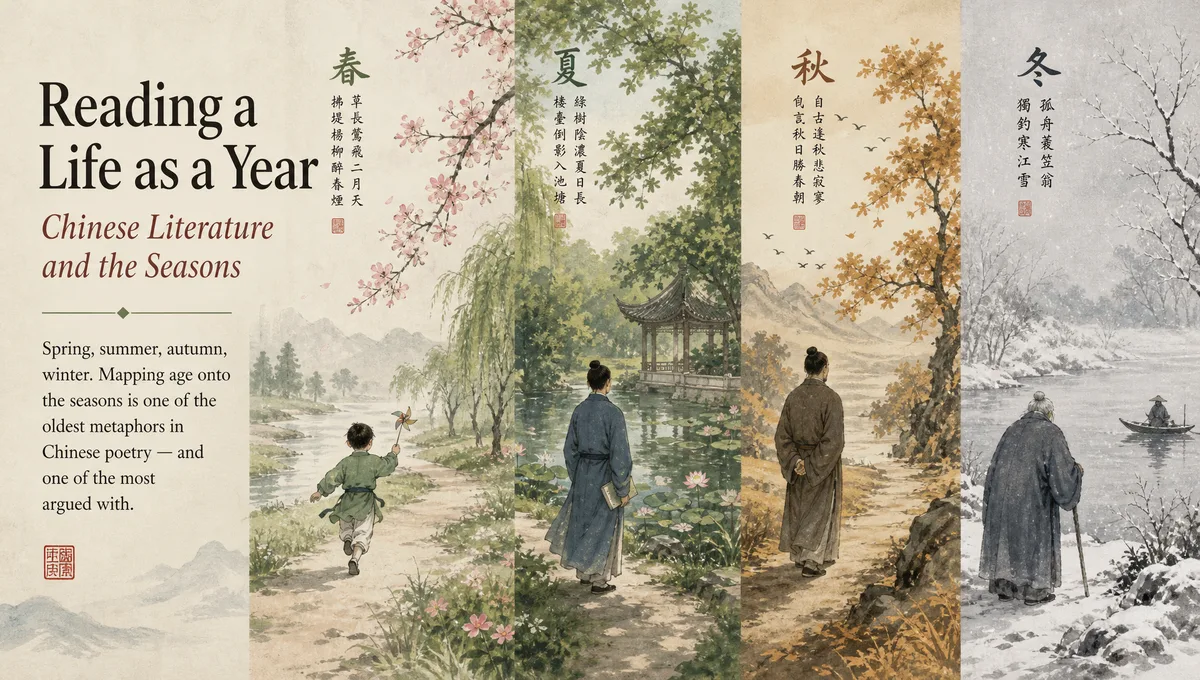
There is a habit in Chinese writing of reading a life the way you read a year. Spring for youth, summer for the working years, autumn for the second half, winter for the end. The metaphor is old, it is everywhere, and it is not always kind.
What makes it interesting is that the tradition argued with itself about it, at length, in verse. Both sides are still quotable.
The Ladder, Built by Decades
The first famous attempt is not about seasons at all. It is a list of ages, and it is the reason Chinese readers can recite their own decade markers.
In the Analects, Confucius describes his own progress:
- Fifteen. His heart set on learning.
- Thirty. He stood.
- Forty. No longer confused.
- Fifty. He knew the decree of heaven.
- Sixty. His ear was attuned.
- Seventy. He could follow what his heart wanted without stepping over the line.
In the original: wu shi you wu er zhi yu xue, san shi er li, si shi er bu huo, wu shi er zhi tian ming, liu shi er er shun, qi shi er cong xin suo yu, bu yu ju.
Read it closely and notice what the ladder actually describes. Every rung is a form of understanding, and nothing on the list declines. The man at seventy is freer than the man at fifteen.
That makes it one of the earliest anti-decline passages in the language. It is also the reason er li, bu huo and zhi tian ming are still used as names for decades.
Spring and Summer, Briefly
The two earlier seasons carry less weight in the poetry, and the reason is instructive.
Spring is youth, but it is a youth that is already passing. Chinese literature has a whole mood for it, shang chun — the ache at spring going by. The poems are less about being young than about noticing that it is ending. The Peony Pavilion and a thousand lyric poems work the same nerve.
Summer is the odd one out. It barely appears as a life stage at all. It is the season of work, heat and no particular feeling, and the tradition mostly leaves it alone. If anything, that is the most honest part of the metaphor: the busy middle of a life is not very photogenic.
The seasons that got the poetry are the two ends.
Beiqiu: Autumn Enters as Sadness
The melancholic reading arrives later, and it arrives hard.
The line usually credited as the origin is from Song Yu, in a piece called the Nine Arguments: bei zai qiu zhi wei qi ye — sorrowful, this air of autumn. Four characters, and a mood settles over Chinese poetry for the next two thousand years. Bei qiu, the sadness of autumn, becomes a genre.
Du Fu, writing eight hundred years later, far from home after a lifetime of poor health, produced the most quoted instance: wan li bei qiu chang zuo ke, bai nian duo bing du deng tai. A thousand miles from home, always a guest, grieving the autumn; climbing the terrace alone.
The season and the state of a life are fused in that couplet. It is magnificent, and it is also a trap for a reader over fifty. It teaches you to hear your own October as bad news.
The Poet Who Refused It
Which is why the counter-line matters so much.
Liu Yuxi spent years in exile, and had every excuse to agree with the tradition. Instead he opened a short poem about autumn by rejecting it outright: zi gu feng qiu bei ji liao, wo yan qiu ri sheng chun zhao. Since ancient times, people have grieved over autumn’s emptiness; I say autumn days beat the mornings of spring.
He then explains himself with a crane rising into clear sky, and a poem reaching the blue of it. The argument is not that autumn is secretly spring. It is that autumn has its own weather, and the sadness is a habit of the reader rather than a property of the season.
Our piece on the three lessons of autumn works through the same idea from the side of what to collect and what to leave.
Winter, and the Words for Late Life
The winter half of the metaphor is built into ordinary vocabulary. Mu nian is the late years, wan sui the same, sui mu the year’s end.
The language simply assumes that a life and a year run on the same clock. Nobody has to build the metaphor. It is already in the words people use to describe their own parents.
The poetry that comes with it is usually more defiant than the vocabulary. Cao Cao, writing in his fifties as a general, produced the line everybody knows: lao ji fu li, zhi zai qian li — an old horse in its stall still thinks of a thousand miles. Li Shangyin gave the ambivalent version, looking at a sunset: xi yang wu xian hao, zhi shi jin huang hun. The late light is incomparably good, and it is nearly dusk.
Both readings sit inside the same four characters about the evening. The tradition keeps both.
What the Metaphor Does to a Reader
The trouble with the seasons as a model for a life is this.
A year has a fixed sequence, and it ends. Map a person onto it and the metaphor hands you a conclusion: you are in autumn, therefore decline, therefore winter. Anyone past fifty has heard some version of it, usually as a compliment about being in the prime of the second half.
The answer is not to throw the metaphor out. It is to notice that the tradition never agreed about it, and that the disagreement is the interesting part. Confucius drew a ladder going up. Song Yu drew a season going down. Liu Yuxi looked at the same leaves and saw better weather than spring.
Three men, one calendar, three readings. The season was never doing the talking.
Reading the Season in Season
One practical suggestion, and it is why this belongs in October.
Read the autumn poems in autumn. Bei qiu and its rebuttal land differently when the light outside matches the page. The argument between them becomes concrete in a way it never is in a summer classroom.
Then read the late-life poems slowly, in the evening, and notice which of the two moods shows up in your own reading. It is usually a reliable reporter.
Our piece on poems about ageing covers the same ground from the side of the poets rather than the seasons.
What This Is Not
It is not a philosophy of ageing, and it prescribes nothing about how anyone should feel about their own decade. It is also not a claim that the seasonal metaphor is wrong, only that it was always one position among several, argued in public for a very long time.
Common Questions
Where does san shi er li come from?
From the passage in the Analects where Confucius lists his own progress by decade. Er li, bu huo and zhi tian ming are still used as shorthand for thirty, forty and fifty.
What is bei qiu?
Literally “sadness of autumn”, the poetic mood that begins with a line by Song Yu and runs through Du Fu and most of the tradition.
Did anyone disagree with it?
Yes, and famously. Liu Yuxi opened a poem by saying autumn is better than spring, which is a direct argument with the genre.
Is autumn really the standard image for middle age?
It is the standard image for the second half, and it was used that way long before anything resembling retirement existed.
Does the seasonal metaphor still matter now?
It shapes ordinary words like mu nian and wan sui, and it shapes how people talk about their own decades, which is reason enough to know where it came from.
More of this sits in the wisdom section.