Arts6 min read
Fan Painting: Art Made to Be Held, Not Hung
A folding fan is a painting with creases and a shape. How Chinese artists composed for the pleats, and why the round fan became a symbol of autumn.
By Lian Zhao — Copy Editor
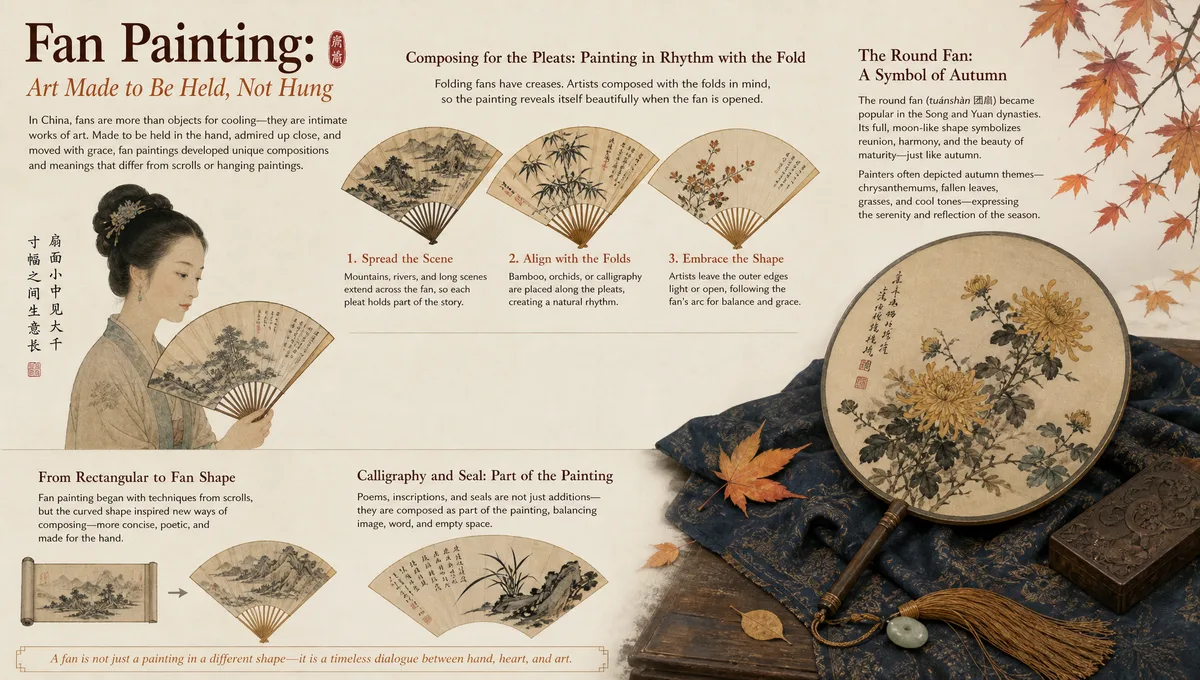
Most painting is made to be hung. A fan is made to be carried, opened, waved and put away, and every part of its design follows from that.
That is what makes fan painting interesting. The support is awkward on purpose. There are creases, there is an arc, and there is a second side, and the artist has to solve all three before the first stroke goes down.
Two Fans, Two Problems
Chinese fans come in two working forms, and they ask for different pictures.
The tuan shan, the round fan. A handle with a round or oval face, usually stiff, often silk. This is the older form, and it has the simpler problem: a single framed picture, seen all at once. The circle does the composing for you, which is why so many round fans hold one motif — a lotus, a bird on a branch, a single rock.
The zhe shan, the folding fan. Paper or silk over ribs, opening into an arc. This form is generally dated to the Song and became properly popular in the Ming. It folds into a stick and lives in a sleeve, which made it portable art, and it creates the real technical challenge: the surface is pleated. Paint runs on a fan the way it runs anywhere, and every crease in the leaf is a line the artist cannot ignore.
Composing for the Creases
Think about what a pleated arc does to a drawing.
The leaf runs in a set of radiating lines running out from the pivot. A composition placed without accounting for them looks accidental. A bird’s wing crosses a fold. A branch bends at a crease. A character of calligraphy gets cut in half by a ridge.
Experienced hands work with the grain. Mountains get arranged so their slopes follow the ribs. A branch is angled to run along a fold rather than across it. Calligraphy is set in columns that belong to the arc, so the writing looks as if the fan chose it.
There is a practical trick that shows up across the tradition. The composition is usually squeezed toward the outer edge, where the pleats spread out. Near the pivot, where they bunch together, it stays loose.
One Side Painted, One Side Written
A folding fan has two faces, and the convention makes use of both. One side carries a painting; the other carries calligraphy.
It is a two-step object. You show the picture to a visitor, and the visitor turns it over and reads. The written side is often a poem that comments on the painting, or the reverse, with the picture illustrating a line the owner already liked. A fan could therefore be bought blank, and completed by a painter and a calligrapher who might never meet.
Because the leaf is replaceable, the ribs outlast the art. Shan gu were made in bamboo, sandalwood, ebony and, at the top of the market, ivory. A good set of ribs could hold a third or fourth leaf, which is why collectors often care about the hardware as much as the picture.
Fans Inside Paintings
There is a nice recursion in the tradition. Fans appear inside paintings, and how they appear tells you the subject.
A woman holding a round fan is a standard figure in Ming and Qing painting, and the object does the work of setting the season and the mood at once. A scholar with a folding fan is indoors or in a garden, mid-conversation. A fan lying closed on a table, next to a book nobody is reading, is a small signal that the heat has gone.
The most famous fan in Chinese literature is not a real object at all. The Peach Blossom Fan, a seventeenth-century play by Kong Shangren, turns a fan stained with blood into the thread that holds a whole story together. An accessory became a plot.
The Fan as an Autumn Object
The most interesting thing about the fan in Chinese poetry is that it stopped being a summer object.
A fan is used when it is hot, which means it is put away when the heat ends. Poets picked up the parallel immediately. The fan that is loved in summer and set aside in autumn became the standard image for a person whose usefulness has passed. A courtier who has lost favour. A beauty who has grown older. Anyone whose season has ended.
The classic text is a short poem attributed to Ban Jieyu, a Han dynasty consort, written in the voice of a round fan. The fan fears the arrival of autumn, when the cool wind takes away the heat. It is folded away in a box. The affection is cut off halfway.
Qiu shan jian juan — the autumn fan that gets thrown away — is now a fixed phrase in the language.
So the object carries two feelings at once, and the tradition is comfortable with both. Held in July, it is a small pleasure. Read in October, it is a warning about how quickly a season can end. Our piece on poems about ageing covers the same theme in verse that has no fan in it at all.
Where the Fans Went
Hand fans left daily life in the twentieth century, and the reasons are not mysterious. Ceiling fans and then air conditioning, first in offices and later in homes, removed the need. A fan became a thing you buy at a tourist shop or inherit from a drawer.
What survived is the art object. Fan painting is collected, and the best leaves are valued for the old reasons. The composition solving the creases. The two sides working as a pair. The ribs.
The craft is also being practised again, at a small scale. Studios in Suzhou and Hangzhou still mount leaves on ribs. Blank fans with decent bamboo frames are easy to buy for anyone who wants to try.
How to Look at One
Four things, in order.
The folds first. Trace the lines before looking at the picture, then see whether the composition obeyed them or fought them.
The blank areas. Fan painting on paper usually leaves a good deal of the leaf untouched, and the empty sections are load-bearing. It is the same instinct you can see at work in ink painting, squeezed into an awkward shape.
The turn. Look at the second side. Half the object is on the other face, and a fan with only one side finished is an unfinished object.
The ribs. Materials, carving, and whether the leaf looks like its first one. A fan whose paper is far older than its ribs has a story.
Painting One Yourself
Fan making survives as a studio practice, and the beginner’s route is cheap. Blank folding fans with a decent set of bamboo ribs are widely sold, and so are round silk blanks.
Start with the round one. The circle is forgiving, it teaches the framing, and mistakes stay contained. Then move to a folding leaf and find out that the creases are exactly as difficult as they sound. That difficulty is the reason the tradition spent several hundred years getting good at them.
If you already keep a brush practice, this is a natural fourth surface to work on, after paper, calligraphy and the long handscroll. More of this sits in the culture & arts section.