Arts6 min read
Borrowed Scenery: How a Chinese Garden Steals a Mountain
A Suzhou garden is a few mu inside a wall. The trick is that the pagoda on the other side of the city appears to stand inside it.
By Lian Zhao — Copy Editor
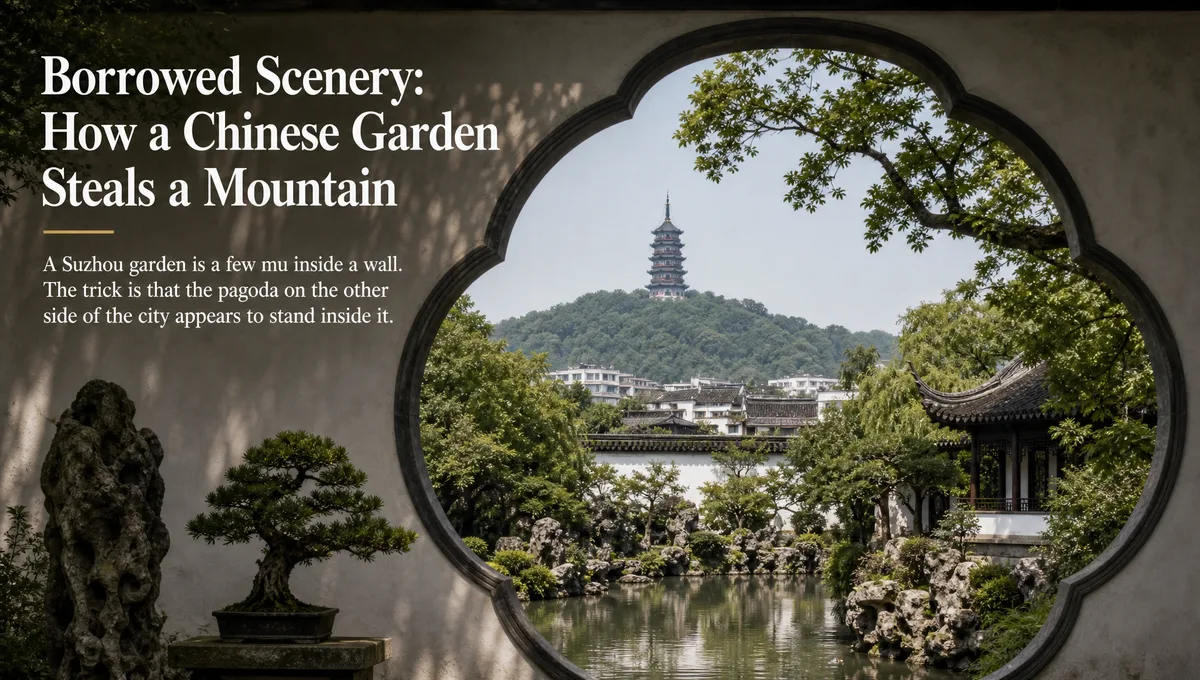
A classical Chinese garden is usually small. The famous ones in Suzhou sit inside city walls on plots of a few mu. Lanes, houses and neighbours press in on every side, and whatever you build, the view ends at a whitewashed wall.
The solution the tradition arrived at is one of the most useful design ideas anywhere. If you cannot own the view, borrow it.
The Problem With Owning Land
Start with the arithmetic. In a crowded city, land is expensive and the garden is enclosed. Scale is out of the question. You will never have a hill.
What you can control is what a person sees from one particular place. That turns out to be different from what you own, because a sight line is not a property line.
A roof, a distant tree, a mountain, the moon and the sound of a temple bell are available to anyone who arranges to look at them properly. So the design stops asking what to build and starts asking what is already out there.
Jiejing, and the Book That Named It
The technique is called jie jing, borrowed scenery. It got its manual in the Ming dynasty.
Ji Cheng, a garden designer, wrote the Yuan Ye, usually translated as The Craft of Gardens, published in the 1630s. The last chapter is about jie jing, and he treats it as the highest part of the craft rather than a trick.
His list has five categories: yuan jie, lin jie, yang jie, fu jie and ying shi er jie.
Far, near, up, down, and by season. Half of it is not scenery at all. Sound counts. Time counts. Anything you can arrange to be present is fair material.
The Pagoda in the Garden
The example everyone uses is the Humble Administrator’s Garden in Suzhou. A pagoda stands several streets away from its western section. From one spot in the garden, the pagoda appears framed inside the plot, as if it had been built there.
It is not an illusion in any technical sense. Trees and a wall hide everything in between, and the tower does the rest. The garden borrows several acres of city it does not own and cannot control. It does it with a frame and a gap.
The same move appears at larger scale elsewhere. In Beijing, the Summer Palace takes in the western hills. At Jichang Garden in Wuxi, the layout is built to hold the hills just beyond its wall. Each garden is composed around something it can see but never possess.
Frames, Windows and Gates
Borrowing needs a frame, which is where the rest of the vocabulary comes in.
The yuedong men, the moon gate, is a circular doorway that turns a walk into a sequence of pictures. As you approach, the view assembles itself inside the circle. The lou chuang, the pierced lattice window, does the same job from a corridor. It breaks a borrowed view into a pattern.
Two related ideas sit alongside them. Kuang jing means framing a view deliberately. Dui jing means placing one thing opposite another so that each makes a picture of the other. The garden is full of apertures, and each one is a decision about what a person will see.
Li Yu, writing in the seventeenth century, put it in four characters worth keeping: qu jing zai jie. The view is taken by borrowing. He was talking about windows in a house. The argument is the same.
Borrowing by Season
The category that visitors miss most is ying shi er jie, borrowing by the season, and it is the one that rewards a second visit.
Winter brings snow, which flattens a garden into two colours and turns every roof into a composition. Spring brings blossom, and the timing of each species arranged so that something is always opening. Autumn brings the leaves, which is why so many gardens in the south are planted with maples in specific corners.
Sound belongs to the same category, and it is deliberately installed. Banana plants are placed under windows so that rain makes a noise. Water is routed to fall where a room can hear it, not just where a path can see it. Bamboo is planted where wind will move it.
A courtyard that looks like it contains almost nothing is often a courtyard tuned for a season and a sound. The empty space is not waiting for something. It is set up.
Why It Is Not Cheating
There is a reading in which borrowed scenery is a kind of deceit. The garden is pretending to own a mountain.
The tradition does not see it that way, and the reason is worth understanding. A garden is not a claim about property. It is an arrangement of attention.
A designer can turn a corner and put a far hill into your field of view. The composition is real whether or not the deed is signed. There is a small proof of this in how visitors behave. Nobody stands at the famous spot and checks the map. They stand there and look. The mountain is working.
How to Spot It
If you visit a garden and want to see the technique rather than the brochure, four habits help.
Look for the frame first. A doorway, a window, a gap in a wall. Ask what the frame is aimed at. Then step back and check whether it hits.
Then look past the wall. Find the boundary and note what stands above it. A borrowed view usually announces itself as the one thing in the composition that could not have been built.
Listen. Ying shi er jie includes sound. Water, birds, a bell, rain on banana leaves. Gardens are designed for all of them.
Go twice, in different seasons. Borrowing by season is the part you cannot see in one visit. The same window is a different design in April and in November.
Reading an empty space as content is the habit this site keeps returning to. It sits in ink painting, where the blank area carries the picture. It also sits in the design of a tea room, where a bare wall does work that a painting would spoil.
Common Questions
Is jie jing only about distant views?
No. The category includes neighbouring roofs, the moon, water, sound and seasonal change. Anything you can borrow counts.
Who codified it?
Ji Cheng, in the Yuan Ye, published in the 1630s. The final chapter is devoted to borrowed scenery.
Does the Suzhou pagoda really look as if it is inside the garden?
From specific viewpoints, yes. Trees and walls hide the streets in between, which is all a frame needs.
Is this idea used in Western gardens?
Partly, and it is usually called a borrowed view. The difference is that Chinese theory treats it as the main principle rather than a fortunate accident.
What is the practical lesson?
Do not build what you can borrow. A view, a sound and a season are cheaper than land, and they often compose better.
More of this sits in the culture & arts section.